
Resources
Explore a wide range of valuable resources on GCED to deepen your understanding and enhance your research, advocacy, teaching, and learning.
232 Results found
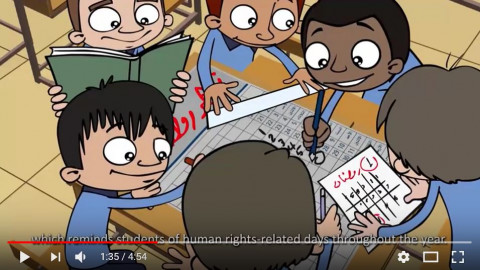 [Video] Equal rights between girls and boys Year of publication: 2015 Corporate author: United Nations Relief and Works Agency for Palestine Refugees in the Near East (UNRWA) Palestine refugee students of all ages learn about human rights in their everyday lives through the Human Rights, Conflict Resolution and Tolerance Education Programme, funded by the United States. In this short animation, young boys and girls learn to respect each other’s rights regardless of gender.
  National meeting on peace education: working papers; report Year of publication: 2015 Corporate author: Encuentro de Educacion para la Paz y los Derechos Humanos This document presents the most relevant reflections and commitments made up from the First National Encounter of Education for Peace and Human Rights, which took place on July 29th of 2014, with the participation of the Mayors, Secretaries of Education from the different territories of Colombia, governmental organizations, NGO's and multilateral agencies. Education for a culture of peace, human rights, citizenship, democracy and regional integration: ECOWAS reference manual, for use by trainer of trainers Year of publication: 2013 Corporate author: UNESCO Dakar | Economic Community of West African States (ECOWAS) The manual comprises seven modules dealing with the Culture of Peace and Conflict Management; Human Rights; Civism and Citizenship; Democracy and Good Governance; Gender and Development; Public Health, Environment and Sustainable Development; and Regional Integration. Each module has sub-themes with introductions, reference materials, general objectives to guide the trainer and generic pedagogical tables that are flexible enough to be adapted to available teaching resources in the different ECOWAS countries. It is also suitable and adaptable to the training of teachers involved in both formal and non-formal education delivery at different levels of teaching and learning. The ultimate goal of the Manual is to build a critical mass of ECOWAS citizens equipped with competent skills, not only for cognitive and psycho-motor domains of education, but also affective skills for positive values, attitudes and behaviors that promote peace, tolerance and peaceful co-existence of community citizens. Programa Mundial para Educação em Direitos Humanos: segunda fase, plano de ação Year of publication: 2012 Corporate author: UN Office of the High Commissioner for Human Rights According to Human Rights Council resolution 12/4, the second phase of the World Programme (2010–2014) will focus “on human rights education for higher education and on human rights training programmes for teachers and educators, civil servants, law enforcement officials and military personnel at all levels” and “Member States should also continue the implementation of human rights education in primary and secondary school systems”. The plan of action focuses on human rights education in two broadly defined sectors, i.e. higher education and training for civil servants, law enforcement officials and the military.
  World programme for human rights education: second phase; plan of action Year of publication: 2012 Corporate author: UN Office of the High Commissioner for Human Rights According to Human Rights Council resolution 12/4, the second phase of the World Programme (2010–2014) will focus “on human rights education for higher education and on human rights training programmes for teachers and educators, civil servants, law enforcement officials and military personnel at all levels” and “Member States should also continue the implementation of human rights education in primary and secondary school systems”. The plan of action focuses on human rights education in two broadly defined sectors, i.e. higher education and training for civil servants, law enforcement officials and the military. Educação para a cultura da paz, os direitos humanos, a cidadania, a democracia e a integração regional: manual de referência da CEDEAO, à intenção do(a) formador/formador(a) de formadores/formadoras Year of publication: 2013 Corporate author: UNESCO Dakar | Economic Community of West African States (ECOWAS) The manual comprises seven modules dealing with the Culture of Peace and Conflict Management; Human Rights; Civism and Citizenship; Democracy and Good Governance; Gender and Development; Public Health, Environment and Sustainable Development; and Regional Integration. Each module has sub-themes with introductions, reference materials, general objectives to guide the trainer and generic pedagogical tables that are flexible enough to be adapted to available teaching resources in the different ECOWAS countries. It is also suitable and adaptable to the training of teachers involved in both formal and non-formal education delivery at different levels of teaching and learning. The ultimate goal of the Manual is to build a critical mass of ECOWAS citizens equipped with competent skills, not only for cognitive and psycho-motor domains of education, but also affective skills for positive values, attitudes and behaviors that promote peace, tolerance and peaceful co-existence of community citizens.
  Exploring our roles as global citizens: an educator's guide (grades 3-5) Year of publication: 2013 Author: Elizabeth O. Crawford Corporate author: TeachUNICEF ‘Exploring Our Roles as Global Citizens’ is a four-lesson unit with extension activities and a student-led inquiry project that is designed to introduce the concept of global citizenship, including relevant knowledge, skills, values, and civic actions; to educate students about universal human rights outlined in the Convention on the Rights of the Child (CRC) and what their responsibilities are to ensure these rights are protected; to foster students’ skills in developing perspectives, critical and creative thinking, research, and decision-making about a chosen global issue using a student-led inquiry model; and to empower students to recognize and use their individual strengths to make a positive difference in their local communities. Lesson 1: What Is Global Citizenship? This lesson engages students in reflecting upon what it means to be a global citizen. Although students are often taught the concepts of citizenship and the characteristics of good citizenship during the elementary years, students may not have considered previously their roles as citizens in a global society. Using authentic examples of global citizenship among youth as a springboard for discussion, students determine how they are citizens at various levels. Afterward, students begin their inquiry of a chosen global issue about which they will take informed action at the end of the unit. Lesson 2: We Are Citizens of the World and We Have Rights! Building upon their prior learning about citizenship, students are introduced to human rights, or those rights to which all persons are entitled. Students learn about the Convention on the Rights of the Child (CRC) and create a concept map outlining categories and examples of human rights. Afterward, students relate human rights to contemporary global issues and how it is our responsibility to take action when the rights of others are violated. Lesson 3: Global Citizens Take Responsibility In this lesson, students learn about their individual and collective responsibility to protect human rights. Through analysis of authentic photographs depicting responsible citizenship, students explore the idea that global citizens are proactive when the rights of others are threatened. To demonstrate their learning, students role-play characteristics of global citizenship. Subsequently, in cooperative groups, students continue their global issue research and begin to consider how they will take informed action as global citizens. Lesson 4: Global Change Begins With Me In this culminating lesson, students reflect upon their learning about global citizenship and how they can be positive change agents in their communities. Students first explore how individuals take action to solve a problem or to improve conditions for others. Using these examples as inspiration, students determine how they, too, can be “changemakers.” As a final assessment, students synthesize what they have learned by creating a comprehensive definition of global citizenship, and develop an action plan to address the global issue they have researched.
  Global citizenship: a high school educator's guide (grades 9-12) Year of publication: 2013 Corporate author: TeachUNICEF Global Citizenship is a unit of four lessons designed to introduce the concept of global citizenship and place it in the context of international human rights; to engage students in a guided inquiry into the meaning of global citizenship and its relationship to national citizenship; to educate about how the United Nations has framed global rights and responsibilities for the 21st century and is acting on them via the Millennium Development Goals (MDGs); and to investigate how the U.S. Fund for UNICEF has engaged individuals in support of global citizenship as well as to engage students in designing and implementing a plan to act locally in support of global issues. Global citizenship in primary and secondary education in the Netherlands Year of publication: 2012 Author: Lette Hogeling Corporate author: National Committee for International Cooperation and Sustainable Development (NCDO) NCDO has examined the opinions and methods of teachers and directors with regard to global citizenship, as well as the obstacles and opportunities they experience around global citizenship in education. More than 1,500 teachers and almost 300 directors have participated in the research. A large majority of the teachers in primary and secondary education think that global citizenship is an important subject for Dutch education. Also, the majority of the teachers are of the opinion that it is important that the lessons link up with current events. Nevertheless, only a minority of the teachers in primary and secondary education believe that global citizenship should be a compulsory part of the curriculum. It is mainly teachers of geography, economics, cultural and social subjects who are of the opinion that global citizenship is an important theme. Global citizenship: from public support to active participation Year of publication: 2012 Author: Christine Carabain | Shelena Keulemans | Marije van Gent | Gabi Spitz Corporate author: National Committee for International Cooperation and Sustainable Development (NCDO) This publication explores the concept of global citizenship by drawing on the most relevant, mainly scientific, literature. This exploration will in the coming years be the basis for NCDO’s programmes in the area of research, staff training, and knowledge sharing. NCDO has the important task of engaging people in these two major changes in perspective: what does it mean, how important is it to us, how can we contribute to it? NCDO considers it its responsibility to raise awareness amongst Dutch citizens of the growing connection and mutual dependency between people across the globe, as well as to make them aware of the opportunities they have to help tackle global issues. In other words: NCDO aims to advance the global dimension of citizenship in the Netherlands. But what exactly is that global dimension of citizenship? Despite growing awareness of the importance of global citizenship, a clear and broadly accepted definition of the concept is still lacking (Hart, 2011). To date the concept is often explained by using examples and focus areas. This publication will present the definition of global citizenship that NCDO will employ in the coming period.