
Resources
Explore a wide range of valuable resources on GCED to deepen your understanding and enhance your research, advocacy, teaching, and learning.
14 Results found
 Bank of Digital Task Sheets Corporate author: Council of Europe Around forty sheets of tasks anchored in real life and reflective tasks are available. The proposed tasks implement the didactic framework that promotes a socio-interactional approach and extends the usual typology of tasks with tasks anchored in real life.These tasks, carried out on online participatory sites, allow the people who carry them out to experience both authentic (inter)actions and digital citizenship.Alongside these tasks, reflective tasks invite learners to reflect on online practices and in particular on their own uses of digital technology. They are to be adapted according to the contexts of use and provide examples of the implementation of the approach defined in the Didactic Framework. Banque de fiches de tâches numériques Corporate author: Conseil de l'Europe Une quarantaine de fiches de tâches ancrées dans la vie réelle et de tâches réflexives sont disponibles. Les tâches proposées mettent en œuvre le cadre didactique qui promeut une approche socio-interactionnelle et étend la typologie habituelle des tâches avec des tâches ancrées dans la vie réelle.Ces tâches, réalisées sur des sites participatifs en ligne, permettent aux personnes qui les réalisent de faire l'expérience, à la fois, d'(inter)actions authentiques et de la citoyenneté numérique.A côté de ces tâches, des tâches réflexives invitent les apprenant·es à réfléchir sur les pratiques en ligne et notamment sur leurs propres usages du numérique. Elles sont à adapter en fonction des contextes d'utilisation et permettent de donner des exemples de mise en œuvre de l'approche définie dans le Cadre didactique.
  Citizens as Users of Languages and Digital Technology Year of publication: 2021 Corporate author: European Centre for Modern Languages (ECML) | Council of Europe A recent meta-analysis of the literature portrays male and female citizens who are users of languages and digital technologies. This helps to understand the goals of an education aimed at developing male and female citizens capable of using digital technology in a competent, informed, safe, responsible, ethical, and critical manner. Citoyens et citoyennes usagers et usagères des langues Year of publication: 2021 Corporate author: European Centre for Modern Languages (ECML) | Conseil de l'Europe Une méta-analyse de la littérature récente dresse le portrait des citoyens et citoyennes usagers et usagères de langues et du numérique. Cela permet de connaitre les objectifs d’une éducation qui vise le développement de citoyens et citoyennes capables d’utiliser le numérique d’une façon compétente, informée, sûre, responsable, éthique et critique.
 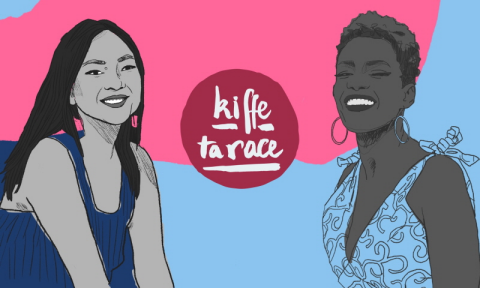 Kiffe Ta Race Year of publication: 2018 Corporate author: Binge Audio Pourquoi le mot « race » est-il tabou ? Qu’en est-il quand on est, à la fois, victime de discriminations raciales et sexuelles ? Comment assumer son identité plurielle ? Un mardi sur deux, Rokhaya Diallo et Grace Ly reçoivent un·e invité·e pour explorer les questions raciales sur le mode de la conversation et du vécu. Why is the word "race" taboo? What happens when you are both a victim of racial and sexual discrimination? How do you come to terms with your plural identity? Every other Tuesday, Rokhaya Diallo and Grace Ly welcome a guest to explore racial issues in a conversational, real-life setting.
  Qui a peur des Juifs ? Antisémitisme, la tentation perpétuelle Year of publication: 2023 Corporate author: Illana Weizman Dans cette série podcast, la sociologue Illana Weizman questionne les expériences juives et l’hostilité subie par cette population en compagnie d’intellectuel-les, d’artistes, de chercheurs-euses, de militant-es ou de politiques rencontré·es des deux côtés de la frontière franco-suisse.Où en est la lutte contre l’antisémitisme aujourd’hui? Quand les courants antiracistes prônent l’écoute des concernés, n’est-il pas temps de l’appliquer pleinement aux Juifs? In this podcast series, sociologist Illana Weizman discusses the Jewish experience and the hostility suffered by this population in the company of intellectuals, artists, researchers, activists and politicians from both sides of the Franco-Swiss border. When anti-racist currents advocate listening to those concerned, isn't it time to apply this fully to Jews?
  Jeunesse et citoyenneté : une culture à réinventer: 23 recommandations pour redynamiser la culture citoyenne (Rapport d'information; No.648, 2021-2022) Year of publication: 2022 Author: Stéphane Piednoir | Henri Cabanel Corporate author: Sénat français Des sujets proches des préoccupations de la mission d’information ont été inscrits à l’agenda d’autres institutions et structures du Sénat pendant cette mission d’information qui s’est déroulée du 1er décembre 2021 au 7 juin 2022. Cette convergence souligne l’importance de ces questions et l’urgence de mesures destinées à réparer le lien entre les citoyens et les institutions et, à travers l’éducation citoyenne de la jeunesse, à renforcer la cohésion nationale et à préparer l’avenir de notre démocratie. Au terme de ses travaux, la mission formule vingt-trois recommandations pour mieux éduquer et former à la citoyenneté, pour encourager une citoyenneté active par l’engagement, et pour repenser les pratiques démocratiques afin de rapprocher les citoyens – et plus particulièrement les jeunes – des institutions. Elle considère que ces questions doivent, à l’approche de la nouvelle législature, constituer une priorité pour les pouvoirs publics.
  Le guide qui rend ton évènement plus éco-citoyen Corporate author: eventecocitoyen Ce guide sert à faciliter le passage à l’action de tous et toutes en proposant des conseils, outils, témoignages et ressources pratiques pour rendre les concerts et/ou festivals de Belgique plus éco-citoyens ! Pour permettre un questionnement, une remise en question en soi, qui implique ensuite des changements de comportements. Ici on vous donne des conseils/trucs et astuces mais aussi des ressources pour vous permettre de réfléchir autrement, d’agrandir notre angle de vue. This guide serves: To help everyone take action by offering advice, tools, testimonials and practical resources to make Belgium's concerts and/or festivals more eco-citizen! To enable questioning, self-questioning, which then implies changes in behavior. Here we give you tips and tricks, but also resources to help you think differently, to widen our angle of vision.
  The Two Minutes of Citizenship Corporate author: Vie Publique "Les 2 minutes citoyennes" is a series of podcasts designed to provide a concise explanation of the concepts, notions and principles essential to understanding the workings of public life and French and European institutions. Produced by the editorial staff of vie-publique.fr, these educational capsules are aimed at all citizens. Les deux minutes citoyennes Corporate author: Vie Publique « Les 2 minutes citoyennes » est une série de podcasts visant à expliquer de façon synthétique les concepts, les notions ou les principes essentiels à la compréhension du fonctionnement de la vie publique et des institutions françaises et européennes. Produites par la rédaction du site vie-publique.fr, ces capsules pédagogiques s’adressent à tous les citoyens.