
Resources
Explore a wide range of valuable resources on GCED to deepen your understanding and enhance your research, advocacy, teaching, and learning.
3 Results found
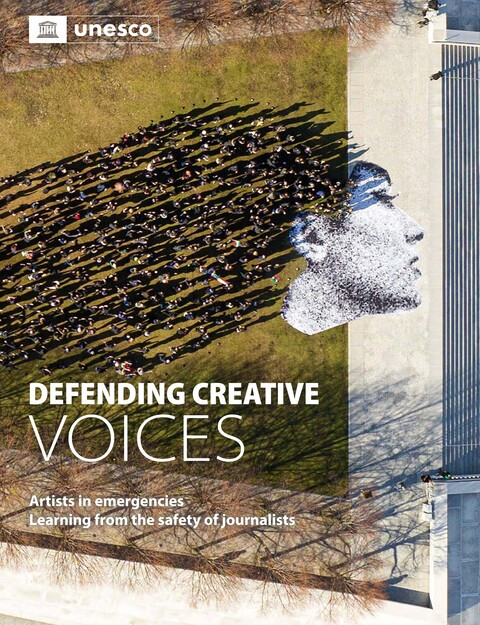 Defending Creative Voices: Artists in Emergencies, Learning from the Safety of Journalists Year of publication: 2023 Author: Rosario Soraide Corporate author: UNESCO Artists and cultural professionals often come across significant challenges to their freedom of expression, including violence and harassment – online and offline – legal persecution, detention, imprisonment and, in the worst of cases, murder. Emergency situations can result in additional risks for them, as many become increasingly targeted in connection to the visibility of their work and see their livelihoods impacted upon by income loss and unemployment in the cultural sector. While the attacks and threats that artists and cultural professionals face during emergencies are similar to those affecting journalists, they do not receive the same level of attention nor access to protection mechanisms and opportunities for assistance. Over the past decades, a strong framework has emerged to advance journalists’ safety at international, regional and national levels, including through legal and regulatory instruments, protection mechanisms, support networks and consistent collective mobilization for their rights. Despite growing awareness of the vulnerability of artists and cultural professionals in emergency contexts and increased efforts to safeguard their rights and ensure their safety, progress in this regard remains comparatively much more incipient. With the support of UNESCO’s Culture and Communication and Information Sector, and based on a comparative analysis, this study therefore aims to strengthen the protection of artists and cultural professionals during emergencies by drawing lessons from the experience, challenges, and achievements in the field of journalists’ safety. It presents actionable recommendations and identifies areas in which synergies between key stakeholders promoting, respectively, artistic and media freedom could serve to reinforce the protection of both at-risk artists and journalists. Défendre les voix créatives: artistes en situation d'urgence, apprendre de la sécurité des journalistes Year of publication: 2023 Author: Rosario Soraide Corporate author: UNESCO Les artistes et les professionnels de la culture se heurtent souvent à des obstacles importants à leur liberté d'expression, comme la violence et le harcèlement, en ligne et hors ligne, la persécution juridique, la détention, l'emprisonnement et, dans le pire des cas, l'assassinat. Les situations d'urgence peuvent engendrer des risques supplémentaires pour ces groupes, car nombre d'entre eux sont de plus en plus ciblés en raison de la visibilité de leur travail et voient leurs moyens de subsistance affectés par la perte de revenus et la hausse du chômage dans le secteur culturel. Alors que les attaques et les menaces auxquelles sont confrontés les artistes et les professionnels de la culture dans les situations d'urgence sont similaires à celles qui touchent les journalistes, ils ne bénéficient pas du même niveau d'attention ni du même accès aux mécanismes de protection et aux aides disponibles. Au cours des dernières décennies, un cadre solide a été mis en place pour promouvoir la sécurité des journalistes aux niveaux international, régional et national, notamment via des instruments juridiques et réglementaires, des mécanismes de protection, des réseaux de soutien et une mobilisation collective constante en faveur de leurs droits. Malgré une prise de conscience croissante de la vulnérabilité des artistes et des professionnels de la culture dans les situations d'urgence et un développement des initiatives visant à sauvegarder leurs droits et garantir leur sécurité, les progrès à cet égard restent comparativement beaucoup plus embryonnaires. Avec le soutien des Secteurs de la Culture, et de la Communication et de l’Information de l'UNESCO, et sur la base d'une analyse comparative, cette étude vise à renforcer la protection des artistes et des professionnels de la culture dans les situations d'urgence en tirant les leçons de l'expérience, des défis et des résultats obtenus dans le domaine de la sécurité des journalistes. Elle élabore des recommandations réalisables et définit les domaines dans lesquels la collaboration entre les principaux acteurs promouvant, respectivement, la liberté artistique et la liberté des médias pourrait servir à renforcer la protection des artistes et des journalistes en danger.
  Draft Text of the Revised 1974 Recommendation Concerning Education for International Understanding, Co-Operation and Peace and Education Relating to Human Rights and Fundamental Freedoms Year of publication: 2023 Corporate author: UNESCO In accordance with the UNESCO Constitution and the Rules of Procedure concerning Recommendations to Member States and international conventions covered by the terms of Article IV, paragraph 4, of the Constitution, the draft text of the revised Recommendation concerning education for international understanding, co-operation and peace and education relating to human rights and fundamental freedoms, and the related preliminary report, were sent to UNESCO Member States through the circular letter CL/4401 (September 2022) for their written commentsand observations. On the basis of their comments, a second draft of the text was prepared. In circular letter CL/4433 (April 2023), the second draft together with the Definitive Report were submitted to Member States. The Special Committee meeting of experts designated by Member States took place from 30 May to 2 June 2023, as per the circular letter CL/4417 (November 2022), and from 10 to 12 July 2023, as per circular letter CL/4442 (June 2023).