
Resources
Explore a wide range of valuable resources on GCED to deepen your understanding and enhance your research, advocacy, teaching, and learning.
4 Results found
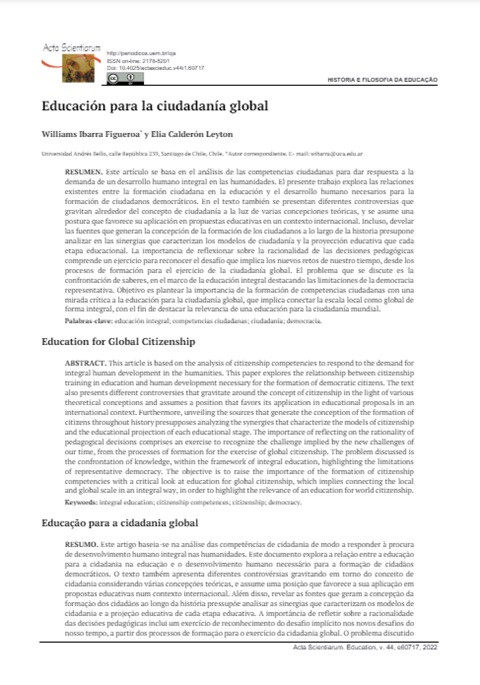 Education for Global Citizenship(Acta Scientiarum. Education; vol. 44) Year of publication: 2022 Author: Williams Ibarra Figueroa | Elia Calderón Leyton Corporate author: Maringá State University Press This work explores the relationships between citizen training in education and the human development necessary for the formation of democratic citizens. The text also presents different controversies that revolve around the concept of citizenship in light of various theoretical conceptions, and a position is assumed that favors its application in educational proposals in an international context. Even revealing the sources that generate the conception of the formation of citizens throughout history presupposes analyzing the synergies that characterize the models of citizenship and the educational projection of each educational stage. The importance of reflecting on the rationality of pedagogical decisions includes an exercise to recognize the challenge that the new challenges of our time imply, from the training processes for the exercise of global citizenship. Educación para la ciudadanía global(Acta Scientiarum. Education; vol. 44) Year of publication: 2022 Author: Williams Ibarra Figueroa | Elia Calderón Leyton Corporate author: Maringá State University Press El presente trabajo explora las relaciones existentes entre la formación ciudadana en la educación y el desarrollo humano necesarios para la formación de ciudadanos democráticos. En el texto también se presentan diferentes controversias que gravitan alrededor del concepto de ciudadanía a la luz de varias concepciones teóricas, y se asume una postura que favorece su aplicación en propuestas educativas en un contexto internacional. Incluso, develar las fuentes que generan la concepción de la formación de los ciudadanos a lo largo de la historia presupone analizar en las sinergias que caracterizan los modelos de ciudadanía y la proyección educativa que cada etapa educacional. La importancia de reflexionar sobre la racionalidad de las decisiones pedagógicas comprende un ejercicio para reconocer el desafío que implica los nuevos retos de nuestro tiempo, desde los procesos de formación para el ejercicio de la ciudadanía global.
 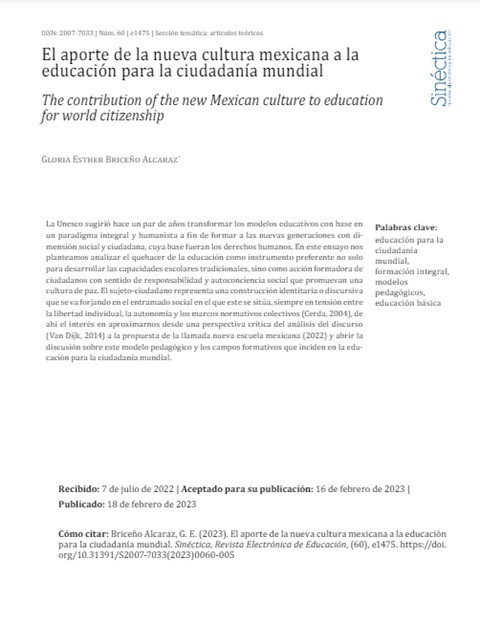 The Contribution of the New Mexican Culture to Education for World Citizenship(Sinéctica, Revista electrónica de educación; no. 60) Year of publication: 2023 Author: Gloria Esther Briceño Alcaraz Corporate author: Sinéctica, Revista Electrónica de Educación A couple of years ago, UNESCO suggested transforming educational models based on an in-tegral and humanist paradigm in order to train new generations with a social and civic di-mension, based on human rights. In this essay we propose to analyze the work of education as a preferential instrument not only to develop traditional school skills, but also as an ac-tion to form citizens with a sense of responsibility and social self-awareness that promote a culture of peace. The citizen-subject represents an identity or discursive construction that is forged in the social framework in which it is situated, always in tension between individual freedom, autonomy and collective normative frameworks (Cerda, 2004), hence the interest in approaching from a critical perspective of discourse analysis (Van Dijk, 2014) to the pro-posal of the new educational model of Mexico called the New Mexican School (2022) and open the discussion on this pedagogical model and the formative fields that affect education for global citizenship. El aporte de la nueva cultura mexicana a la educación para la ciudadanía mundial(Sinéctica, Revista electrónica de educación; núm. 60) Year of publication: 2023 Author: Gloria Esther Briceño Alcaraz Corporate author: Sinéctica, Revista Electrónica de Educación La UNESCO sugirió hace un par de años transformar los modelos educativos con base en un paradigma integral y humanista a fin de formar a las nuevas generaciones con dimensión social y ciudadana, cuya base fueran los derechos humanos. En este ensayo nos planteamos analizar el quehacer de la educación como instrumento preferente no solo para desarrollar las capacidades escolares tradicionales, sino como acción formadora de ciudadanos con sentido de responsabilidad y autoconciencia social que promuevan una cultura de paz. El sujeto-ciudadano representa una construcción identitaria o discursiva que se va forjando en el entramado social en el que este se sitúa, siempre en tensión entre la libertad individual, la autonomía y los marcos normativos colectivos (Cerda, 2004), de ahí el interés en aproximarnos desde una perspectiva crítica del análisis del discurso (Van Dijk, 2014) a la propuesta de la llamada nueva escuela mexicana (2022) y abrir la discusión sobre este modelo pedagógico y los campos formativos que inciden en la educación para la ciudadanía mundial.