
Resources
Explore a wide range of valuable resources on GCED to deepen your understanding and enhance your research, advocacy, teaching, and learning.
78 Results found
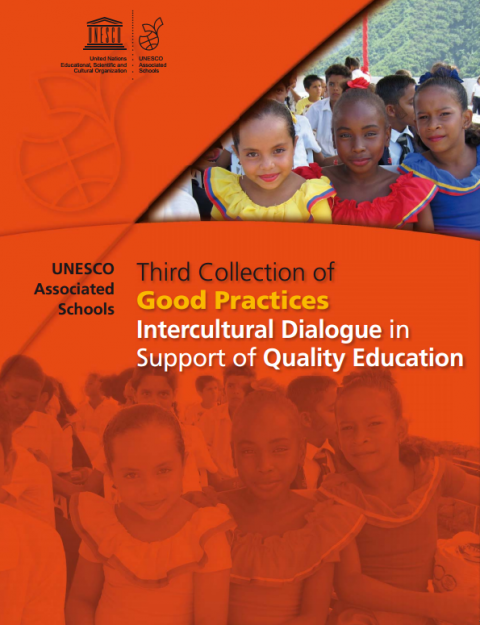 Troisième recueil de bonnes pratiques: le dialogue interculturel à l'appui de l'éducation de qualité Year of publication: 2013 Corporate author: UNESCO Associated Schools Project Network (ASPnet) Les écoles associées de l'UNESCO (réSEAU) mènent des projets pilotes visant à renforcer les principes humanistes et éthiques de l'UNESCO dans les programmes scolaires et tout au long du processus d'apprentissage, souvent dans le cadre de l'ONU et de la Journée internationale de l'UNESCO, années et décennies, la promotion du dialogue interculturel est donc une priorité Reseau. Les initiatives présentées dans ce troisième Collection de Reseau bonnes pratiques ont été réalisées par les écoles Reseau et leurs institutions partenaires dans le cadre de l'Année internationale du rapprochement des cultures (2010). Les projets sélectionnés illustrent à la fois l'éducation multiculturelle et l'éducation interculturelle dans l'action.
  Promoting the culture of dialogue between cultures in the Arab world Year of publication: 2013 Author: Selim El Sayegh Corporate author: UNESCO Beirut The major challenge of the Arab uprisings resides in the youth drive. Accounting for 60 per cent of the Arab population, Youth have been calling for political and economic reforms. During the revolts, these claims have become more radical seeking a fundamental change. This gradual evolution, from a relatively partial change to a more absolute comprehensive one, ushers in a new era with a different intellectual construct. With the ousting of dictatorships, all civil society forces are unleashed with huge actual and potential resources mobilized to contribute to building up the new order. Groups of solidarity, communities, parties, associations, and organizations of all nature among many others put forward new ideas and adequate action plans. Liberty thus acclaimed becomes the outcry for dignity, honor and pride. Never before in the Arab world has the individual had such a central place as it does today. An individual fully grasping the possibilities of restored liberty and recognized dignity gives birth to a new citizen acting in a new paradigm; a new citizen that seeks a transcendence of the ego to relate the individual to the common good. This fresh paradigm empowers the individual as a citizen in the name of equality, while simultaneously recognizing the right of difference of each citizen when it comes to belonging to a culture or sub‐culture. The right to be different involves more than the right to differ and to dispute and by the same token, the obligation of peaceful settlement. The right to be different, by belonging to a culture or a sub‐culture means in a new era of liberty and dignity, the obligation to conduct a transformation of the patterns generating disputes and conflicts among cultures. Henceforth, the issue of promoting the culture of intercultural dialogue in the aftermath of the Arab revolts represents major characteristics that will be reflected hereafter. Promouvoir la culture du dialogue entre les cultures dans le monde Arabe Year of publication: 2013 Author: Selim El Sayegh Corporate author: UNESCO Beirut Le défi majeur des soulèvements arabes réside dans le lecteur de la jeunesse. Comptabilisation de 60 pour cent de la population arabe, de la jeunesse ont été réclame des réformes politiques et économiques. Pendant les révoltes, ces créances sont devenues plus radicales à la recherche d'un changement fondamental. Cette évolution progressive, d'un changement relativement partielle à l'une complète plus absolue, ouvre la voie à une nouvelle ère avec une construction intellectuelle différente. Avec l'éviction des dictatures, toutes les forces de la société civile se déchaînent avec d'énormes ressources réelles et potentielles mobilisées pour contribuer à l'édification du nouvel ordre. Des groupes de solidarité, les communautés, les partis, les associations et organisations de toute nature parmi beaucoup d'autres mettent en avant de nouvelles idées et plans d'action adéquats. Liberté ainsi acclamé devient le cri de la dignité, l'honneur et la fierté. Jamais auparavant dans le monde arabe a l'individu avait une telle place centrale comme il le fait aujourd'hui. Un individu de saisir pleinement les possibilités de la liberté restaurée et reconnue la dignité donne naissance à un nouveau citoyen agissant dans un nouveau paradigme; un nouveau citoyen qui cherche une transcendance de l'ego de relier l'individu au bien commun. Ce nouveau paradigme permet l'individu en tant que citoyen au nom de l'égalité, tout en reconnaissant en même temps le droit à la différence de chaque citoyen en ce qui concerne l'appartenance à une culture ou sous-culture. Le droit d'être différent implique plus que le droit à la différence et à contester et par le fait même, l'obligation de règlement pacifique. Le droit à la différence, par l'appartenance à une culture ou d'une sous-culture signifie une nouvelle ère de liberté et de dignité, l'obligation de procéder à une transformation des modèles de génération de différends et les conflits entre les cultures. Dès lors, la question de la promotion de la culture du dialogue interculturel dans la foulée des révoltes arabes représente les principales caractéristiques qui seront reflétées ci-après.
  Alternative bilingual Miskito-Spanish intercultural literacy education linked to the exercise of citizenship and community production Year of publication: 2008 Corporate author: Regional Literacy and CONFINTEA VI Preparatory Conference in Latin America and the Caribbean: From Literacy to Lifelong Learning: Towards the Challenges of the 21st Century, Mexico City, 2008 The Alternative Bilingual Intercultural Literacy Education project is carried out in five rural indigenous communities and eleven urban neighbourhoods of Bilwi (Puerto Cabezas) in the North Atlantic Autonomous Region (RAAN) of Nicaragua. In this region, illiteracy is the result of poverty, historical social exclusion and the lack of any official or State programme of adult literacy education in the Miskito language. This constitutes a negation of the right to bilingual intercultural education of the young and adult indigenous population and an obstacle to individual, social and regional development. The project provides literacy classes for young people and adults in their mother tongue Miskito and in Spanish, and deals with intercultural themes of their world view, the environment and indigenous rights. In Nicaragua, this experiment is a unique and alternative model of literacy provision in Miskito, with a Miskito-Spanish bilingual intercultural curriculum of its own. The texts have been produced by authors from the Miskito ethnic group, with contents determined on the basis of a needs analysis and the identification of fundamental features of the Miskito world view. Éducation Interculturelle bilingue Miskito-Espagnol liée à l'exercice de la citoyenneté et de la communauté production Year of publication: 2008 Corporate author: Regional Literacy and CONFINTEA VI Preparatory Conference in Latin America and the Caribbean: From Literacy to Lifelong Learning: Towards the Challenges of the 21st Century, Mexico City, 2008 Le projet de l'éducation interculturelle bilingue est réalisée dans cinq communautés autochtones rurales et onze quartiers urbains de Bilwi (Puerto Cabezas) dans la région de l'Atlantique Nord autonome (RAAN) du Nicaragua. Dans cette région, l'analphabétisme est le résultat de la pauvreté, l'exclusion sociale historique et l'absence de tout programme officiel ou de l'Etat de l'alphabétisation des adultes dans la langue Miskito. Ceci constitue une négation du droit à l'éducation interculturelle bilingue des jeunes et des adultes population indigène et un obstacle au développement individuel, social et régional. Le projet offre des cours d'alphabétisation pour les jeunes et les adultes dans leur Miskito langue maternelle et en espagnol, et traite des thèmes interculturels de leur vision du monde, l'environnement et les droits des autochtones. Au Nicaragua, cette expérience est un modèle unique et alternatif de la prestation de l'alphabétisation en Miskito, avec un bilingue Miskito-espagnol curriculum interculturel propre. Les textes ont été rédigés par des auteurs du groupe ethnique Miskito, avec des contenus déterminés sur la base d'une analyse des besoins et l'identification des caractéristiques fondamentales de la vision du monde Miskito. Intercultural Multilingual Education in Latin America: Mexico, Guatemala, Colombia, Brazil, Ecuador, Peru, Bolivia and Paraguay, and Norway Year of publication: 2011 Corporate author: Internacional de la Educación para Latinoamerica This document deals with Intercultural Bilingual Education (IBE), its current status and the concepts and processes driving it today – and in a certain way the conflicts encompassing it. It contains information on Mexico, Guatemala, Colombia, Brazil, Ecuador, Peru, Bolivia and Paraguay, and includes some data and comments on Norway. Certainly all Latin America is involved in the topic, one way or another, but for now this is the geographical scope of the paper. It seeks to give an overview of the whole and profile a few specific aspects by country. Educación Multilingüe e Intercultural en América Latina: México, Guatemala, Colombia, Brazil, Ecuador, Perú, Bolivia y Paraguay y Noruega Year of publication: 2011 Corporate author: Internacional de la Educación para Latinoamerica This document deals with Intercultural Bilingual Education (IBE), its current status and the concepts and processes driving it today – and in a certain way the conflicts encompassing it. It contains information on Mexico, Guatemala, Colombia, Brazil, Ecuador, Peru, Bolivia and Paraguay, and includes some data and comments on Norway. Certainly all Latin America is involved in the topic, one way or another, but for now this is the geographical scope of the paper. It seeks to give an overview of the whole and profile a few specific aspects by country. Multilingue et éducation interculturelle en Amérique latine: le Mexique, le Guatemala, la Colombie, le Brésil, l'Équateur, le Pérou, la Bolivie et le Paraguay et la Norvège Year of publication: 2011 Corporate author: Internacional de la Educación para Latinoamerica Ce document traite de l'éducation interculturelle bilingue (BIE), son état actuel et les concepts et les processus de conduite aujourd'hui - et d'une certaine manière les conflits englobant elle. Il contient des informations sur le Mexique, le Guatemala, la Colombie, le Brésil, l'Équateur, le Pérou, la Bolivie et le Paraguay, et comprend quelques infomations et commentaires sur la Norvège. Certes, toute l'Amérique Latine est impliqué dans le sujet, d'une façon ou d'une autre, mais pour l'instant c'est la portée géographique du papier. Il vise à donner un aperçu de l'ensemble et le profil de quelques aspects spécifiques par pays. Education for global and multicultural citizenship: a strategy for Victorian Government schools 2009-2013 Year of publication: 2009 Corporate author: State of Victoria (Australia) | Melbourne. Department of Education and Early Childhood Development. Office of Government School Education. Student Learning Programs Division The purpose of this strategy is to provide a renewed vision for global and multicultural education in Victorian Government schools; to align priorities to current legislative, policy and curriculum frameworks; and to guide action across schools, regions and the Department. The strategy offers a new concept for thinking about multicultural education: global and multicultural citizenship. The actions outlined will pursue the following objectives: improving educational outcomes for all students through the implementation of inclusive practices and through learning and teaching that utilises the Victorian Essential Learning Standards (VELS) domains relevant to global and multicultural citizenshipdeveloping the intercultural literacies that students, parents, educators, and leadership groups need to live and work as part of a diverse and globalised populationpromoting social cohesion and diversity as sources of educational and economic advantage for all students • enhancing the engagement, wellbeing and sense of belonging for all students in safe and secure learning environmentsbuilding the capacity of the school community to identify and address overt, subtle and institutionalised racism, stereotyping and other forms of prejudicebuilding and sustaining inclusive and participative school–community partnerships that prepare all students for global and multicultural citizenship. Education à la Citoyenneté Mondiale et Multiculturelle: une stratégie pour les écoles Victorienne Governement 2009-2013 Year of publication: 2009 Corporate author: State of Victoria (Australia) | Melbourne. Department of Education and Early Childhood Development. Office of Government School Education. Student Learning Programs Division Le but de cette stratégie est de fournir une vision renouvelée de l'éducation globale et multiculturelle dans les écoles publiques victorienne; d'aligner les priorités des cadres législatifs, politiques et programmes actuels; et pour guider l'action dans les écoles, les régions et le ministère. La stratégie offre un nouveau concept pour la réflexion sur l'éducation multiculturelle: mondiale et citoyenneté multiculturelle. Les actions décrites poursuivra les objectifs suivants:Améliorer les résultats scolaires pour tous les élèves grâce à la mise en œuvre de pratiques inclusives et par l'apprentissage et l'enseignement ont fait utliser les Normes d'Apprentissage Essentielles Victoriennes (NAEV) les domaines pertinents à la citoyenneté mondiale et multiculturelle développer les alphabétisations interculturelles ne élèves, les parents, les éducateurs et les groupes de leadership doivent vivre et travailler dans le cadre d'une diversité et globalisé promo population ting cohésion sociale et la diversité comme sources d'avantage éducatif et économique pour tous les élèves • renforcement de la participation, bien-être et le sentiment d'appartenance pour tous les élèves dans des environnements d'apprentissage sûrs et sécurisésle renforcement des capacités de la communauté scolaire pour identifier et traiter ouvertement, subtile et institutionnalisés racisme, les stéréotypes et d'autres formes de renforcement des préjugés et de maintien de partenariats inclusifs et participatifs scolaires communautaires a fait préparer tous les élèves à la citoyenneté mondiale et multiculturelle.