
Resources
Explore a wide range of valuable resources on GCED to deepen your understanding and enhance your research, advocacy, teaching, and learning.
76 Results found
 Address by Irina Bokova, Director-General of UNESCO on the occasion of the Conference on Education for Sustainable Development in Support of Cultural and Biological Diversity; Oman, 24 January 2011 Year of publication: 2011 Corporate author: UNESCO. Director-General, 2009-2017 (Bokova, I.G.) This address was given by Irina Bokova, Director-General of UNESCO on the occasion of the Conference on Education for Sustainable Development in Support of Cultural and Biological Diversity. Discours de Mme Irina Bokova, Directrice générale de l'UNESCO à l'occasion de la Conférence sur l'éducation au service du développement durable à l'appui de la diversité culturelle et biologique; Oman, 24 janvier 2011 Year of publication: 2011 Corporate author: UNESCO. Director-General, 2009-2017 (Bokova, I.G.) Cette allocution a été donnée par Irina Bokova, Directrice générale de l'UNESCO, à l'occasion de la Conférence sur l'éducation au développement durable à l'appui de la diversité culturelle et biologique.
 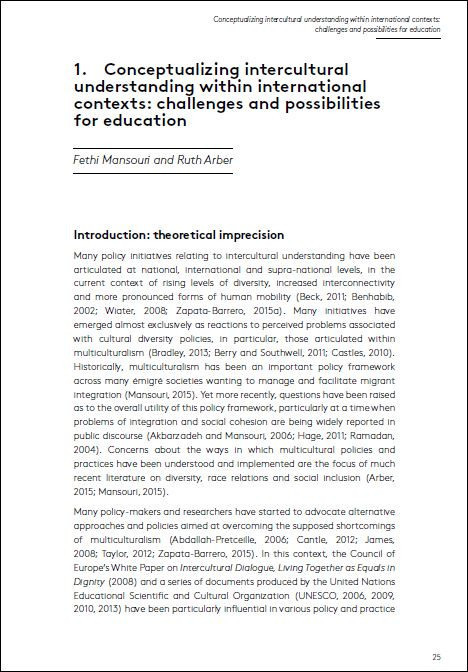 Conceptualizing Intercultural Understanding within International Contexts: Challenges and Possibilities for Education Year of publication: 2017 Author: Fethi Mansouri, Ruth Arber Corporate author: UNESCO This chapter interrogates the ways in which intercultural conception has been defined in diverse contexts, providing the framing context for policy and curriculum measures to work with the manifestations of global population movement, diversity and change. It asks questions the ways in which conversations about intercultural understanding can be broadened to consider how entrenched systemic inequalities, the underlying notional and institutional frameworks that support them, and the mono-cultural and specific privileges and oppression, which are so often their enduring outcome, can be dismantled. To that end, it examines how policy and notional and practical work, in relation to intercultural understanding, can better encompass structural and cultural change regarding the ways in which cross cultural encounters and intercultural relations are shaped and take place.
  Educational Policy Recommendations Based on TERCE Year of publication: 2016 Author: Ernesto Treviño, Cristóbal Villalobos, Andrea Baeza Corporate author: UNESCO Recommendations for Educational Policies in Latin America based on TERCE have been elaborated on request of the Regional Office of Education for Latin America and the Caribbean, OREALC/UNESCO Santiago. This publication is aimed at educational policy makers. For LLECE, decision-making is based on evidence and anchored to conceptual models that allow for the adequate interpretation of reality. This document fulfills this purpose, since it has the fundamental characteristic of translating the conclusions drawn from the TERCE into policy and educational practice. In this sense, the empirical evidence provided by the study shows the main factors that influence the achievement of learning, which represent concrete challenges of educational policy. Recomendaciones de Politicas Educativas en base al TERCE Year of publication: 2016 Author: Ernesto Treviño, Cristóbal Villalobos, Andrea Baeza Corporate author: Organización de las Naciones Unidas para la Educación, la Ciencia y la Cultura (UNESCO) Recomendaciones de Políticas Educativas en América Latina en base al TERCE ha sido elaborado por encargo de la Oficina Regional de Educación para América Latina y el Caribe, OREALC/ UNESCO Santiago. La presente publicación se encuentra orientada a hacedores de política educativa. Para el LLECE, la toma de decisiones debe estar basada en evidencia y anclada a algunos modelos conceptuales que permitan interpretar de manera adequada la realidad. Este documento cumple con este propósito, puesto que posee la característica fundamental de traducir las conclusiones extraídas de la evidencia del TERCE en política y la práctica educativa. En este sentido, la evidencia empírica que aporta el estudio muestra los principales factores que influyen en el logro de los aprendizajes, los cuales representan desafíos concretos de política educativa.
  Citizenship and Culture of Peace in Educational Reform Year of publication: 2005 Author: Raúl Zepeda López, María del Rosario Toj, Edgar Florencio Montúfar Corporate author: UNESCO The concern raised by the themes and contents of civic education and the culture of peace in childhood and youth are issues that are felt in various academic sectors, in social organizations and educational authorities that sometimes translate into articles in the media, where, among other things, one speaks of "the loss of values", generally having as reference to the young generations and making invisible that this loss is mainly present in the adult generations, which are responsible for this situation. These concerns, in spite of that conscious ambiguity, are not gratuitous. They can be a starting point to become aware of the need to develop new capacities and values, the absence of which young Latin Americans identify in their political and social leaders, as has been pointed out in cited studies, carried out by UNICEF for Latin America and for Beatriz de Cazali for Guatemala. The need to respond to this concern is also present in the participants in the dialogues and municipal consensus (2000), as well as among authorities and curriculum developers of MINEDUC in the last five-years. Ciudadanía y cultura de paz en la reforma educativa Year of publication: 2005 Author: Raúl Zepeda López, María del Rosario Toj, Edgar Florencio Montúfar Corporate author: UNESCO La preocupación planteada por los temas y contenidos de la formación ciudadana y la cultura de paz en la niñez y la juventud son cuestiones sentidas en diversos sectores académicos, en organizaciones sociales y autoridades educativas que algunas veces se traducen en sendos artículos en los medios de comunicación en donde, entre otras cosas, se habla de “la pérdida de valores” a secas, generalmente teniendo como referencia a las jóvenes generaciones e invisibilizando que esta pérdida principalmente está presente en las generaciones adultas, las cuales son responsables de esta situación. Estas inquietudes, a pesar de aquella consciente ambigüedad, no son gratuitas. Pueden ser punto de partida para tomar conciencia de la necesidad de desarrollo de nuevas capacidades y valores, cuya ausencia, los jóvenes latinoamericanos identifican en sus dirigentes políticos y sociales, como ha quedado antes señalado en estudios citados, realizados por UNICEF para América Latina y por Beatriz de Cazali para Guatemala. La necesidad de responder a esta preocupación está presente, además, en los participantes en los diálogos y consensos municipales (2000), así como entre autoridades y curriculistas del MINEDUC en los últimos quinquenios.
  Teacher Training for Multicultural Education in Favour of Democracy and Sustainable Development: the Territorial Approach Year of publication: 1995 Author: Raúl Galiardi | Paula Bernadini Mosconi Corporate author: UNESCO This publication is part of the book Teacher Training and Multiculturalism: National Studies. This book presents the outcomes concerning the initial training systems of teachers in eight countries at different levels of development in different regions of the world but who are faced with a common challenge to educate for cultural diversity. Both the conclusions of each particular study and the general outcomes demonstrate the complexity of the problems and the benefits of comparative analysis. Overcoming prejudices and stereotypes is not an easy task nor likely to be achieved in the short term. Mentalities change far more slowly than knowledge and, because of this, educational strategies need to be applied in the long term. This study also shows that it is necessary to improve the exchange of experiences as well as contacts between people and institutions who are confronted with the same problems in different contexts. The publication of the initial outcomes of this project is intended to enrich the quality of discussions between specialists and institutions who, in different parts of the world, are concerned by multicultural education as an instrument to promote understanding, respect and dialogue between cultures.
  Consolidated Report on the Implementation of the 1974 Recommendation Concerning Education for International Understanding, Cooperation and Peace and Education Relating to Human Rights and Fundamental Freedoms Year of publication: 2013 Corporate author: UNESCO Background: In accordance with 34 C/Resolution 87, 177 EX/Decision 35 (I) and 184 EX/Decision 20, the Executive Board has monitored the implementation of the 1974 Recommendation concerning Education for International Understanding, Cooperation and Peace and Education relating to Human Rights and Fundamental Freedoms. Pursuant to 192 EX/Decision 20 (III), the Director-General hereby submits the consolidated report on the implementation by Member States of the Recommendation.Purpose: This document reports on the results of the Fifth Consultation on the Implementation of the Recommendation concerning Education for International Understanding, Cooperation and Peace and Education relating to Human Rights and Fundamental Freedoms (covering the period 2009-2012). The analysis was prepared on the basis of 55 national reports from Member States received by the Secretariat. Rapport de synthèse sur l'application par les États membres de la Recommandation de 1974 sur l'éducation pour la compréhension, la coopération et la paix internationales et l'éducation relative aux droits de l'homme et aux libertés fondamentales Year of publication: 2013 Corporate author: UNESCO Background: In accordance with 34 C/Resolution 87, 177 EX/Decision 35 (I) and 184 EX/Decision 20, the Executive Board has monitored the implementation of the 1974 Recommendation concerning Education for International Understanding, Cooperation and Peace and Education relating to Human Rights and Fundamental Freedoms. Pursuant to 192 EX/Decision 20 (III), the Director-General hereby submits the consolidated report on the implementation by Member States of the Recommendation.Purpose: This document reports on the results of the Fifth Consultation on the Implementation of the Recommendation concerning Education for International Understanding, Cooperation and Peace and Education relating to Human Rights and Fundamental Freedoms (covering the period 2009-2012). The analysis was prepared on the basis of 55 national reports from Member States received by the Secretariat.