
Resources
Explore a wide range of valuable resources on GCED to deepen your understanding and enhance your research, advocacy, teaching, and learning.
32 Results found
 Shared Responsibility, Global Solidarity: Responding to the Socio-Economic Impacts of COVID-19 Year of publication: 2020 Corporate author: United Nations (UN) We are facing a global health crisis unlike any in the 75-year history of the United Nations — one that is killing people, spreading human suffering, and upending people’s lives. But this is much more than a health crisis. It is a human crisis. The coronavirus disease (COVID-19) is attacking societies at their core. The IMF has just reassessed the prospect for growth for 2020 and 2021, declaring that we have entered a recession – as bad as or worse than in 2009. The IMF projects recovery in 2021 only if the world succeeds in containing the virus and take the necessary economic measures.In the face of such an unprecedented situation in recent history, the creativity of the response must match the unique nature of the crisis – and the magnitude of the response must match its scale. No country will be able to exit this crisis alone.This report is a call to action, for the immediate health response required to suppress transmission of the virus to end the pandemic; and to tackle the many social and economic dimensions of this crisis. It is, above all, a call to focus on people – women, youth, low-wage workers, small and medium enterprises, the informal sector and on vulnerable groups who are already at risk.
 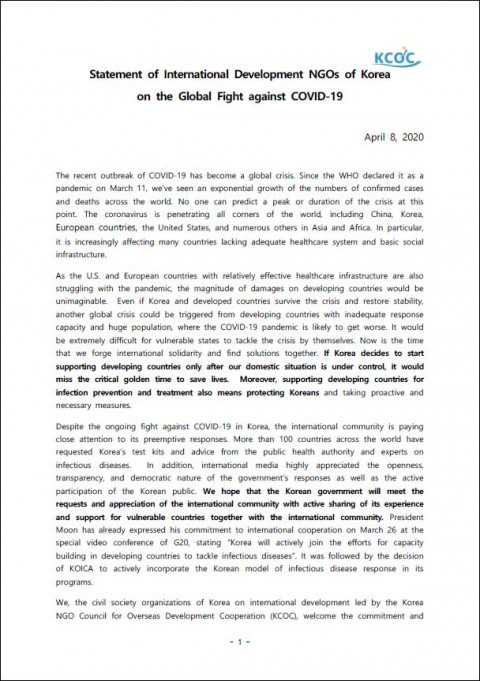 Statement of International Development NGOs of Korea on the Global Fight against COVID-19 Year of publication: 2020 Corporate author: Korea NGO Council for Overseas Development Cooperation (KCOC) The recent outbreak of COVID-19 has become a global crisis. Since the WHO declared it as a pandemic on March 11, we’ve seen an exponential growth of the numbers of confirmed cases and deaths across the world. No one can predict a peak or duration of the crisis at this point.As the U.S. and European countries with relatively effective healthcare infrastructure are also struggling with the pandemic, the magnitude of damages on developing countries would be unimaginable. It would be extremely difficult for vulnerable states to tackle the crisis by themselves. Now is the time that we forge international solidarity and find solutions together. 국제사회의 코로나19 퇴치를 위한 한국 국제개발협력 시민사회단체들의 호소문 Year of publication: 2020 Corporate author: Korea NGO Council for Overseas Development Cooperation (KCOC) 코로나19가 전 지구적 위기로 다가왔습니다. 지난 3월 11일 세계보건기구(WHO)가 팬데믹을 선언한 이래, 전 세계 확진자 및 사망자의 수가 기하급수적으로 증가하고 있고, 그 정점이 어디인지, 언제까지 이 사태가 계속될지 누구도 예측하지 못하는 상황입니다.보건 의료 인프라가 잘 갖춰진 미국과 유럽에서조차 팬데믹의 영향이 심각한 상황임을 감안할 때, 향후 개발도상국(이하 개도국)이 받게 될 피해의 정도를 가늠하기 어렵습니다. 취약한 나라일수록 스스로의 노력만으로 현 위기 상황을 타개하기란 매우 어렵기에 우리는 지금부터 국제적으로 연대하고 공동으로 해결방안을 모색해야 합니다. 또한 개도국의 감염예방 및 치료를 돕는 것이 곧 우리의 안전을 지키는 일이며, 필수적이고도 선제적인 예방책이 될 것이라는 점을 기억해야 합니다.
 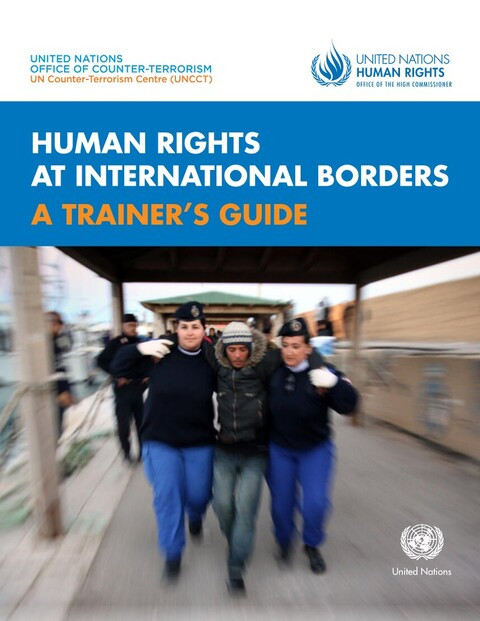 Human Rights at International Borders : A Trainer's Guide Year of publication: 2021 Corporate author: UN. Office of Counter-Terrorism (UNOCT) | UN. Office of the United Nations High Commissioner for Human Rights (UN. OHCHR) | United Nations (UN) International borders can be dangerous places for migrants, particularly for migrants in vulnerable situations. This capacity-building tool seeks to support States and particularly border officials in adopting a human rights-based and gender-responsive approach to border governance. Accompanying presentation slides and course materials have been developed for use in training courses or as a general information resource on the subject.
  New Challenges and Approaches to Regional and Global Security in Central Asia Year of publication: 2020 Corporate author: Organization for Security and Co-operation in Europe (OSCE) On 26 October 2018 in Nur-Sultan, the OSCE Programme Office in Nur-Sultan jointly with the Friedrich Ebert Foundation and the Kazakhstan Council on International Relations, with support from the Institute of Diplomacy under the Academy of Public Administration and the Public Opinion Research Institute co-organized an international conference entitled “New Challenges and Approaches to Regional and Global Security in Central Asia”. This compendium, which includes presentations given at the conference by both Kazakhstan’s and foreign participants, explores main regional security threats in Central Asia and ways to address these problems, as well as regional co-operation issues in responding to contemporary challenges. The edition will be of interest to political scientists, international relations experts, civil servants, scholars, educators, university-level students, and broad sections of the public interested in the contemporary development of the region. The edition is published in Russian and English. The paper of Mr. Pal Dunay is written in the English language in the original, the rest of the reports are in Russian. All reports have been translated and edited with the support of the OSCE Program Office in Nur Sultan. Any opinions and recommendations expressed in the materials arising from the conference are those of the authors and do not necessarily reflect the views of the conference organizers. Новые вызовы и подходы по регионально и глобальной безопасности в Центральной Азии Year of publication: 2020 Corporate author: Organization for Security and Co-operation in Europe (OSCE) 26 октября 2018 г. Офисом программ ОБСЕ в Нур-Султане совместно с Фондом им. Фридриха Эберта и Казахстанским советом по международным отношениям при поддержке Института дипломатии Академии государственного управления и Исследовательского института «Общественное мнение» была организована международная конференция «Новые вызовы и подходы по регионально и глобальной безопасности в Центральной Азии». В данный сборник материалов включены доклады казахстанских и зарубежных участников конференции, раскрывающие основные угрозы безопасности в регионе Центральной Азии и пути решения возникающих проблем, а также актуальные вопросы регионального сотрудничества в реагировании на современные вызовы. Издание предназначено для политологов, экспертов-международников, государственных служащих, научных работников, преподавателей и студентов высших учебных заведений, а также для широкого круга читателей, интересующихся современным развитием региона. Издание публикуется на русском и английском языках. Доклад господина Пал Дунай написан на английском языке в оригинале, остальные доклады на русском языке. Все доклады переведены и отредактированы при содействии Офиса программ ОБСЕ в Нур-Султане. Мнения и рекомендации авторов докладов в рамках конференции принадлежат авторам и не обязательно отражают точку зрения организаторов конференции.
 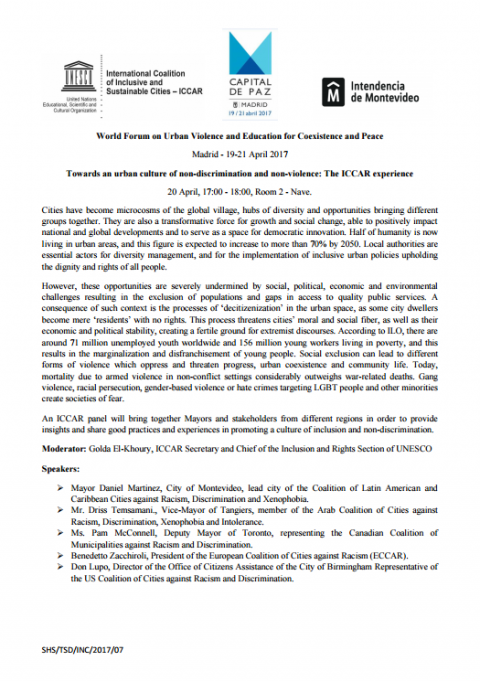 Towards an urban culture of non-discrimination and non-violence: The ICCAR experience Year of publication: 2017 Corporate author: International Coalition of Inclusive and Sustainable Cities This is a conference report for the World Forum on Urban Violence and Education for Coexistence and Peace.
  Imagining and Practising Global Citizenship Education Year of publication: 2020 Corporate author: UNESCO Venice This methodological guide illustrates the ways in which the International Cooperation Centre (ICC) has been promoting and practicing Global Citizenship Education in Italy for more than ten years. The training work developed by the ICC in the field of GCED, presented here in its theoretical articulation and in its practical outlining in some concrete experiences, may offer some reflections in the form of useful recommendations for continuing and strengthening the promotion of GCED.
  Supporting Learning Recovery One Year into COVID-19: The Global Education Coalition in Action Year of publication: 2021 Corporate author: UNESCO | Global Education Coalition The Global Education Coalition, launched by UNESCO, is a platform for collaboration and exchange to protect the right to education during this unprecedented disruption and beyond.This is the annual report of the Coalition, which builds on the inaugural report published in September 2020, and covers the activity between March 2020 and March 2021.
  L'Enseignement pour le développement durable de l'Arctique Year of publication: 2009 Author: Lars Kullerud Corporate author: UNESCO Education is an essential component of sustainable development. However, for the Arctic there is a history of education systems that tried to force central school models on local people, including different degrees of suppression of local language. This has been improved today to various degrees in the Arctic states. However, lack of skilled teachers with local roots is a circumpolar challenge. Arctic higher educational institutions also face many challenges when attempting to be innovative and competitive due to their small size and geographic isolation. The model of the University of the Arctic allows for a dynamic development of shared education systems through mutual cooperation. This network can be a very efficient tool to for delivering a relevant curriculum for a changing North.