
Resources
Explore a wide range of valuable resources on GCED to deepen your understanding and enhance your research, advocacy, teaching, and learning.
371 Results found
 Education for sustainable development: linking learning and happiness Year of publication: 2007 Author: Joel Bacha Corporate author: UNESCO Bangkok Education for Sustainable Development programmes demonstrating the link between learning and wellbeing and happiness are beginning to emerge throughout the Asia-Pacific region. In small communities throughout the Pacific islands, for example, ESD approaches are helping to engage communities in decision-making about their own lives. L'éducation au développement durable: lier l'apprentissage et le bonheur Year of publication: 2007 Author: Joel Bacha Corporate author: UNESCO Bangkok Des programmes d'éducation pour le développement durable qui démontrent le lien entre l'apprentissage et le bien-être et le bonheur commencent à émerger dans toute la région Asie-Pacifique. Dans les petites localités des îles du Pacifique, par exemple, les approches EDD aident les communautés à prendre des décisions concernant leur propre vie. Promoting sub-regional education for sustainable development in South-East Asia Year of publication: 2011 Corporate author: UNESCO Jakarta UNESCO Office, Jakarta, focuses on five cluster countries, helping their governments to plan and manage the education sector by enhancing national capacities to integrate sustainable development issues and practices into all types and levels of education.
 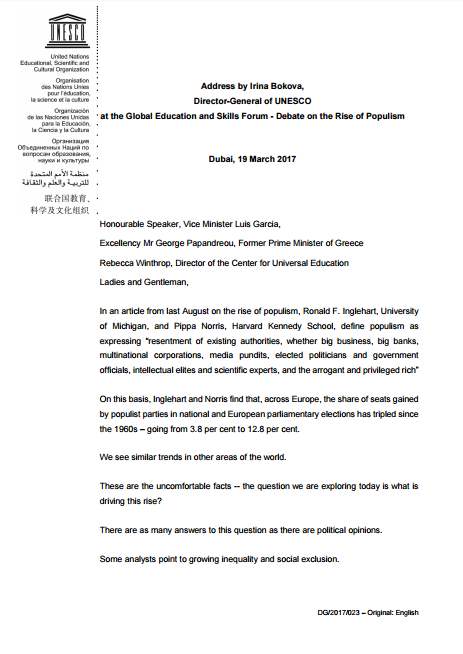 Address by Irina Bokova, Director-General of UNESCO, at the Global Education and Skills Forum: debate on the rise of populism, Dubai, 19 March 2017 Year of publication: 2017 Corporate author: UNESCO. Director-General, 2009-2017 (Bokova, I.G.) This address was presented by Irina Bokova, Director-General of UNESCO at the Global Education and Skills Forum. She debates on the Rise of Populism.
 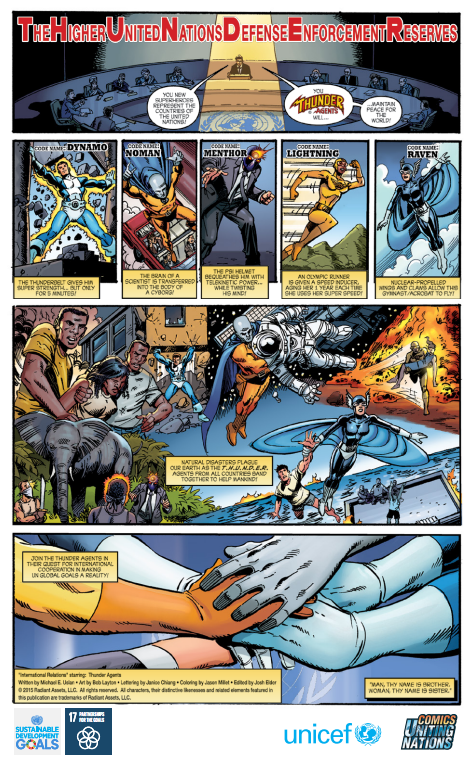 T.H.U.N.D.E.R. Agents Year of publication: 2015 Author: Michael E. Ulsan | Bob Layton | Janic Chiang | Jason Millet | Josh Elder Corporate author: Radiant Assets | LLC | United Nations Children's Fund (UNICEF) T.H.U.N.D.E.R. -- The Higher United Nations Defense Enforcement Reserves -- are UN Superheroes tasked with promoting global cooperation to make the world a better place. The T.H.U.N.D.E.R. Agentswas a comic originally created in the 1960s and is set to be made into a major motion picture in 2018.
  Global education guides Year of publication: 2009 Corporate author: Global Education Network of Young Europeans (GLEN) This document was written as an introduction to global education and as a practical support tool for planning, managing and evaluating global education projects. It is addressed to members of GLEN, the Global Education Network of Young Europeans, as well as to other global educators. The following pages are the result of numerous discussions that have occurred during the last five years both within GLEN and with external global education practitioners and academics. Many of these discussions crystallised at the European Global Education Days (EGED), a five-day seminar that GLEN organised on the occasion of the network’s fifth anniversary in November 2008. The EGED brought together more than 70 global education activists, practitioners and academics from 15 European countries, with the aims of exchanging experiences and good practices of global education, discussing how to evaluate global education projects and measure impact; reflecting on the potential of global education as a tool for activists and how it relates to concepts such as citizenship or development; and using the results of these discussions for the future work of our network: planning global education projects and further engaging with other stakeholders. The world is currently going through a period of accumulated crises: the ecological crisis, the financial and economic crisis, the food crisis. And this on top of all the other problems: hunger, poverty, unequal distributions of resources, violent conflict, etc. The challenges which humankind is facing seem to be greater than ever. However, the Greek word ‘crisis’ does not mean downfall, but decision. We, as human beings and as citizens of this world, can decide to contribute our share for bringing about more just political and economic structures; and more sustainable, democratic, peaceful and inclusive ways of living together. If we do global education, it is in order to address exactly these issues; it is to empower people to become agents of change in view of this vision. So, in this spirit, let us use the present momentum and make the current ‘crisis’ a turning point. Guide d'éducation globale Year of publication: 2009 Corporate author: Global Education Network of Young Europeans (GLEN) Ce document a été écrit comme une introduction à l'éducation mondiale et comme un outil de support pratique pour la planification, la gestion et l'évaluation des projets d'éducation globale. Il est adressé aux membres de GLEN, le Réseau Éducation Mondiale des Jeunes Européens, ainsi que d'autres éducateurs mondiaux. Les pages qui suivent sont le résultat de nombreuses discussions qui ont eu lieu au cours des cinq dernières années, tant au sein de GLEN et avec les praticiens de l'éducation mondiale externes et des universitaires. Beaucoup de ces discussions cristallisées lors des Journées Européennes Global Éducation (JEGÉ), un séminaire de cinq jours qui GLEN organisé à l'occasion du cinquième anniversaire du réseau en Novembre 2008. Le JEGÉ a réuni plus de 70 mondiaux éducation des militants, des praticiens et des universitaires de 15 pays européens, avec les objectifs de l'échange d'expériences et de bonnes pratiques de l'éducation mondiale, discuter de la façon d'évaluer les projets mondiaux d'éducation et de mesurer l'impact; réflexion sur le potentiel de l'éducation mondiale comme un outil pour les militants et comment il se rapporte à des concepts tels que la citoyenneté ou de développement; et en utilisant les résultats de ces discussions pour les travaux futurs de notre réseau: la planification des projets mondiaux d'éducation et engager davantage avec d'autres parties prenantes. Le monde traverse actuellement une période de crises accumulées: la crise écologique, la crise économique et financière, la crise alimentaire. Et cela au-dessus de tous les autres problèmes: la faim, la pauvreté, les distributions inégales des ressources, les conflits violents, etc. Les défis auxquels l'humanité est confrontée semblent être plus que jamais. Cependant, le mot grec ‘crise’ ne signifie pas la chute, mais la décision. Nous, en tant qu'êtres humains et en tant que citoyens de ce monde, pouvons décider de contribuer à provoquer des structures politiques et économiques plus justes; et des moyens plus durables, démocratiques, pacifiques et inclusifs de vivre ensemble. Si nous faisons l'éducation mondiale, il est dans le but de répondre exactement à ces questions; il est d'habiliter les gens à devenir des agents de changement en vue de cette vision. Donc, dans cet esprit, nous utilisons la dynamique actuelle et de faire la ‘crise’ actuelle un point tournant. 글로벌 교육 가이드 Year of publication: 2009 Corporate author: Global Education Network of Young Europeans (GLEN) 본 문서는 글로벌 교육을 소개, 계획 및 관리하고 글로벌 교육 프로젝트를 평가하기 위한 실질적 지원 도구로 작성되었다. 이것은 GLEN 멤버와 영 유로피언의 글로벌 교육 네트워크뿐 아니라, 다른 글로벌 교육자들을 위한 것이다. 다음의 내용은 GLEN 내부와 외부 글로벌 교육 실무자 및 학계 양측에서 지난 5년간 이뤄졌던 수많은 논의의 결과다. 이 논의의 대부분은 2008년 11월 GLEN 네크워크 5주년에 즈음하여 조직된 5일간의 세미나- ‘유러피언 글로벌 교육의 날(EGED)’에서 결정되었다. ‘유러피언 글로벌 교육의 날(EGED)’은 유럽 15개 국에서 70명 이상의 글로벌 교육 활동가, 실무자 및 학계 관계자들이 함께 하여 어떻게 글로벌 교육 프로젝트를 평가하고 그 영향을 측정하는 가에 대한 논의를 하였다. 또한 활동가를 위한 도구로써 글로벌 교육의 잠재력을 반영하는 것과 이를 어떻게 ‘시민의식’ 혹은 ‘개발’의 개념과 연계시키는 가에 대한 논의도 이어 나갔다. 아울러, 향후 우리의 네트워크 작업을 위한 본 논의들의 결과를 어떻게 사용하는 가에 대한 방안도 모색하였는데, 여기에선 글로벌 교육 프로젝트를 계획하고 더 나아가 다른 이해관계자들도 참여시키는 방안도 모색하였다. 세계는 현재 축적된 위기의 시간을 겪고 있다. 즉, 생태 위기, 금융 및 경제 위기, 식량 위기를 겪고 있다. 그리고 그 위에 기아, 빈곤, 불평등한 자원 분배, 폭력 충돌 등 다른 문제들도 산적하고, 이러한 문제들에 직면한 인류의 도전은 그 어느 때보다 중요하게 여겨진다. 그러나 그리스어 ‘위기’라는 단어는 ‘몰락’이 아니라 하나의 ‘결정’을 의미한다. 우리는 인류와 세계시민으로서 더 정의로운 정치와 경제구조를 이끌기 위해 우리 각자의 몫을 기여할 수 있고, 더불어 평화롭게 함께 살고, 더 지속가능하고 민주적인 것에 기여하는 방법을 찾을 수 있다. 우리가 글로벌 교육을 하는 것은 바로 이러한 문제점을 해결하기 위해서이다. 다시 말해서, 미래에 대한 비전을 갖고 변화의 동인이 되는 사람에게 힘을 실어 주는 것이다. 그러므로 우리는 이러한 정신으로 현재의 동력이 되어 오늘날의 위기를 전환점으로 만들도록 한다. Address by Irina Bokova, Director-General of UNESCO on the occasion of the Seminar on Climate Change and Education at the UN University: Responding to Climate Change Starts with Education; Tokyo, 26 November 2010 Year of publication: 2010 Corporate author: UNESCO. Director-General, 1999-2009 (Matsuura, K.) This document is an address of Irina Bokova, Director-General of UNESCO on the occasion of the Seminar on Climate Change and Education at the UN University “Responding to Climate Change Starts with Education” in Tokyo, 26 November 2010. She highlighted the importance of climate change education for the sustainable future and underlined the importance of several programme such as Sandwatch and YouthXchange which have been lead by the UNESCO. Discours de Mme Irina Bokova, Directrice générale de l'UNESCO à l'occasion du Séminaire sur les changements climatiques et l'éducation à l'Université des Nations Unies: Réagir aux changements climatiques commence par l'éducation Year of publication: 2010 Corporate author: UNESCO. Director-General, 1999-2009 (Matsuura, K.) Ce document est une adresse de Irina Bokova, Directrice générale de l'UNESCO à l'occasion du Séminaire sur les changements climatiques et l'éducation à l'Université des Nations Unies "Réagir aux changements climatiques commence par l'éducation" à Tokyo, le 26 Novembre 2010. Elle a souligné l'importance de la l'éducation au changement climatique pour l'avenir durable et a souligné l'importance de plusieurs programmes tels que Sandwatch et YouthXchange qui ont été prêcher par l'UNESCO.