
Resources
Explore a wide range of valuable resources on GCED to deepen your understanding and enhance your research, advocacy, teaching, and learning.
371 Results found
 Educación para Todos (EPT) en América Latina y el Caribe: Balance y Desafíos post-2015, 30-31 de Octubre del 2014, Lima, Perú: Declaración de Lima Year of publication: 2014 Corporate author: Organización de las Naciones Unidas para la Educación, la Ciencia y la Cultura (UNESCO) The Ministers of Education of Latin America and the Carribean (LAC), high-level government officials, UN agencies, representatives of civil society organizations and development partners, gathered at th meeting on "Education for All (EFA) in Latin America and the Carribean: Assessment of progress and post-2015 challenges", in Lima, Peru, from 30 to 31 October 2014. Having deliberated on progress towards EFA in the region, the Muscat Agreement adopted at the Global EFA Meeting (GEM) in Muscat, Oman, 12-14 May 2014, and the outcome document of the UN General Assembly Open Working Group for Sustainable Development Goals, and having examined the unfinished EFA tasks in the region, as well as the challenges and priorities that will configure the post-2015 education agenda for the region, the Lima Statement was adopted. L'Education pour tous (EPT) en Amérique latine et dans les Caraïbes: Évaluation des Progrès et Enjeux de l'après-2015, 30-31 Octobre 2014, Lima, Pérou: Déclaration de Lima Year of publication: 2014 Corporate author: Organisation des Nations Unies pour l'éducation, la science et la culture (UNESCO) The Ministers of Education of Latin America and the Carribean (LAC), high-level government officials, UN agencies, representatives of civil society organizations and development partners, gathered at th meeting on "Education for All (EFA) in Latin America and the Carribean: Assessment of progress and post-2015 challenges", in Lima, Peru, from 30 to 31 October 2014. Having deliberated on progress towards EFA in the region, the Muscat Agreement adopted at the Global EFA Meeting (GEM) in Muscat, Oman, 12-14 May 2014, and the outcome document of the UN General Assembly Open Working Group for Sustainable Development Goals, and having examined the unfinished EFA tasks in the region, as well as the challenges and priorities that will configure the post-2015 education agenda for the region, the Lima Statement was adopted. Education for All (EFA) in Latin America and the Caribbean: Assessment of Progress and Post-2015 Challenges, 30-31 October 2014, Lima, Peru: Lima Statement Year of publication: 2014 Corporate author: UNESCO The Ministers of Education of Latin America and the Carribean (LAC), high-level government officials, UN agencies, representatives of civil society organizations and development partners, gathered at th meeting on "Education for All (EFA) in Latin America and the Carribean: Assessment of progress and post-2015 challenges", in Lima, Peru, from 30 to 31 October 2014. Having deliberated on progress towards EFA in the region, the Muscat Agreement adopted at the Global EFA Meeting (GEM) in Muscat, Oman, 12-14 May 2014, and the outcome document of the UN General Assembly Open Working Group for Sustainable Development Goals, and having examined the unfinished EFA tasks in the region, as well as the challenges and priorities that will configure the post-2015 education agenda for the region, the Lima Statement was adopted. Education for All (EFA) in Latin America and the Caribbean: Assessment of Progress and Post-2015 Challenges, 30-31 October 2014, Lima, Peru: Lima Statement Year of publication: 2014 Corporate author: Organisation des Nations Unies pour l'éducation, la science et la culture (UNESCO) Les ministres de l'éducation de l'Amérique latine et les Caraïbes (ALC), les responsables gouvernementaux de haut niveau, les organismes de l’ONU, des représentants d'organisations de la société civile et les partenaires au développement, réunis à e réunion sur "l'Éducation Pour Tous (EPT) en Amérique latine et les Caraïbes : évaluation des progrès et des défis de l'après-2015 ", à Lima, Pérou, du 30 au 31 Octobre 2014. après en avoir délibéré sur les progrès vers l'EPT dans la région, l'accord Muscat adopté lors de la Réunion Mondiale sur l'EPT (RME) à Muscat, Oman, 12-14 mai 2014, et le document final du Groupe de travail à composition Assemblée générale de l'ONU pour les objectifs de développement durable, et après avoir examiné les tâches inachevées de l'EPT dans la région, ainsi que les défis et les priorités qui configureront l'ordre du jour de l'éducation post-2015 pour la région, la Déclaration de Lima a été adopté. Programme d'action de l'UNESCO: pour une culture de la paix et de la non-violence, une vision en action Year of publication: 2013 Corporate author: Organisation des Nations Unies pour l'éducation, la science et la culture (UNESCO) This document builds upon the experience and resources of the Intersectoral Platform for a Culture of Peace and Non-Violence and has benefited from the contribution of Professor Arjun Appadurai. This document shows the UNESCO's mission; Buidling the defences of peace in the minds of men and women and Culture of peace and Non-violence which is positive values, attitudes and behaviours for everyday peace. This document pointed out today's multiple crisis, and then introduced the programme of action on a culture of peace and non-violence. After drew the UNESCO's strategies, UNESCO's peace activities were followed.
 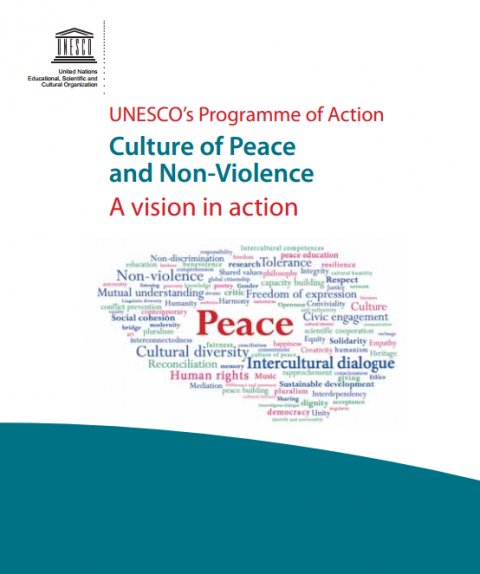 UNESCO's programme of action: culture of peace and non-violence, a vision in action Year of publication: 2013 Corporate author: UNESCO This document builds upon the experience and resources of the Intersectoral Platform for a Culture of Peace and Non-Violence and has benefited from the contribution of Professor Arjun Appadurai. This document shows the UNESCO's mission; Buidling the defences of peace in the minds of men and women and Culture of peace and Non-violence which is positive values, attitudes and behaviours for everyday peace. This document pointed out today's multiple crisis, and then introduced the programme of action on a culture of peace and non-violence. After drew the UNESCO's strategies, UNESCO's peace activities were followed. UNESCO's programme of action: culture of peace and non-violence, a vision in action Year of publication: 2013 Corporate author: Organisation des Nations Unies pour l'éducation, la science et la culture (UNESCO) Ce document se fonde sur l'expérience et les ressources de la plate-forme intersectorielle pour une Culture de la Paix et la non-violence et a bénéficié de la contribution du Professeur Arjun Appadurai. Ce document montre la mission de l'UNESCO; Buidling Construire les défenses de la paix dans l'esprit des hommes et des femmes et la culture de la paix et de non-violence qui est des valeurs positives, les attitudes et les comportements pour la paix tous les jours. Ce document a souligné multiples crises d'aujourd'hui, et a ensuite présenté le programme d'action sur une culture de paix et de non-violence. Après les stratégies de l'UNESCO, les activités de paix de l'UNESCO ont été suivies. Dialogue interculturel: impliquer les jeunes dans le monde entier Year of publication: 2010 Author: Elizabeth Khawajkie Corporate author: UNESCO | DAIMLER It is hoped that this review will help to highlight why there is a persistent call for the continuation of such endeavors, like Mondialogo, which promoted dialogue among cultures and people, mutual respect and understanding so effectively. The Mondialogo journey, begun as an exploratory exercise, ended with compelling and often moving experiences.
 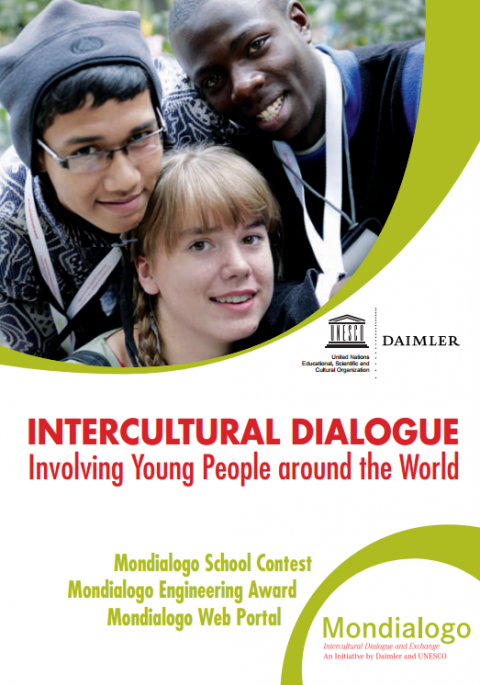 Intercultural dialogue: involving young people around the world Year of publication: 2010 Author: Elizabeth Khawajkie Corporate author: UNESCO | DAIMLER It is hoped that this review will help to highlight why there is a persistent call for the continuation of such endeavors, like Mondialogo, which promoted dialogue among cultures and people, mutual respect and understanding so effectively. The Mondialogo journey, begun as an exploratory exercise, ended with compelling and often moving experiences. Le dialogue interculturel: la participation des jeunes à travers le monde Year of publication: 2010 Author: Elizabeth Khawajkie Corporate author: UNESCO | DAIMLER Il est à espérer que cet examen permettra de mettre en évidence la raison pour laquelle il y a un appel persistant pour la poursuite de ces efforts, comme Mondialogo, qui a favorisé de manière efficace le dialogue entre les cultures et les peuples, le respect mutuel et la compréhension. Le voyage Mondialogo, commencé comme un exercice exploratoire, a pris fin avec des expériences convaincantes et souvent en mouvement.