
Resources
Explore a wide range of valuable resources on GCED to deepen your understanding and enhance your research, advocacy, teaching, and learning.
371 Results found
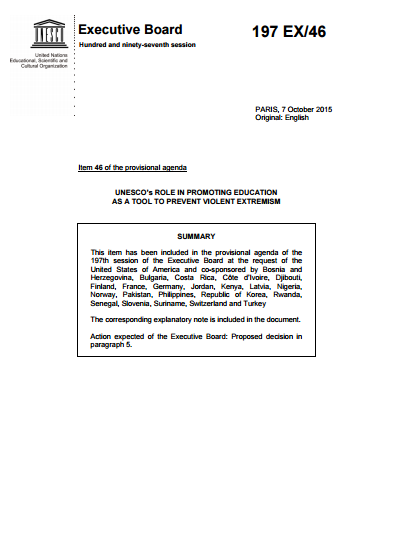 UNESCO's role in promoting education as a tool to prevent violent extremism Year of publication: 2015 Corporate author: UNESCO This item has been included in the provisional agenda of the 197th session of the Executive Board at the request of the United States of America and co-sponsored by Bosnia and Herzegovina, Bulgaria, Costa Rica, Côte d’Ivoire, Djibouti, Finland, France, Germany, Jordan, Kenya, Latvia, Nigeria, Norway, Pakistan, Philippines, Republic of Korea, Rwanda, Senegal, Slovenia, Suriname, Switzerland and Turkey
  Tenth Meeting of the High-level Group on Education for All (EFA), 22-24 March 2011, Jomtien, Thailand: Jomtien Statement Year of publication: 2011 Corporate author: UNESCO This statement is the outcome of 10th meeting of the High-level Group on Education for All. The meeting was held from 22 to 24 March 2011 in Jomtien, Thailand to urge to progress towards the EFA goals. Dixième Réunion du Groupe de Haut Niveau sur l'Éducation pour Tous (EPT), 22-24 Mars 2011, Jomtien, Thaïlande: Déclaration de Jomtien Year of publication: 2011 Corporate author: UNESCO Cette déclaration est le résultat de la 10e réunion du Groupe de haut niveau sur l'éducation pour tous. La réunion a eu lieu du 22 au 24 Mars 2011 à Jomtien, en Thaïlande pour pousser à progresser vers les objectifs de l'EPT. Recommendation concerning Education for International Understanding, Cooperation and Peace and Education Relating to Human Rights and Fundamental Freedoms, adopted by the General Conferences at its 18th session, Paris, 19 November 1974 Year of publication: 1974 Corporate author: UNESCO Following is the authentic text of the Recommendation duly adopted by the General Conference of the United Nations Educational, Scientific and Cultural Organization during its eighteenth session, which was held in Paris and declared closed the twenty-third day of November 1974. The General Conference recommends that Member States should submit to provisions as follows: to apply the following provisions by taking whatever legislative or other steps may be required in conformity with the Constitutional practice of each State to give effect within their respective territories to the principles set forth in this recommendation; to bring this recommendation to the attention of the authorities, departments or bodies responsible for school education, higher education and out-of-school education, of the various organizations carrying out educational work among young people and adults such as student and youth movements, associations of pupils’ parents, teachers’ unions and other interested parties; to submit to it, by dates and in the form to be decided upon by the Conference, reports concerning the action taken by them in pursuance of this recommendation. Recommendation concerning Education for International Understanding, Cooperation and Peace and Education Relating to Human Rights and Fundamental Freedoms, adopted by the General Conferences at its 18th session, Paris, 19 November 1974 Year of publication: 1974 Corporate author: UNESCO Voici le texte authentique de la recommandation dûment adoptée par la Conférence générale de l'Organisation des Nations Unies pour l'éducation, la science et la culture lors de sa dix-huitième session, qui a eu lieu à Paris et déclarée close le vingt-troisième jour de Novembre 1974. La Conférence générale recommande que les États membres devraient se soumettre à des dispositions comme suit: pour appliquer les dispositions suivantes en prenant toutes les dispositions législatives ou autres en conformité avec la pratique constitutionnelle de chaque Etat pour donner effet dans leurs territoires respectifs aux principes énoncés dans la présente recommandation; de porter cette recommandation à l'attention des autorités, des services ou organismes responsables de l'enseignement scolaire, l'enseignement supérieur et de l'éducation hors de l'école, des diverses organisations exerçant une action éducative auprès des jeunes et des adultes tels que les étudiants et les mouvements de jeunesse, les associations des des parents, des enseignants des élèves les syndicats et les autres parties intéressées; de lui présenter, aux dates et sous la forme d'être décidée par la Conférence, des rapports concernant les mesures prises par eux en application de cette recommandation.Recommandation sur l'Education Pour la compréhension, la coopération et la paix et l'éducation relatives aux Droits de l'homme et des libertés Fondamentales, ADOPTÉE par les Conférences générales Le LORs de sa 18e session, Paris, le 19 Novembre 1974 1974년 11월 19일, 파리 제 18차 총회에서 채택된 인권과 기본적 자유, 국제 이해와 협력 및 평화에 관한 교육을 위한 권고안 Year of publication: 1974 Corporate author: 유네스코 다음은 1974년 11월 파리에서 열리고 같은 달 23일에 폐회된, 제 18차 유엔 교육, 과학과 문화, 교육 기구 총회에서 정식 채택된 권고안의 실제 텍스트이다. 총회는 회원국이 다음과 같은 규정을 준수할 것을 권고한다. 즉, 해당 결의안에 명시된 원칙에 해당하는 지역들 내에서 효과를 얻기 위해 각 국가의 실제 헌법에 부합하며, 입법 혹은 다른 어떤 단계에 따라 본 권고안을 준수할 것을 권고한다. 또한, 이 권고안은 ‘학부모, 교사’ 협회와 기타 이해 관계자들 연합, 그리고 학생과 청소년 운동 단체와 같은 성인 및 젊은이들 사이에서 교육 사업을 수행하는 다양한 조직, 학교 교육과 고등 교육, 학교 밖 교육을 위한 책임 기관 또는 관련 부서들의 주의를 필요로 한다. 아울러 유엔 총회에서 본 권고안이 결정된 형식과 그 날짜로부터 실질적으로 이를 수행한 내용 및 그 조치에 관한 보고서를 제출한다. Declaração e Plano de Ação Integrado sobre a Educação para a Paz, os Direitos Humanos e a Democracia Year of publication: 1995 Corporate author: UNESCO This document is Declaration of the 44th session of the International Conference on Education (Geneva, October 1994) endorsed by the General Conference Declaration of the 44th session of the International Conference on Education (Geneva, October 1994) endorsed by the General Conference of UNESCO at its twenty-eight session Paris, November 1995 of UNESCO at its twenty-eight session Paris, November 1995. إعلان وإطار العمل المتكامل بشأن التربية من أجل السلام وحقوق الإنسان والديمقراطية Year of publication: 1995 Corporate author: UNESCO This document is Declaration of the 44th session of the International Conference on Education (Geneva, October 1994) endorsed by the General Conference Declaration of the 44th session of the International Conference on Education (Geneva, October 1994) endorsed by the General Conference of UNESCO at its twenty-eight session Paris, November 1995 of UNESCO at its twenty-eight session Paris, November 1995. Deklaratsiya i Kompleksnye Ramki Dejstvij po Vospitaniyu v Dykhe mira, Prav Cheloveka i Demokratii Year of publication: 1995 Corporate author: UNESCO This document is Declaration of the 44th session of the International Conference on Education (Geneva, October 1994) endorsed by the General Conference Declaration of the 44th session of the International Conference on Education (Geneva, October 1994) endorsed by the General Conference of UNESCO at its twenty-eight session Paris, November 1995 of UNESCO at its twenty-eight session Paris, November 1995. Declaración y Plan de Acción Integrado sobre la Educación para la Paz, los Derechos Humanos y la Democracia Year of publication: 1995 Corporate author: UNESCO This document is Declaration of the 44th session of the International Conference on Education (Geneva, October 1994) endorsed by the General Conference Declaration of the 44th session of the International Conference on Education (Geneva, October 1994) endorsed by the General Conference of UNESCO at its twenty-eight session Paris, November 1995 of UNESCO at its twenty-eight session Paris, November 1995.