
Resources
Explore a wide range of valuable resources on GCED to deepen your understanding and enhance your research, advocacy, teaching, and learning.
371 Results found
 Programme Interinstitution d'éducation pour la paix: compétences pour la vie constructive; aperçu du programme Year of publication: 2005 Author: Antonella Verdiani Corporate author: UN. Office of the United Nations High Commissioner for Refugees (UNHCR) | Inter-agency Network for Education in Emergencies (INEE) Ce manuel est l'une des composantes du «Programme Interinstitution d'éducation pour la paix». Le programme est conçu pour les gestionnaires de l'éducation des ministères chargés de l'éducation formelle et non-formelle et pour les organismes qui mettent en œuvre des activités d'éducation au nom du gouvernement. La structure de mise en œuvre est basée sur l'expérience acquise au cours des huit années, le programme a été utilisé, de 1998 à 2005. Le programme a été évalué par des experts externes et les nouveaux matériaux révisés (2005) intègrent à la fois les suggestions formulées dans l'évaluation et les réactions des spécialistes qui œuvre dans le domaine.
  Address by Irina Bokova, Director-General of UNESCO on the occasion of the Event on Education for Preventing Violent Extremism; Brussels, 21 March 2017 Year of publication: 2017 Corporate author: UNESCO. Director-General, 2009-2017 (Bokova, I.G.) This address was delivered by Irina Bokova, Director-General of UNESCO on the occasion of the Event on Education for Preventing Violent Extremism.
  Address by Irina Bokova, Director-General of UNESCO, on the occasion of the event organized by Albania, Jordan and the Holy See: Fighting radicalization and extremism through Education; United Nations General Assembly 2016; New York, 20 September 2016 Year of publication: 2016 Corporate author: UNESCO. Director-General, 2009-2017 (Bokova, I.G.) This address was presented by Irina Bokova, Director-General of UNESCO, on the occasion of the event organized by Albania, Jordan and the Holy See.
  Message from Irina Bokova, Director-General of UNESCO on the occasion of the International Day of Peace, 21 September 2013 Year of publication: 2013 Corporate author: UNESCO. Director-General, 2009-2017 (Bokova, I.G.) This is the message from Irina Bokova, Director-General of UNESCO on the occasion of the International Day of Peace, 21 September 2013. Message de la Directrice générale de l'UNESCO, Irina Bokova, à l'occasion de la Journée internationale de la paix, 21 septembre 2013 Year of publication: 2013 Corporate author: UNESCO. Director-General, 2009-2017 (Bokova, I.G.) This is the message from Irina Bokova, Director-General of UNESCO on the occasion of the International Day of Peace, 21 September 2013. Mensaje de la Directora General de la UNESCO, Irina Bokova, con motivo del Día Internacional de la Paz, 21 de septiembre de 2013 Year of publication: 2013 Corporate author: UNESCO. Director-General, 2009-2017 (Bokova, I.G.) This is the message from Irina Bokova, Director-General of UNESCO on the occasion of the International Day of Peace, 21 September 2013. Послание Генерального директора ЮНЕСКО г-жи Ирины Боковой по случаю Международного дня мира, 21 сентября 2013 г. Year of publication: 2013 Corporate author: UNESCO. Director-General, 2009-2017 (Bokova, I.G.) This is the message from Irina Bokova, Director-General of UNESCO on the occasion of the International Day of Peace, 21 September 2013. رسالة من السيدة إيرينا بوكوفا، المديرة العامة لليونسكو، بمناسبة اليوم العالمي للسلام، ٢١ أيلول/سبتمبر٢٠١٣ Year of publication: 2013 Corporate author: UNESCO. Director-General, 2009-2017 (Bokova, I.G.) This is the message from Irina Bokova, Director-General of UNESCO on the occasion of the International Day of Peace, 21 September 2013. 联合国教科文组织总干事伊琳娜•博科娃在国际和平日的致辞,2013年9月21日 Year of publication: 2013 Corporate author: UNESCO. Director-General, 2009-2017 (Bokova, I.G.) This is the message from Irina Bokova, Director-General of UNESCO on the occasion of the International Day of Peace, 21 September 2013.
 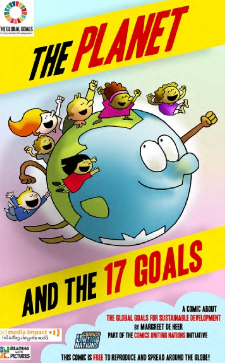 The Planet and the 17 Goals Author: Margreet De Heer Corporate author: United Nations Children's Fund (UNICEF) UNICEF has teamed up with the Comics UnitingNations initiative to use the creative and exciting medium of comics to bring the messages of sustainable development to comics fans globally! Comics have been developed by world renown illustrators, writers and comics developers from around the world.Dutch illustrator Margreet de Heer has lent her talents to the Comics United Nations project to help inform children and youth about the new global goals.