
Resources
Explore a wide range of valuable resources on GCED to deepen your understanding and enhance your research, advocacy, teaching, and learning.
371 Results found
 Learning to live together: education for conflict resolution, responsible citizenship, human rights and humanitarian norms Year of publication: 2013 Author: Margaret Sinclair Corporate author: Education Above All (Qatar) L'éducation ne peut offrir des remèdes immédiats aux problèmes locaux et mondiaux que nous voyons sur les écrans d'information tous les jours, mais elle peut contribuer à les résoudre sur le long terme. Ce livre examine spécifiquement la contribution que l'éducation peut apporter pour vivre ensemble même dans les pays où la formation des enseignants et les ressources en classe sont limitées.De nombreux pays ont des populations diverses (ethniques, linguistiques, religieuses, etc.) cherchent à maintenir l'harmonie entre les différents groupes. Dans certains pays, cependant, en particulier lorsque le stress économique ou les changements climatiques ont intensifié les arguments sur les ressources, les tensions ont conduit à des conflits armés. Cela apporte avec elle toute la misère de la mort, les blessures, le déplacement et la pauvreté, ainsi que la perturbation des systèmes éducatifs. Dans certains cas, l'éducation elle-même a été un facteur contributif à l'éclatement du conflit, notamment grâce à des possibilités d'éducation inégales pour les différents groupes, et à travers les programmes scolaires biaisés.La guerre civile a causé des souffrances indicibles au cours des dernières années, et dans un monde globalisé, il a des effets négatifs de débordement vers les pays voisins et d'autres pays. Il est essentiel d'élaborer des politiques de l'éducation et la réforme des programmes qui peuvent aider à transmettre les valeurs et les compétences pour apprendre à vivre ensemble pour les jeunes, pour aider à réduire les tensions, à l'intérieur et entre les pays.Education décideurs politiques peuvent aider à jeter les bases d'un avenir meilleur en ajustant le contenu et le processus de l'éducation afin de refléter les compétences et les valeurs des droits de l'homme, des normes humanitaires, la résolution pacifique des conflits, le développement durable et d'autres questions comme éléments de local, national et citoyenneté mondiale.Réforme de l'éducation ne suffit pas, bien sûr, de résoudre les nombreux problèmes de notre temps. L'objectif de ce volume est sur la contribution qui peut être faite par le biais d'aligner le contenu de l'éducation à l'objectif d'apprendre à vivre ensemble. Ce travail aura un plus grand impact quand il a lieu au sein des systèmes et politiques d'éducation qui sont conformes aux valeurs des droits de l'homme et bien sûr, quand d'autres secteurs en dehors de l'éducation font leurs contributions respectives.Ce livre montre que l'éducation transformatrice pour la résolution des conflits et la paix, à la citoyenneté locale, nationale et mondiale, des droits de l'homme et des valeurs humanitaires peut être appliqué même dans des conditions difficiles, s'il y a un engagement politique de le faire. Les auteurs ont fourni des exemples et les enseignements tirés de leurs propres expériences en tant que praticiens éminents dans le domaine.
  Buenos Aires Recommendations Year of publication: 2007 Corporate author: PRELAC II Recognizing that education is a public good and is the key to building a more just and better world for all, the Second Intergovernmental Meeting of the Regional Education Project, PRELAC II, held in the city of Buenos Aires, on the 29th and March 30, 2007, agrees the following recommendations as criteria and lines of action for national policies and international cooperation. Recomendaciones de Buenos Aires Year of publication: 2007 Corporate author: PRELAC II Reconociendo que la educación es un bien público y es la llave para la construcción de un mundo más justo y mejor para todos, la Segunda Reunión Intergubernamental del Proyecto Regional de Educación, PRELAC II, reunida en la ciudad de Buenos Aires, los días 29 y 30 de marzo de 2007, acuerda las siguientes recomendaciones como criterios y líneas de acción para las políticas nacionales y la cooperación internacional.
  The Teacher as a Promoter of the Pedagogy of Coexistence for Education for Peace Year of publication: 2014 Author: María Elena López Serrano | Rosa María Medrano Domínguez | Patricia Villar López Corporate author: Universidad Católica Silva Henríquez Recognizing the diversity in the aulic space allows to create spaces of harmonious coexistence that promote and accept interculturality, for this the teacher becomes the nodal axis to propitiate the conditions that allow the students to recognize themselves as equal beings capable of developing their capacities to the maximum academic and personal. To achieve this goal it is essential that the teacher recognizes himself and others, in such a way that generates spaces in which students identify as social beings able to interact with their peers, the educational community and their environment. What has been described here supports the proposal of the pedagogy of coexistence in the aulic space as a promoter of education for peace that contributes to the reduction of the violence experienced in society. The proposal is based on a documentary research on the pedagogy of coexistence linked to diversity and interculturality to promote education for peace. The proposal recognizes the teacher as the axis that drives education for peace through fostering harmonious environments in the classroom. It is not possible to speak of harmonic coexistence without considering the teacher's awareness of his role as a social educator, which promotes through Pedagogy of Coexistence an intercultural education that attends to diversity and that favors education for peace and contributes to the decrease of cultural violence. El docente como promotor de la pedagogía de la convivencia para la educación por la paz Year of publication: 2014 Author: María Elena López Serrano | Rosa María Medrano Domínguez | Patricia Villar López Corporate author: Universidad Católica Silva Henríquez Reconocer la diversidad en el espacio áulico permite propiciar espacios de convivencia armónica que promuevan y acepten la interculturalidad, por ello el docente se convierte en el eje nodal para propiciar las condiciones que permitan a los estudiantes reconocerse como seres iguales capaces de desarrollar al máximo sus capacidades académicas y personales. Para conseguir este objetivo es fundamental que el docente se reconozca en sí mismo y en los demás, de tal forma que genere espacios en el que los alumnos se identifiquen como seres sociales capaces de interactuar con sus pares, con la comunidad educativa y su entorno. Lo hasta aquí descrito sustenta la propuesta de la pedagogía de la convivencia en el espacio áulico como promotor de la educación para la paz que contribuya a la disminución de la violencia que se vivencia en la sociedad. La propuesta se sustenta en una investigación documental respecto a la pedagogía de la convivencia vinculada con la diversidad e interculturalidad para promover la educación por la paz.La propuesta reconoce al docente como el eje que impulsa la educación por la paz a través de propiciar ambientes armónicos en el aula. No es posible hablar de Convivencia armónica sin considerar la conciencia del docente respecto a su rol como educador social, que promueve a través de la Pedagogía de la Convivencia una educación intercultural que atienda a la diversidad y que favorezca la educación para la paz y contribuya a la disminución de la violencia cultural. Aprender a vivir juntos: un programa intercultural e interreligioso para la educacion ética Year of publication: 2008 Corporate author: Arigatou Foundation (Switzerland) | Interfaith Council on Ethics Education for Children Learning to Live Together has been developed for use in different religious and secular contexts as a resource for everyone concerned with promoting ethics and values. The objective has been to develop a resource that is relevant on a global level and yet flexible enough to be interpreted within different cultural and social contexts. The resource has been tested in many different regions and cultural contexts to assure that it is relevant in regional and local contexts (see ‘We did it like this’, p.187). Test workshops have been held in 10 different countries, where the GNRC was able to bring together various religious and secular organisations working with children. During the test workshops, this resource manual was used to the benefit of more than 300 children and youth, representing African Traditional Religions, Bahá’í Faith, Buddhism, Christianity, Hinduism, Islam, Judaism, members of Brahma Kumaris and a number of people of secular thinking. Test workshops as well as input and comments from experts in the area of education, ethics, spirituality, intercultural and interfaith learning and child rights have contributed important experiences and opportunities for learning for the development of this resource. Learning to Live Together is already having an impact. In a GNRC programme in Israel, the resource material was used during a six-day journey made by a group of Jewish, Christian, and Muslim youth to the historical sites of Israel and Palestine, all of which have symbolic relevance to the conflict in their region. At each stop, youth participants discussed their values and their differing perceptions of their shared history. Learning to Live Together is an adaptable resource that can be used with children from many different cultural, religious and social contexts to nurture common values and a mutual respect for different backgrounds and traditions. The resource provides space for enhancing children’s innate potential for spirituality and hope for a better world, as a contribution to changing the situation for children worldwide. The Users Guide provides all necessary information for its use. UNESCO and UNICEF have been closely involved in developing Learning to Live Together and have endorsed the material as an important contribution to a quality education, which takes a multicultural and multi-religious society into consideration. UNESCO’s Guidelines for Intercultural Education underpin the philosophy and the approach of the resource: “Religious education can be described as learning about one’s own religion or spiritual practices, or learning about other religions or beliefs. Interfaith education, in contrast, aims to actively shape the relations between people from different religions”. Apprendre à vivre ensemble: un programme interculturel et interreligieux pour l'enseignement de l'éthique Year of publication: 2008 Corporate author: Arigatou Foundation (Switzerland) | Interfaith Council on Ethics Education for Children Learning to Live Together has been developed for use in different religious and secular contexts as a resource for everyone concerned with promoting ethics and values. The objective has been to develop a resource that is relevant on a global level and yet flexible enough to be interpreted within different cultural and social contexts. The resource has been tested in many different regions and cultural contexts to assure that it is relevant in regional and local contexts (see ‘We did it like this’, p.187). Test workshops have been held in 10 different countries, where the GNRC was able to bring together various religious and secular organisations working with children. During the test workshops, this resource manual was used to the benefit of more than 300 children and youth, representing African Traditional Religions, Bahá’í Faith, Buddhism, Christianity, Hinduism, Islam, Judaism, members of Brahma Kumaris and a number of people of secular thinking. Test workshops as well as input and comments from experts in the area of education, ethics, spirituality, intercultural and interfaith learning and child rights have contributed important experiences and opportunities for learning for the development of this resource. Learning to Live Together is already having an impact. In a GNRC programme in Israel, the resource material was used during a six-day journey made by a group of Jewish, Christian, and Muslim youth to the historical sites of Israel and Palestine, all of which have symbolic relevance to the conflict in their region. At each stop, youth participants discussed their values and their differing perceptions of their shared history. Learning to Live Together is an adaptable resource that can be used with children from many different cultural, religious and social contexts to nurture common values and a mutual respect for different backgrounds and traditions. The resource provides space for enhancing children’s innate potential for spirituality and hope for a better world, as a contribution to changing the situation for children worldwide. The Users Guide provides all necessary information for its use. UNESCO and UNICEF have been closely involved in developing Learning to Live Together and have endorsed the material as an important contribution to a quality education, which takes a multicultural and multi-religious society into consideration. UNESCO’s Guidelines for Intercultural Education underpin the philosophy and the approach of the resource: “Religious education can be described as learning about one’s own religion or spiritual practices, or learning about other religions or beliefs. Interfaith education, in contrast, aims to actively shape the relations between people from different religions”. تعلم العيش معا: برنامج التواصل بين الثقافات والأديان لتعليم الأخلاق Year of publication: 2008 Corporate author: Interfaith Council on Ethics Education for Children | Arigatou Foundation (Switzerland) Learning to Live Together has been developed for use in different religious and secular contexts as a resource for everyone concerned with promoting ethics and values. The objective has been to develop a resource that is relevant on a global level and yet flexible enough to be interpreted within different cultural and social contexts. The resource has been tested in many different regions and cultural contexts to assure that it is relevant in regional and local contexts (see ‘We did it like this’, p.187). Test workshops have been held in 10 different countries, where the GNRC was able to bring together various religious and secular organisations working with children. During the test workshops, this resource manual was used to the benefit of more than 300 children and youth, representing African Traditional Religions, Bahá’í Faith, Buddhism, Christianity, Hinduism, Islam, Judaism, members of Brahma Kumaris and a number of people of secular thinking. Test workshops as well as input and comments from experts in the area of education, ethics, spirituality, intercultural and interfaith learning and child rights have contributed important experiences and opportunities for learning for the development of this resource. Learning to Live Together is already having an impact. In a GNRC programme in Israel, the resource material was used during a six-day journey made by a group of Jewish, Christian, and Muslim youth to the historical sites of Israel and Palestine, all of which have symbolic relevance to the conflict in their region. At each stop, youth participants discussed their values and their differing perceptions of their shared history. Learning to Live Together is an adaptable resource that can be used with children from many different cultural, religious and social contexts to nurture common values and a mutual respect for different backgrounds and traditions. The resource provides space for enhancing children’s innate potential for spirituality and hope for a better world, as a contribution to changing the situation for children worldwide. The Users Guide provides all necessary information for its use. UNESCO and UNICEF have been closely involved in developing Learning to Live Together and have endorsed the material as an important contribution to a quality education, which takes a multicultural and multi-religious society into consideration. UNESCO’s Guidelines for Intercultural Education underpin the philosophy and the approach of the resource: “Religious education can be described as learning about one’s own religion or spiritual practices, or learning about other religions or beliefs. Interfaith education, in contrast, aims to actively shape the relations between people from different religions”.
 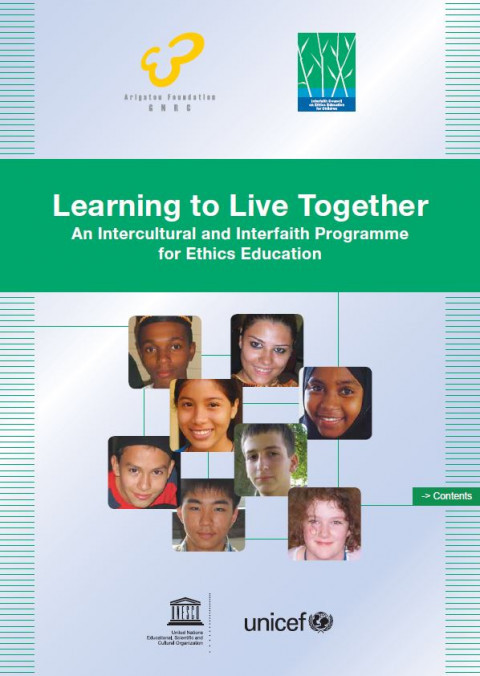 Learning to live together: an intercultural and interfaith programme for ethics education Year of publication: 2008 Corporate author: Interfaith Council on Ethics Education for Children | Arigatou Foundation (Switzerland) Learning to Live Together has been developed for use in different religious and secular contexts as a resource for everyone concerned with promoting ethics and values. The objective has been to develop a resource that is relevant on a global level and yet flexible enough to be interpreted within different cultural and social contexts. The resource has been tested in many different regions and cultural contexts to assure that it is relevant in regional and local contexts (see ‘We did it like this’, p.187).Test workshops have been held in 10 different countries, where the GNRC was able to bring together various religious and secular organisations working with children. During the test workshops, this resource manual was used to the benefit of more than 300 children and youth, representing African Traditional Religions, Bahá’í Faith, Buddhism, Christianity, Hinduism, Islam, Judaism, members of Brahma Kumaris and a number of people of secular thinking. Test workshops as well as input and comments from experts in the area of education, ethics, spirituality, intercultural and interfaith learning and child rights have contributed important experiences and opportunities for learning for the development of this resource. Learning to Live Together is already having an impact. In a GNRC programme in Israel, the resource material was used during a six-day journey made by a group of Jewish, Christian, and Muslim youth to the historical sites of Israel and Palestine, all of which have symbolic relevance to the conflict in their region. At each stop, youth participants discussed their values and their differing perceptions of their shared history.Learning to Live Together is an adaptable resource that can be used with children from many different cultural, religious and social contexts to nurture common values and a mutual respect for different backgrounds and traditions. The resource provides space for enhancing children’s innate potential for spirituality and hope for a better world, as a contribution to changing the situation for children worldwide. The Users Guide provides all necessary information for its use. UNESCO and UNICEF have been closely involved in developing Learning to Live Together and have endorsed the material as an important contribution to a quality education, which takes a multicultural and multi-religious society into consideration. UNESCO’s Guidelines for Intercultural Education underpin the philosophy and the approach of the resource: “Religious education can be described as learning about one’s own religion or spiritual practices, or learning about other religions or beliefs. Interfaith education, in contrast, aims to actively shape the relations between people from different religions”. Наше творч разно: Доклад Всемирной комиссии по культуре и развитию; сокращенный вариант Year of publication: 1996 Corporate author: World Commission on Culture and Development This report is designed to address a diversified audience across the world that ranges from community activists, field workers, artists and scholars to government officials and politicians. We want it to inform the world’s opinion leaders and to guide its policy-makers. We want it to capture the attention of the world’s intellectual and artistic communities, as well as the general public. We aim to have shown them how culture shapes all our thinking, imagining and behaviour. It is the transmission of behaviour as well as a dynamic source for change, creativity, freedom and the awakening of innovative opportunities. For groups and societies, culture is energy, inspiration and empowerment, as well as the knowledge and acknowledgment of diversity: if cultural diversity is ‘behind us, around us and before us”, as Claude L&i-Strauss put it, we must learn how to let it lead not to the clash of cultures, but to their fruitful coexistence and to intercultural harmony. Just as in the tasks of building peace and consolidating democratic values, an indivisible set of goals, so too economic and political rights cannot be realized separately from social and cultural rights. The challenge to humanity is to adopt new ways of thinking, new ways of acting, new ways of organizing itself in society, in short, new ways of living. The challenge is also to promote different paths of development, informed by a recognition of how cultural factors shape the way in which societies conceive their own futures and choose the means to attain these futures. I have for some time been concerned with the “culture of peace”. There is now considerable evidence that neglect of human development has been one of the principal causes of wars and internal armed conflicts, and that these, in turn, retard human development. With government complicity and with the intention of raising export receipts, private businesses continue to sell advanced military technology, nuclear materials and equipment for the production of bacteriological and chemical warfare. The concept of state sovereignty which still prevails today has increasingly come under scrutiny. In the area of peace-keeping, the distinction between external aggression and internal oppression is often unrealistic. The predominant threat to stability are violent conflicts within countries and not between them. There is an urgent need to strengthen international human rights law. Many of the most serious troubles come from within states – either because of ethnic strife or repressive measures by governments. Conditions that lead to tyranny and large-scale violations of human rights at home sooner or later are likely to spill over into a search for enemies abroad. The temptation of repressive states to export internal difficulties is great. Consider the Soviet Union’s invasion of Hungary and Czechoslovakia after it had used domestic oppression and the persistent refusal - for many years - of the previous South African governments to grant independence to Namibia. An ounce of prevention is better than a ton of punishment.