
Resources
Explore a wide range of valuable resources on GCED to deepen your understanding and enhance your research, advocacy, teaching, and learning.
29 Results found
 Teaching approaches that help to build resilience to extremism among young people Year of publication: 2011 Corporate author: United Kingdom. Department of Education This is a summary for decision-makers – policy- makers, school leaders, teachers and other practitioners, such as youth and community workers – of the key ingredients of evidence-based teaching approaches and interventions that are effective in building resilience to extremism among young people. It also details support factors in schools and other education settings that maximize the benefits and impact of such interventions. Teaching approaches that help to build resilience to extremism among young people Year of publication: 2011 Corporate author: United Kingdom. Department of Education Il s’agit d’un résumé des éléments clés des approches et interventions éducatives qui se sont avérées efficaces pour développer et renforcer la résilience des jeunes à l’extrémisme, destiné aux décideurs politiques ou non, chefs d’établissement scolaire, enseignants et autres acteurs du domaine éducatif, comme les jeunes et les animateurs socio-culturels. Le livre détaille également le soutien à apporter aux écoles et autres environnements éducatifs pour maximiser les bénéfices et l’impact de ces interventions.
 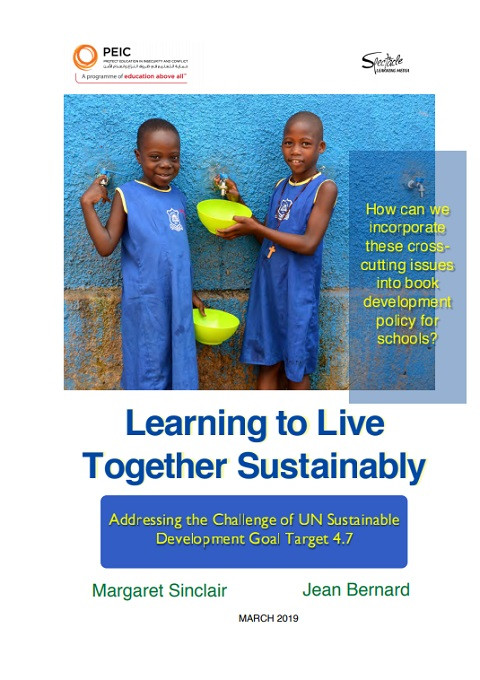 Learning to Live Together Sustainably: Addressing the Challenge of UN Sustainable Development Goal Target 4.7 Year of publication: 2019 Author: Margaret Sinclair | Jean Bernard Corporate author: Protect Education in Conflict and Insecurity (PEIC) | Spectacle Learning Media The practical advice and guidelines in this book help support learning to live together, conflict transformation and peace at the individual, group and community levels. The framework for developing widely accessible, high quality learning materials supports the UN Sustainable Development Goals and is relevant to formal and non-formal education activities and projects. This document also raises important issues about the professional responsibilities of policy-makers at global and national level, who determine what content is addressed in the classroom. In particular, it addresses the need for education materials that support cross-cutting issues such as learning to live together, global citizenship education, and education for sustainable development.
  Homegrown terrorism and transformative learning: an interdisciplinary approach to understanding radicalization Year of publication: 2010 Author: Alex S. Wilner | Claire-Jehanne Dubouloz Since 2001, a preponderance of terrorist activity in Europe, North America and Australia has involved radicalized Westerners inspired by Al Qaeda. Described as ‘homegrown terrorism’, perpetrators are citizens and residents born, raised, and educated within the countries they attack. While most scholars and policy-makers agree that radicalization plays a central role in persuading Westerners to embrace terrorism, little research properly investigates the internal and cognitive processes inherent to radicalization. Transformative learning theory, developed from the sciences in education, health and rehabilitation, provides an unconventional and interdisciplinary way to understand the radicalization process. The theory suggests that sustained behavioural change can occur when critical reflection and the development of novel personal belief systems are provoked by specific triggering factors. Homegrown terrorism and transformative learning: an interdisciplinary approach to understanding radicalization Year of publication: 2010 Author: Alex S. Wilner | Claire-Jehanne Dubouloz Depuis 2001, une grande partie de l'activité terroriste en Europe, en Amérique du Nord et en Australie a impliqué des Occidentaux radicalisés inspirés par Al Qaïda. Décrite comme un « terrorisme venant de l’intérieur », leurs auteurs sont des citoyens et des résidents qui sont nés, ont grandi et ont été éduqués dans les pays qu'ils attaquent. Alors que la plupart des chercheurs et des décideurs conviennent que la radicalisation joue un rôle central pour convaincre les Occidentaux d'embrasser le terrorisme, peu de recherche étudie d’une manière adéquate les processus internes et cognitifs inhérents à la radicalisation. La théorie de la pédagogie transformative, développée à partir des sciences de l'éducation, de la santé et de la réadaptation, fournit une manière peu commune et interdisciplinaire de comprendre le processus de radicalisation. Cette théorie suggère que le changement de comportement de manière durable peut se produire lorsque la réflexion critique et le développement de nouveaux systèmes de croyance personnelle sont provoqués par des facteurs déclencheurs spécifiques.
  Abu Dhabi Memorandum on Good Practices for Education and Countering Violent Extremism Year of publication: 2014 Author: Sara Zeiger Corporate author: Hedayah Foundation The contents of this brief are based on the discussions that occurred from 3 to 4 November 2014 at an expert workshop on Research Trends in Countering Violent Extremism hosted by Hedayah in Abu Dhabi, United Arab Emirates. The purpose of this two-day expert roundtable was to bring together researchers, policymakers and practitioners in a closed discussion of the current trends in CVE research. The goals at the meeting were to address the current research outcomes in countering violent extremism; determine the critical gaps in research on CVE; identify the new and emerging threats of violent extremism; and establish a recommended research agenda for Hedayah and CVE researchers in the coming two years. Abu Dhabi Memorandum on Good Practices for Education and Countering Violent Extremism Year of publication: 2014 Author: Sara Zeiger Corporate author: Hedayah Foundation Le contenu de cette note est basé sur les discussions qui ont eu lieu les 3 et 4 Novembre 2014 dans un atelier d'experts sur les orientations de la recherche dans la lutte contre l'extrémisme violent, organisé par Hedayah à Abu Dhabi aux Emirats Arabes Unis. Cette table ronde d'experts de deux jours avait comme objectif de réunir des chercheurs, des décideurs et des praticiens autour d’une discussion close sur les orientations actuelles de la recherche contre l’extrémisme violent. Ils ont examiné les résultats des recherches actuelles dans la lutte contre l'extrémisme violent (CVE) ; déterminé les lacunes importantes ; identifié les nouvelles menaces et les menaces émergentes de l'extrémisme violent ; et établi un programme recommandé de recherche à l’intention des chercheurs de Hedayah et tous les chercheurs qui travaillent sur la lutte contre l’extrémisme violent, pour les deux années à venir.
 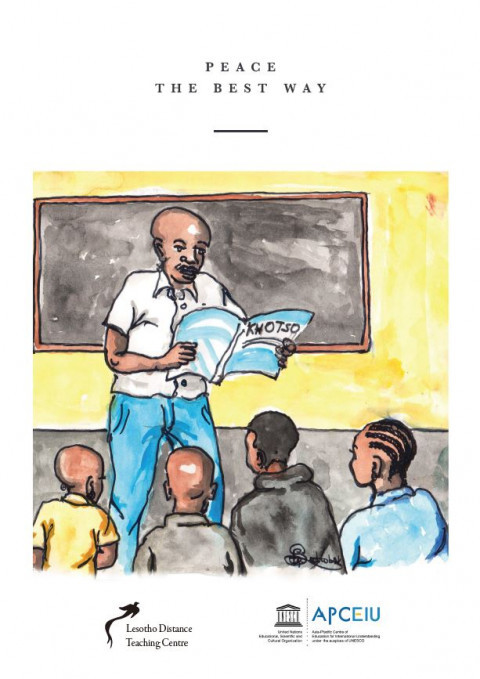 Peace the Best Way Year of publication: 2017 Corporate author: Lesotho Distance Teaching Centre (LDTC) The storybook titled “Peace, the Best Way (Ngoan’a Khotso Ha a Lebale Tsa Khotso)” is an end-product of Workshop in Lesotho on GCED: Teacher Training on Peace Education & GCED Learning Material Development held between 12 and 14 of July 2017. During the workshop, participants created learning materials on peace and conflict transformation based on what they have learned throughout the sessions.The authors share their stories of conflicts that they encounter in their everyday lives and further identify ways of managing and resolving the conflicts in a peaceful manner to let everyone live in harmony. They hope to instill the importance of peace not only to the adults reading the book, but also to the younger generation who learn from their parents and adults of the community.The book published in English as well as Sesotho, will be used as teaching and learning resources for learners and also be disseminated to public locations including schools, community centers and libraries.For more information on the Workshop, Please click here.
 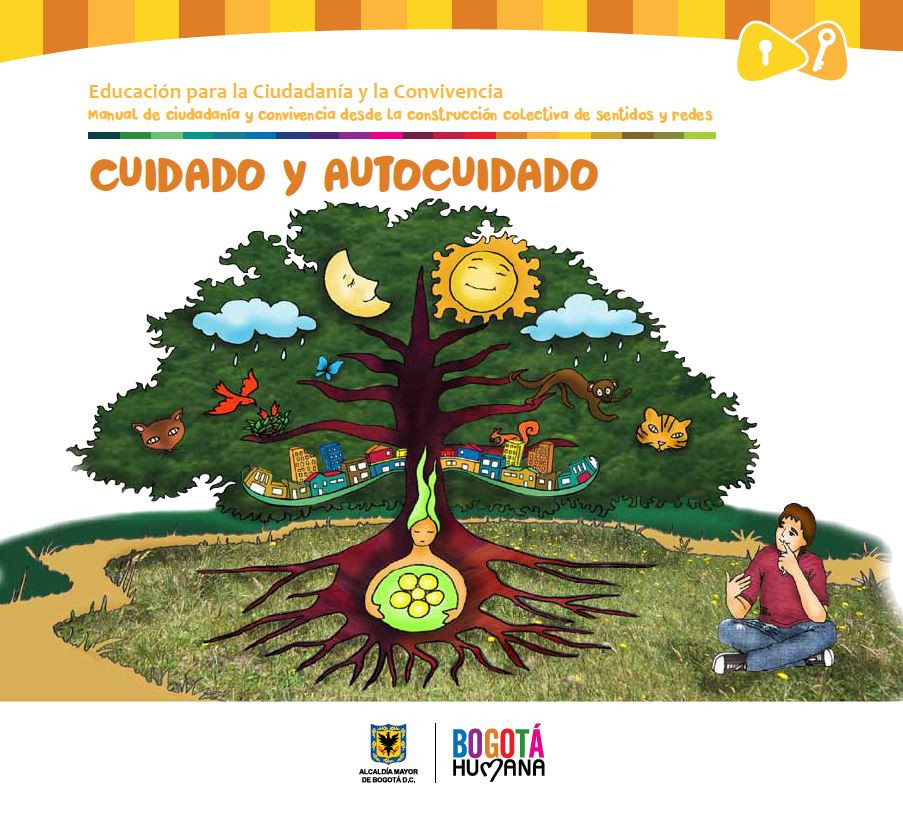 Care and Self-care: Manual of Citizenship and Coexistence from the Collective Construction of Meanings and Networks Year of publication: 2015 Corporate author: Centro de Investigación y Educación Popular (CINEP) This manual, which corresponds to the second phase of the Pedagogical Tool Box for Education for Citizenship and Coexistence, presents three axes of reflection: 1) self-care; 2) care of the others and the others: people near and far; and 3) care of strangers and the other. Each of the axes is accompanied by didactic tools that allow deepening in the contents. Cuidado y autocuidado: Manual de ciudadanía y convivencia desde la construcción colectiva de sentidos y redes Year of publication: 2015 Corporate author: Centro de Investigación y Educación Popular (CINEP) Este manual, que corresponde a la segunda fase de la Caja de Herramientas Pedagógicas de Educación para la Ciudadanía y la Convivencia, presenta tres ejes de reflexión: 1) autocuidado; 2) cuidado de los otros y las otras: personas cercanas y lejanas; y 3) cuidado de las personas extrañas y de lo otro. Cada uno de los ejes se encuentra acompañado de herramientas didácticas que permiten profundizar en los contenidos.