
Resources
Explore a wide range of valuable resources on GCED to deepen your understanding and enhance your research, advocacy, teaching, and learning.
29 Results found
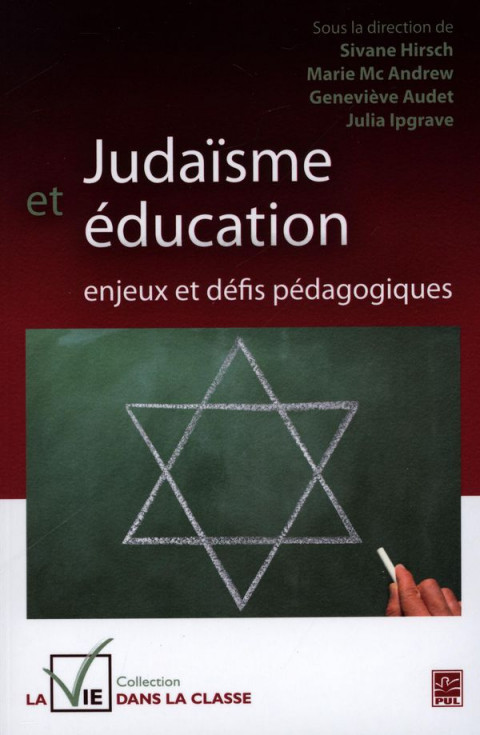 Judaïsme et éducation : enjeux et défis pédagogiques The question of relations between ethnic groups defined by different markers, including religion, is more than ever necessary in our plural societies. This original work focuses on the role of education in the dynamics of relations between the Jewish community and fellow citizens of all origins in Quebec, Canada and in other countries. Indeed, while the Jewish communities are often well established in their host societies, they often remain little known to the population and especially of the majority groups. The authors address three issues that may challenge the stakeholder community and school, but also the general public interested in "living together" and its challenges : Education on Jewish communities in public schools; Education on the Holocaust and innovative practices in this regard; Moving Jewish schools and their impact. (By the publisher - Translation)
  World Development Report 2018 and Its Policy Implications for Education Development in China Year of publication: 2018 Author: Liu Ji 2018 comprehensively describes a crisis that is looming worldwide: Schooling does not equalize learning. Drawing on key insights from the report, this study provides a high—level summary and relates the findings to common and critical issues that China is today. Specifically, this study highlights five important policy implications for education development in China: Education quality monitoring, adaptive policies, evidence-based decision, expanding human capital investments, and building stronger ties with international organizations. 如何应对全球学习危机——世界银行((2018世界发展报告》述评 Year of publication: 2018 Author: Liu Ji 作为世界银行最重要的旗舰报告,《世界发展报告》四十年来首次以教育为题,深入探讨如何应对全球学习危机、提高教育质量、优化人力资本结构、应对人类发展重要难题。从政策理念上看,世行教育策略的革新代表着世行在人力资本政策上较大的方向性改变:由关注教育投入转向教育产出和学习结果。同时,《2018世界发展报告》总结了适用于各教育阶段的大量实证研究和国际成功政策经验,对全球教育政策具有风向标的重要意义、对我国发展新时期的教育与人才策略有积极启示。本文通过对报告结论详细梳理,结合我国国情提出五点政策建议。
  Neither Villains Nor Victims: Towards an Educational Perspective on Radicalisation Year of publication: 2015 Author: Stijn Sieckelincka, Femke Kaulingfreksb, Micha de Wintera This study questions whether the perspectives of security and intelligence serve educators well enough in the early stages of radicalization. Assigned to signal deviant behaviour, educators are unwittingly drawn into a villain-victim imagery of their students. This imagery seems to impede a genuine educational outlook on radicalization. Key notions of this outlook may be ‘critically addressing ideals’ and ‘forming pedagogical coalitions’. Neither Villains Nor Victims: Towards an Educational Perspective on Radicalisation Year of publication: 2015 Author: Stijn Sieckelincka, Femke Kaulingfreksb, Micha de Wintera Cette étude cherche à déterminer si les perspectives de sécurité et de renseignement sont vraiment utilisées à bon escient par les éducateurs dans les premiers stades de la radicalisation. Chargé de signaler les comportements déviants, les éducateurs sont amenés à se représenter leurs étudiants comme des "méchants" ou des victimes. Cette perspective empêche de porter un regard pertinent sur la radicalisation dans le milieu éducatif. Deux éléments-clés pour développer une approche plus adaptée consistent à porter un regard critique sur les idéaux et former des "coalitions" pédagogiques.
  Interrupting Extremism by Creating Educative Turbulence Year of publication: 2014 Author: Lynn Davies Corporate author: Curriculum Inquiry This article begins from the premise that it is important to explore how people unlearn, as well as learn, specifically in terms of extremist or violent attitudes. Three different country examples are given of intergroup encounters that interrupt rigidities in attitudes: working across ethnic groups in Sri Lanka, tackling religious divides in Northern Ireland through shared classes, and initiatives to prevent violent extremism in the United Kingdom. Pedagogical implications of unlearning involve working with the four Ds of deradicalization, debiasing, disengagement and desistence. Interrupting Extremism by Creating Educative Turbulence Year of publication: 2014 Author: Lynn Davies Corporate author: Curriculum Inquiry Cet article développe l'idée qu'il est important d'analyser les processus de désapprentissage, autant que d'apprentissage, qui conduisent un individu à adopter des attitudes extrémistes ou violentes. Des exemples tirés de trois pays sont mobilisés pour montrer comment des rencontres intergroupes conduisent à infléchir des comportements rigides : le travail entre groupes ethniques au Sri Lanka, la lutte contre les divisions religieuses en Irlande du Nord à l'aide de classes mixtes, et des initiatives visant à prévenir l'extrémisme violent au Royaume-Uni. Les implications pédagogiques d'une approche par le "désapprentissage" nécessitent de mobiliser les quatre "D": déradicalisation, désubjectivation, désengagement et désistance.
  Beyond Bali Education Package Year of publication: 2012 Author: Lily Taylor | Saul Karnovsky The Beyond Bali Project funded by Building Community Resilience (BCR) aims to develop and produce an education resource for secondary school students (years 8/9) on the Bali bombings and the Bali Peace Park. The resource is designed to build social resilience to violent extremism by: - providing students with the skills and tools to critically analyze and challenge violent extremism, its causes and consequences - raising awareness and education on the social impacts of violent extremism - encouraging students to think about how societies can resist the influence of violent extremism - engaging students through activities and discussion about the Bali Peace Park as social resistance to terrorism. Beyond Bali Education Package Year of publication: 2012 Author: Lily Taylor | Saul Karnovsky Le projet Beyond Bali financé par Building Community Resilience (BCR) a pour objectif l’élaboration d’une ressource pédagogique pour les collégiens (de 5ème et 4ème) qui porte sur les attentats survenus à Bali et le Bali Peace Park. Cette ressource est conçue afin de renforcer la résilience sociale à l’extrémisme violent. Pour ce faire, elle :- Fournit aux étudiants les compétences et les outils nécessaires pour analyser de façon critique et remettre en question l’extrémisme violent, ses causes et ses conséquences,- Sensibilise aux impacts sociaux de l’extrémisme violent- Encourage les étudiants à réfléchir sur les façons dont les sociétés peuvent résister à l’influence de l’extrémisme violent- Propose aux étudiants de participer à des activités et à engager des discussions autour du Bali Peace Park.
  Education as a Security Issue Author: Ian Jamison Corporate author: Tony Blair Faith Foundation The use of education as both tool and target of religious extremists globally is perhaps one of the most important generational challenges we face today. To ensure that the next generation is open to a more pluralistic world, we must ensure that their education equips them to safely encounter the 'Other'. This not only means improving knowledge, understanding and interaction, but also critically requires investment in developing essential soft skills that can ensure these are properly employed.