
Resources
Explore a wide range of valuable resources on GCED to deepen your understanding and enhance your research, advocacy, teaching, and learning.
26 Results found
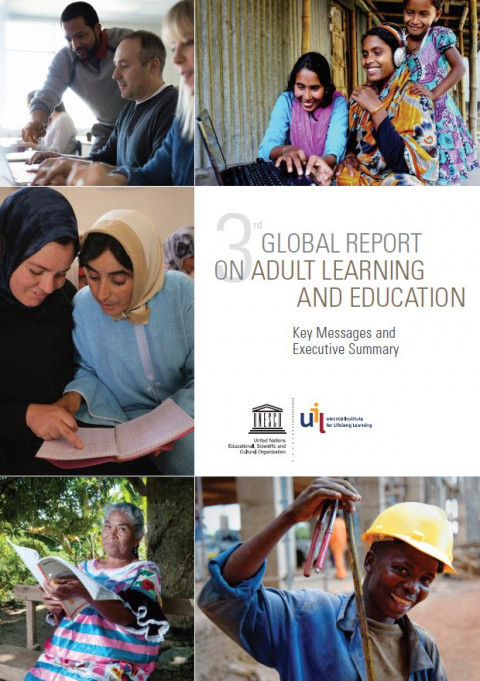 [Summary] 3rd Global Report on Adult Learning and Education: The Impact of Adult Learning and Education on Health and Well-being, Employment and the Labour Market, and Social, Civic and Community Life; Key Messages and Executive Summary Year of publication: 2016 Corporate author: UNESCO Institute for Lifelong Learning (UIL) The third Global Report on Adult Learning and Education (GRALE III) draws on monitoring surveys completed by 139 UNESCO Member States to develop a differentiated picture of the global state of adult learning and education (ALE). It evaluates countries’ progress in fulfilling the commitments they made in the Belém Framework for Action, which was adopted at the Sixth International Conference on Adult Education (CONFINTEA VI) in 2009.In addition, the report examines the impact of ALE on three major areas: health and well-being; employment and the labour market; and social, civic and community life. GRALE III provides policymakers, researchers and practitioners with compelling evidence for the wider benefits of ALE across all of these areas. In so doing, it highlights some of the major contributions that ALE can make to realizing the 2030 Agenda for Sustainable Development. This report is guided by three goals: first, to analyse the results of a monitoring survey of UNESCO Member States, and to take stock of whether countries are fulfilling the commitments they made at CONFINTEA VI; second, to strengthen the case for adult learning and education with evidence of its benefits on health and well-being,employment and the labour market, and social, civic and community life; and third, to provide a platform for debate and action at national, regional and global levels.
  ПЕРЕОСМЫСЛИМ НАШЕ БУДУЩЕЕ Year of publication: 2021 Corporate author: International Commission on the Futures of Education | UNESCO Наше человечество, наша планета находятся в опасности, пандемия лишь подтвердила нашу хрупкость и взаимозависимость, чтобы изменить ход вещей и переосмыслить наше будущее, необходимы неотложные совместные действия; в этом докладе Международной комиссии по перспективам образования подтверждается способность образования к осуществлению коренных изменений. Перед нами стоит двойная задача – выполнить невыполненное обещание обеспечить право на качественное образование для каждого ребёнка, молодого человека и взрослого и полностью реализовать преобразующий потенциал образования, способного проложить путь к устойчивому коллективному будущему. Для этого нам нужен новый общественный договор в области образования, который сможет устранять проявления несправедливости, преобразуя будущее.Этот новый общественный договор должен основываться на принципах прав человека, недопущения дискриминации, социальной справедливости, уважения жизни, человеческого достоинства и культурного разнообразия. Он должен включать в себя этику заботы о людях, взаимности и солидарности. Он должен укреплять позиции образования как общественного дела и общего блага.Этот доклад, который готовился два года на основе глобального процесса консультаций с участием миллиона человек, предлагает правительствам, учреждениям, организациям и гражданам всего мира разработать новый общественный договор в области образования, который поможет нам построить мирное, справедливое и устойчивое будущее, отвечающее всеобщим интересам.Представленные здесь концепции, принципы и предложения являются лишь отправной точкой. Их воплощение в практику в конкретных условиях – это коллективная работа. Уже есть много положительных моментов, и в настоящем докладе предпринята попытка их отразить и развить. Это не инструкция и не план, а начало жизненно важного разговора.
 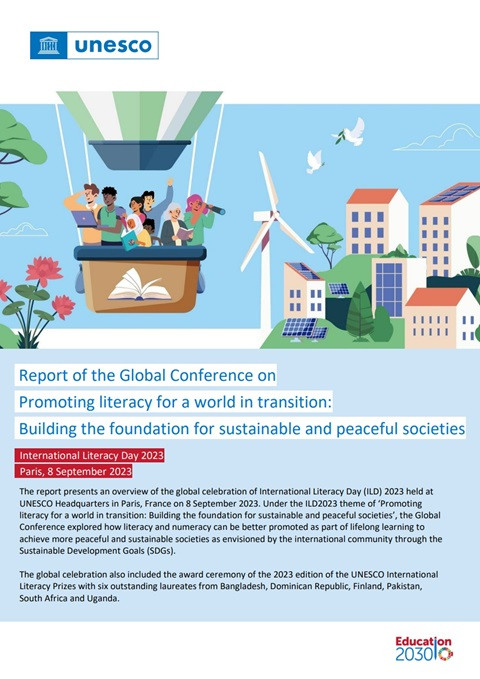 Report of the Global Conference on Promoting Literacy for a World in Transition: Building the Foundation for Sustainable and Peaceful Societies Year of publication: 2024 Corporate author: UNESCO The report presents an overview of the global celebration of International Literacy Day (ILD) 2023 held at UNESCO Headquarters in Paris, France on 8 September 2023. Under the ILD 2023 theme of ‘Promoting literacy for a world in transition: Building the foundation for sustainable and peaceful societies’, the Global Conference explored how literacy and numeracy can be better promoted as part of lifelong learning to achieve more peaceful and sustainable societies as envisioned by the international community through the Sustainable Development Goals (SDGs). The global celebration also included the award ceremony of the 2023 edition of the UNESCO International Literacy Prizes with six outstanding laureates from Bangladesh, Dominican Republic, Finland, Pakistan, South Africa and Uganda.
  UNESCO Futures of Education Report Explained by Members of the International Commission Year of publication: 2022 Corporate author: UNESCO Initiated by UNESCO, the International Commission on the Futures of Education has prepared a new report on how education can best shape the future of humanity and the planet. In this video, members of the Commission and its chair explain the main recommendations and defining features of their report, Reimagining our futures together: A new social contract for education. The report is part of UNESCO’s Futures of Education initiative which aims to rethink education and shape the future. The initiative is catalyzing a global debate on how knowledge, education and learning need to be reimagined in a world of increasing complexity, uncertainty, and precarity.
 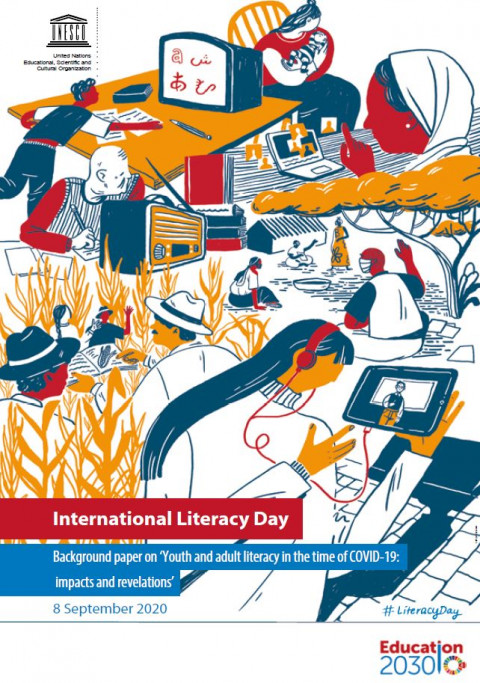 International Literacy Day: Background Paper on 'Youth and Adult Literacy in the Time of COVID-19; Impacts and Revelations' Year of publication: 2020 Corporate author: UNESCO Specially prepared on the occasion of International Literacy Day 2020, this background paper illustrates the impact of the COVID-19 crisis on youth and adult literacy, based on the limited information that is currently available. It provides five regional snapshots and identifies preliminary lessons learned thus far, while aiming to inspire continued reflection and subsequent action. It also makes the case for the ongoing importance of advancing youth and adult literacy, a priority that was already neglected even before the pandemic but which deserves all our attention. ILD 2020 thus seeks to trigger reimaginations of literacy teaching and learning in the COVID-19 crisis and beyond, with a particular focus on the role of educators.
  Reimagining Our Futures Together: A New Social Contract for Education Year of publication: 2021 Corporate author: International Commission on the Futures of Education | UNESCO Our humanity and planet Earth are under threat. The pandemic has only served to prove our fragility and our interconnectedness. Now urgent action, taken together, is needed to change course and reimagine our futures. This report by the International Commission on the Futures of Education acknowledges the power of education to bring about profound change. We face a dual challenge of making good on the unfulfilled promise to ensure the right to quality education for every child, youth and adult and fully realizing the transformational potential of education as a route for sustainable collective futures. To do this, we need a new social contract for education that can repair injustices while transforming the future.This new social contract must be grounded in human rights and based on principles of non-discrimination, social justice, respect for life, human dignity and cultural diversity. It must encompass an ethic of care, reciprocity, and solidarity. It must strengthen education as a public endeavour and a common good.This report, two years in the making and informed by a global consultation process engaging around one million people, invites governments, institutions, organizations and citizens around the world to forge a new social contract for education that will help us build peaceful, just, and sustainable futures for all.The visions, principles, and proposals presented here are merely a starting point. Translating and contextualizing them is a collective effort. Many bright spots already exist. This report attempts to capture and build on them. It is neither a manual nor a blueprint but the opening up of a vital conversation.