
Resources
Explore a wide range of valuable resources on GCED to deepen your understanding and enhance your research, advocacy, teaching, and learning.
53 Results found
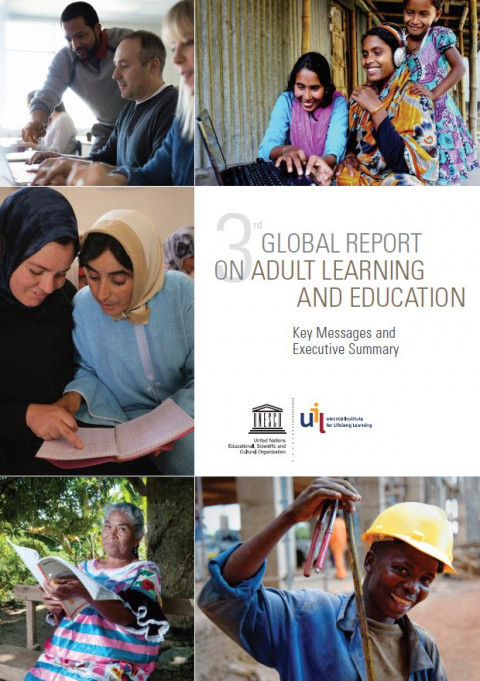 [Résumé] 3e rapport mondial sur l'apprentissage et l'éducation des adultes: l'impact de l'apprentissage et l'éducation des adultes sur la santé et le bien-être, l'emploi et le marché du travail, et la vie sociale, civique et communautaire, points à retenir et résumé exécutif Year of publication: 2016 Corporate author: UNESCO Institute for Lifelong Learning (UIL) Le troisième Rapport mondial sur l’apprentissage et l’éducation des adultes (GRALE III) s’appuie sur les réponses de 139 Etats membres de l’UNESCO à l’enquête de suivi GRALE III et brosse un tableau nuancé de la situation de l’apprentissage et de l’éducation des adultes dans le monde. Le rapport évalue les progrès accomplis par les pays dans la mise en oeuvre des engagements qu’ils ont pris dans le Cadre d’action de Belém, document adopté lors de la sixième Conférence internationale sur l’éducation des adultes (CONFINTEA VI) en 2009.En outre, le rapport examine l’impact de l’apprentissage et de l’éducation des adultes sur trois domaines majeurs : la santé et le bien-être ; l’emploi et le marché du travail ; et la vie sociale, civique et communautaire. GRALE III fournit aux décideurs politiques, chercheurs et praticiens des preuves irréfutables des bénéfices élargis de l’apprentissage et l’éducation des adultes dans tous ces domaines et éclaire, de ce fait, les contributions essentielles qu’ils peuvent apporter à la réalisation du Programme de développement durable à l’horizon 2030.Ce rapport répond à trois objectifs : premièrement, analyser les résultats d’un suivi des États membres de l’UNESCO et établir si les pays remplissent les engagements pris à CONFINTEA VI ; deuxièmement, promouvoir l’apprentissage et l’éducation des adultes par des preuves de leurs effets positifs sur la santé et le bien-être, l’emploi et le marché du travail, ainsi que la vie sociale, civique et communautaire ; et troisièmement fournir une plate-forme de débat et d’action aux niveaux national, régional et international.
  وضع تصورات جديدة لمستقبلنا معاً: عقد اجتماعي جديد للتربية والتعليم Year of publication: 2022 Corporate author: International Commission on the Futures of Education | UNESCO تُستشف من أحوال العالم في الوضع الراهن أن البشرية وكوكب الأرض معرضان للخطر. وقد قدمت الجائحة التي حلت بنا في الفترة الأخيرة دليلاً دامغاً على أن العالم الذي نعيش فيه يتسم بالهشاشة وتترابط أجزاؤه ترابطاً وثيقاً. ولا بد لنا الآن من اتخاذ إجراءات عاجلة معاً لتغيير المسار ووضع تصورات جديدة لمستقبلنا. وينطوي هذا التقرير الصادر عن اللجنة الدولية المعنية بمستقبل التربية والتعليم على إقرار بقدرة التربية والتعليم على إحداث تغيير عميق في الأوضاع الراهنة. وثمة تحديان ماثلان أمامنا الآن، أولهما هو الوفاء بالوعد المتمثل في ضمان الحق في التعليم الجيد لجميع الأطفال والشباب والكبار، وهو وعد لم يتحقق بعد، وثانيهما هو تحقيق كامل الإمكانات الكفيلة بإحداث التغيير الجذري المنشود، التي ينطوي عليها التعليم بوصفه سبيلاً إلى بناء مستقبل جماعي مستدام. ولا سبيل إلى بلوغ هذه الغاية إلا بإبرام عقد اجتماعي جديد للتربية والتعليم يتيح إصلاح المظالم والاضطلاع في الوقت نفسه بتغيير المستقبل على النحو المنشود. ويجب أن يقوم هذا العقد الاجتماعي الجديد على حقوق الإنسان وأن يستند إلى مبادئ عدم التمييز، والعدالة الاجتماعية، واحترام الحياة، والكرامة الإنسانية، والتنوع الثقافي. ويجب أن يشتمل على أخلاقيات الرعاية والتبادل والتضامن. ويجب أن يعزز التعليم باعتباره عملاً ومنفعة مشتركة. وينطوي هذا التقرير، الذي استغرق إعداده عامين واسترشد معدوه بعملية تشاور عالمية شارك فيها نحو مليون شخص، على دعوة موجهة إلى الحكومات والمؤسسات والمنظمات والمواطنين في جميع أنحاء العالم لصياغة عقد اجتماعي جديد للتربية والتعليم يساعدنا في بناء مستقبل مستدام ينعم فيه الجميع بالسلام والعدل. وليست الرؤى والمبادئ والمقترحات المعروضة ههنا سوى منطلق لمزيد من العمل، إذ ينبغي بذل جهد جماعي لتجسيد هذه الرؤى والمبادئ والمقترحات بما يتماشى مع الظروف والبيئات التي تندرج فيها. وقد تحقق بالفعل العديد من المنجزات البارزة في هذا الشأن. ويسعى في هذا التقرير إلى استعراضها والارتكاز عليها لبناء صرح جديد. وليس هذا التقرير دليلاً إرشادياً ولا خطة لإيجاد حلول، بل هو فتح لباب التحاور في شأن يتسم بأهمية حيوية.
  Repenser nos futurs ensemble: un nouveau contrat social pour l'éducation Year of publication: 2021 Corporate author: International Commission on the Futures of Education | UNESCO L’avenir de l’humanité sur la planète est, nous le savons aujourd’hui, compromis. La pandémie a eu au moins le mérite de démontrer combien nos existences sont fragiles et combien nos destins sont inextricablement liés. Il est nécessaire et urgent désormais, d’agir collectivement pour changer de cap et réinventer notre avenir. Dans ce tournant, l’éducation jouera un rôle crucial pour sa capacité, universellement reconnue, à provoquer le changement. Mais pour jouer son rôle, elle devra surmonter un double défi : honorer, d’une part, sa plus vieille promesse, c’est-à-dire d’être effective et d’assurer le droit à une éducation de qualité pour chaque enfant, chaque jeune, chaque adulte partout à travers le monde ; et, d’autre part, assumer entièrement son potentiel transformateur, afin d’ouvrir la voie vers un avenir collectif durable. Pour y parvenir, il convient de s’engager dans un nouveau contrat social pour l’éducation, qui permette de corriger les injustices tout en transformant l’avenir. Ce nouveau contrat social doit être enraciné dans les droits humains et être fondé sur les principes de non-discrimination, de justice sociale, de respect de la vie, de la dignité humaine et de la diversité culturelle ; il doit aussi s’appuyer sur une éthique de la sollicitude, de la réciprocité et de la solidarité ; il doit enfin renforcer l’éducation comme projet public et un bien commun de l’humanité. Le présent rapport, préparé durant deux ans et qui a pu s’appuyer sur une consultation mondiale de près d’un million de personnes, invite les gouvernements, les partenaires et les citoyens du monde entier à élaborer un nouveau contrat social en faveur de l’éducation, pour construire un avenir pacifique, juste et durable pour toutes et tous. Les conceptions, les principes et les propositions avancés ici ne constituent qu’un point de départ. Seul un effort collectif pourra les traduire en actes et les adapter aux situations locales. Il existe en effet de vraies lueurs d’espoir. Ce rapport essaie de les ressaisir afin que l’avenir se construise sur ces fondations. Qu’on n’y voit donc pas un manuel ou un plan directeur : c’est le début d’une conversation vitale.
  Europe and North America Regional Workshop on the Global Action Programme on Education for Sustainable Development and Cities Year of publication: 2017 Corporate author: UNESCO UNESCO promotes Education for Sustainable Development (ESD) through the Global Action Programme (GAP), the official follow-up to the UN Decade of ESD. The Europe and North America region was the first to officially adopt a regional strategy for the United Nations Decade of Education for Sustainable Development (DESD, 2005-2014), which seeks to promote a better quality of life for populations and human settlements. Learning to live in a sustainable way and securing people’s involvement and participation in community and urban life are key factors in ensuring sustainable economic, social and environmental development. It is in this context that UNESCO, the UNESCO Global Network of Learning Cities, with its secretariat in the UNESCO Institute for Lifelong Learning (UIL) in Hamburg, and the Free and Hanseatic City of Hamburg, organized the regional workshop for Europe and North America on the role of cities in accelerating sustainable solutions at local level through education. More than 50 experts and city representatives from Europe and North America participated in the regional workshop in Hamburg, Germany, from 12 to 14 December 2016. The workshop examined how education and learning beyond the formal system can be used to support the implementation of the five Ps (Planet, People, Peace, Prosperity and Partnership) of the 2030 Agenda to achieve the Sustainable Development Goals (SDGs). Experts shared their views on ESD, with cities providing insight into their good practices and enriching discussions on the challenges of promoting the various SDGs through education and lifelong learning at city level. These discussions helped to promote awareness on integrating ESD in their cities’ development and education agendas. Programme d'action global pour l'Education en vue du développement durable et les villes: atelier régional pour l'Europe et l'Amérique du Nord Year of publication: 2017 Corporate author: UNESCO L’UNESCO oeuvre pour l’éducation au développement durable (EDD) dans le cadre du Programme d’action global, suivi officiel de la Décennie des Nations Unies pour l'éducation au service du développement durable (DEDD, 2005-2014). La région Europe et Amérique du Nord a été la première à adopter formellement une stratégie régionale pour la Décennie visant à promouvoir une meilleure qualité de vie pour les populations et les établissements humains. L’apprentissage d’un mode de vie durable et la participation des individus à la vie de la communauté et de la ville sont des conditions essentielles d’un développement économique, social et environnemental durable. C’est dans ce contexte que l’UNESCO, son Réseau mondial des villes apprenantes, dont le secrétariat est hébergé par l’Institut de l'UNESCO pour l'apprentissage tout au long de la vie (UIL) à Hambourg, et les autorités de la Ville libre et hanséatique de Hambourg ont organisé l’atelier régional pour l’Europe et l’Amérique du Nord sur le rôle des villes dans la mise en place accélérée de solutions locales durables, par l’éducation. Plus de 50 experts et représentants de villes d’Europe et d’Amérique du Nord ont participé à l’atelier régional, qui s’est tenu à Hambourg (Allemagne) du 12 au 14 décembre 2016. Ils ont réfléchi à la manière de s’appuyer sur l’éducation et l’apprentissage, au-delà du cadre formel, pour faciliter la mise en oeuvre des « cinq P » – planète, population (humanité), paix, prospérité et partenariats – du Programme 2030 et réaliser les Objectifs de développement durable (ODD). Les experts ont partagé leurs vues sur l’EDD, et les municipalités ont présenté leurs bonnes pratiques et enrichi les discussions sur les défis que représentait la promotion des différents ODD par l’éducation et l’apprentissage tout au long de la vie, au niveau des villes. Ces discussions ont aidé les villes à mieux comprendre comment intégrer l’EDD dans leurs programmes de développement et d’éducation.
 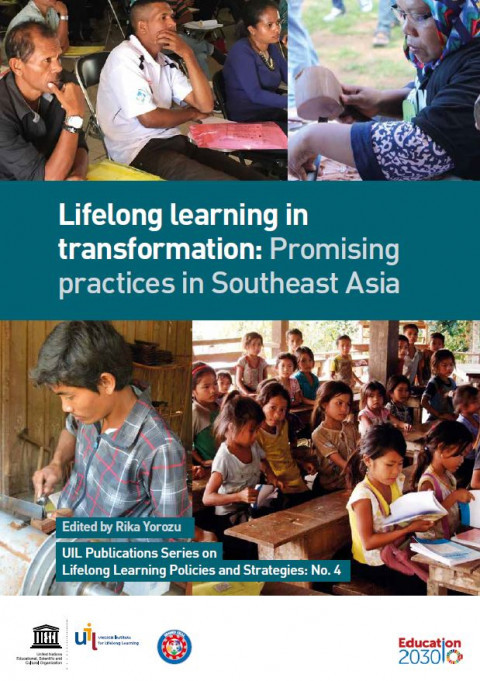 Lifelong Learning in Transformation: Promising Practices in Southeast Asia Year of publication: 2017 Author: Rika Yorozu Corporate author: UNESCO Institute for Lifelong Learning (UIL) This report is an outcome of a project on building a lifelong learning agenda in Southeast Asian countries, which aims to address the region’s remaining educational challenges in ensuring ‘inclusive and equitable quality education and promot[ing] lifelong learning opportunities for all’ (Goal 4 of the 2030 Agenda for Sustainable Development). By sharing promising policies and practices in implementing integrated lifelong learning from different perspectives, countries can learn from one another and move their visions for lifelong learning fully into practice. The publication documents a variety of promising practices from 11 countries, focusing particularly on the features critical to the promotion of lifelong learning for all; namely, inclusive and gender-responsive teaching and learning practices, recognition of learning outcomes from non-formal and informal learning, collaboration between social and economic development sectors and coherent national government policies and strategies. The report comprises three main sections: a reflection on lifelong learning in international and national documents, a collection of good practice drawn from their national reports, and a set of recommendations for policies and programmes promoting lifelong learning. It is hoped that these recommendations will stimulate discussion and new developments, in both policy and practice, in the region.
  Annual Report 2018 : UNESCO INSTITUTE FOR LIFELONG LEARNING Year of publication: 2019 Corporate author: UNESCO Institute for Lifelong Learning (UIL) UIL’s 2018 Annual Report shows how, last year, our work contributed to fulfilling our mission to support better policy-making and strengthen the capacities of UNESCO Member States in the field of lifelong learning. UIL’s vision is for all children, youth and adults to benefit from quality lifelong learning, within the framework of sustainable development and peace, and we pursue it in the context of the United Nations 2030 Agenda for Sustainable Development, particularly Sustainable Development Goal (SDG) 4 on quality education and lifelong learning. Its publications are a valuable resource for education researchers, planners, policy-makers and practitioners.
  Envision 4.7: Bridge 47 Global Event; Helsinki, Finland 5–7 November 2019: Report Year of publication: 2019 Corporate author: Bridge 47 | Frinland. Ministry of Education and Culture | Finland. Ministry for Foreign Affairs Global event Envision 4.7 was held in Helsinki in November 2019. The event brought around 200 people together to discuss ways to take the SDG Target 4.7 forward. In this report you can find summaries of all the speeches, panel discussions, workshops and working groups that were held at the event, together with a summary of discussions around all the different topics. You can also find pictures and drawings from the event at the report.
 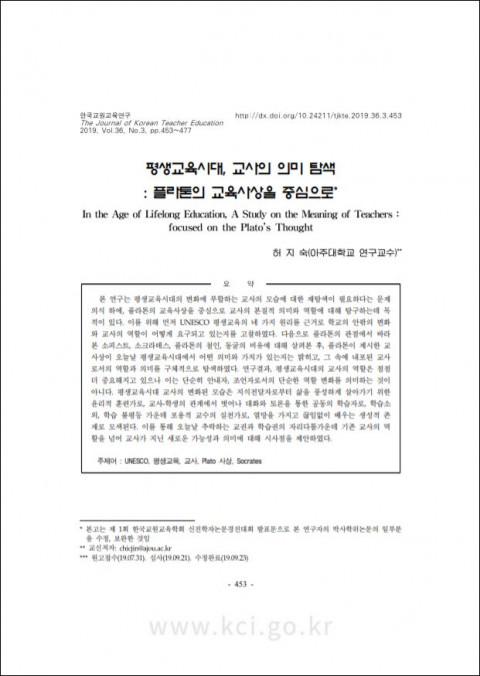 평생교육시대, 교사의 의미 탐색: 플라톤의 교육사상을 중심으로 (한국교원교육연구 제36권 제3호) Year of publication: 2019 Author: JiSuk Huh Corporate author: Korean Society for the Study of Teacher Education 본 연구는 평생교육시대의 변화에 부합하는 교사의 모습에 대한 재탐색이 필요하다는 문제의식 하에, 플라톤의 교육사상을 중심으로 교사의 본질적 의미와 역할에 대해 탐구하는데 목적이 있다. 이를 위해 먼저 UNESCO 평생교육의 네 가지 원리를 근거로 학교의 안팎의 변화와 교사의 역할이 어떻게 요구되고 있는지를 고찰하였다. 다음으로 플라톤의 관점에서 바라본 소피스트, 소크라테스, 플라톤의 철인, 동굴의 비유에 대해 살펴본 후, 플라톤이 제시한 교사상이 오늘날 평생교육시대에서 어떤 의미와 가치가 있는지 밝히고, 그 속에 내포된 교사로서의 역할과 의미를 구체적으로 탐색하였다.연구결과, 평생교육시대의 교사의 역할은 점점 더 중요해지고 있으나 이는 단순히 안내자, 조언자로서의 단순한 역할 변화를 의미하는 것이 아니다. 평생교육시대 교사의 변화된 모습은 지식전달자로부터 삶을 풍성하게 살아가기 위한 윤리적 훈련가로, 교사-학생의 관계에서 벗어나 대화와 토론을 통한 공동의 학습자로, 학습소외, 학습 불평등 가운데 포용적 교수의 실천가로, 열망을 가지고 끊임없이 배우는 생성적 존재로 모색된다. 이를 통해 오늘날 추락하는 교권과 학습권의 자리다툼 가운데 기존 교사의 역할을 넘어 교사가 지닌 새로운 가능성과 의미에 대해 시사점을 제안하였다. In the Age of Lifelong Education, a Study on the Meaning of Teachers: Focused on the Plato’s Thought (The Journal of Korean Teacher Education; Vol. 36, No. 3) Year of publication: 2019 Author: 허지숙 Corporate author: 한국교원교육학회 The purpose of this study is to explore the essential meaning and role of teachers through Plato's educational thought. For this purpose, based on the four principles of UNESCO Lifelong Education, we examine how changes in and out of school and the role of teachers are required. Then, after reviewing Sophist, Socrates, Plato's Philosopher, and the metaphors of Cave from Plato's point of view, it reveals what meaning and value of the teacher image presented by Plato in today's lifelong education.Research shows that the role of teachers in the age of lifelong education is becoming more and more important, but this does not mean simply changing roles as guides and advisors. the changed face of the teacher is an ethical trainer to enrich their lives from a knowledge transferer, a collaborative learner through conversations and discussions outside the teacher-student relationship, a practitioner of inclusive teaching among learning alienation, learning inequality, a teacher as a lifelong learner who loves wisdom. This suggests implications for teachers 'new possibilities and meanings beyond the existing teacher' s role in the fall of the ruling right and the right of learning.