
Resources
Explore a wide range of valuable resources on GCED to deepen your understanding and enhance your research, advocacy, teaching, and learning.
24 Results found
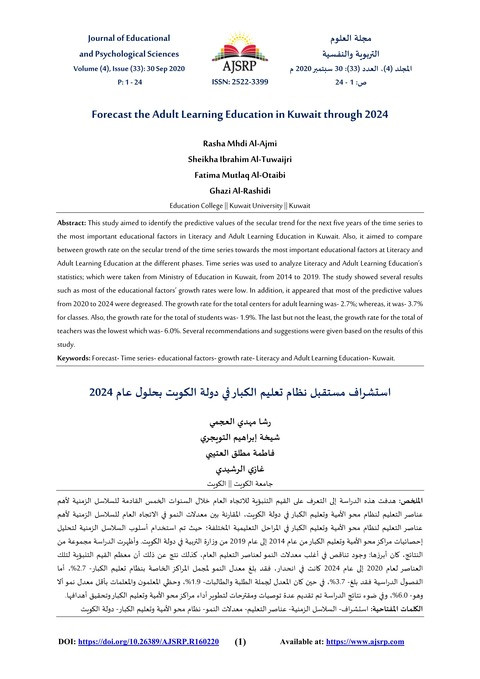 Forecast the Adult Learning Education in Kuwait Through 2024 (Journal of Educational and Psychological Sciences; vol.4, no.33) Year of publication: 2020 Author: Rasha Mhdi Al-Ajmi | Sheikha Ibrahim Al-Tuwaijri | Fatima Mutlaq Al-Otaibi | Ghazi Al-Rashidi Corporate author: Arab Institute of Science and Research Publishing (AISRP) This study aimed to identify the predictive values of the secular trend for the next five years of the time series to the most important educational factors in Literacy and Adult Learning Education in Kuwait. Also, it aimed to compare between growth rate on the secular trend of the time series towards the most important educational factors at Literacy and Adult Learning Education at the different phases. Time series was used to analyze Literacy and Adult Learning Education’s statistics; which were taken from Ministry of Education in Kuwait, from 2014 to 2019. The study showed several results such as most of the educational factors’ growth rates were low. In addition, it appeared that most of the predictive values from 2020 to 2024 were degreased. The growth rate for the total centers for adult learning was- 2.7%; whereas, it was- 3.7% for classes. Also, the growth rate for the total of students was- 1.9%. The last but not the least, the growth rate for the total of teachers was the lowest which was- 6.0%. Several recommendations and suggestions were given based on the results of this study. استشراف مستقبل نظام تعليم الكبار في دولة الكويت بحلول عام 2024 (مجلة العلوم التربوية و النفسية ;no.33, vol.4) Year of publication: 2020 Author: Rasha Mhdi Al-Ajmi | Sheikha Ibrahim Al-Tuwaijri | Fatima Mutlaq Al-Otaibi | Ghazi Al-Rashidi Corporate author: Arab Institute of Science and Research Publishing (AISRP) هدفت هذه الدراسة إلى التعرف على القيم التنبؤية للاتجاه العام خلال السنوات الخمس القادمة للسلاسل الزمنية لأهم عناصر التعليم لنظام محو الأمية وتعليم الكبار في دولة الكويت، المقارنة بين معدلات النمو في الاتجاه العام للسلاسل الزمنية لأهم عناصر التعليم لنظام محو الأمية وتعليم الكبار في المراحل التعليمية المختلفة؛ حيث تم استخدام أسلوب السلاسل الزمنية لتحليل إحصائيات مراكز محو الأمية وتعليم الكبار من عام 2014 إلى عام 2019 من وزارة التربية في دولة الكويت. وأظهرت الدراسة مجموعة من النتائج، كان أبرزها: وجود تناقص في أغلب معدلات النمو لعناصر التعليم العام، كذلك نتج عن ذلك أن معظم القيم التنبؤية لتلك العناصر لعام 2020 إلى عام 2024 كانت في انحدار، فقد بلغ معدل النمو لمجمل المراكز الخاصة بنظام تعليم الكبار- 2.7%، أما الفصول الدراسية فقد بلغ- 3.7%، في حين كان المعدل لجملة الطلبة والطالبات- 1.9%، وحظي المعلمون والمعلمات بأقل معدل نمو ألا وهو- 6.0%، وفي ضوء نتائج الدراسة تم تقديم عدة توصيات ومقترحات لتطوير أداء مراكز محو الأمية وتعليم الكبار وتحقيق أهدافها.
 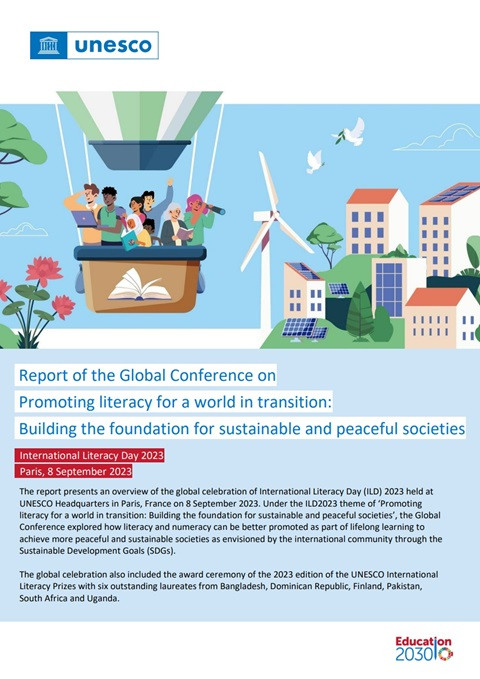 Report of the Global Conference on Promoting Literacy for a World in Transition: Building the Foundation for Sustainable and Peaceful Societies Year of publication: 2024 Corporate author: UNESCO The report presents an overview of the global celebration of International Literacy Day (ILD) 2023 held at UNESCO Headquarters in Paris, France on 8 September 2023. Under the ILD 2023 theme of ‘Promoting literacy for a world in transition: Building the foundation for sustainable and peaceful societies’, the Global Conference explored how literacy and numeracy can be better promoted as part of lifelong learning to achieve more peaceful and sustainable societies as envisioned by the international community through the Sustainable Development Goals (SDGs). The global celebration also included the award ceremony of the 2023 edition of the UNESCO International Literacy Prizes with six outstanding laureates from Bangladesh, Dominican Republic, Finland, Pakistan, South Africa and Uganda.
 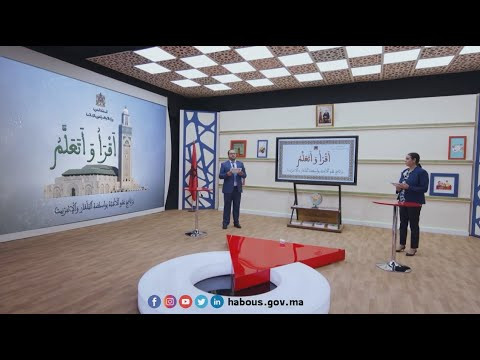 محو الأمية بواسطة التلفازوالانترنت Year of publication: 2020 Corporate author: Morocco. Ministry of Awqaf and Islamic Affairs يتضمن الفيديو تعريف ببرنامج محو الأمية بواسطة التلفاز والأنترنيت ودوره في تعلم المواطنات والمواطنين في دولة المغرب. وقد انطلق برنامج محو الأمية بالمساجد منذ سنة 2000. ويتضمن مستويين المستوى الأول والمستوى الثاني ويستفيد منه كل سنة حوالي 300000 مواطن ومواطنة في دولة المغرب. Literacy through Television and the Internet Year of publication: 2020 Corporate author: Morocco. Ministry of Awqaf and Islamic Affairs The video includes a definition of the literacy program through television and the Internet and its role in the education of citizens in the State of Morocco. The literacy program in mosques was launched in the year 2000. It includes two levels, the first and the second, and every year about 300,000 citizens in the State of Morocco benefit from it.
  Reading the past, writing the future Year of publication: 2016
 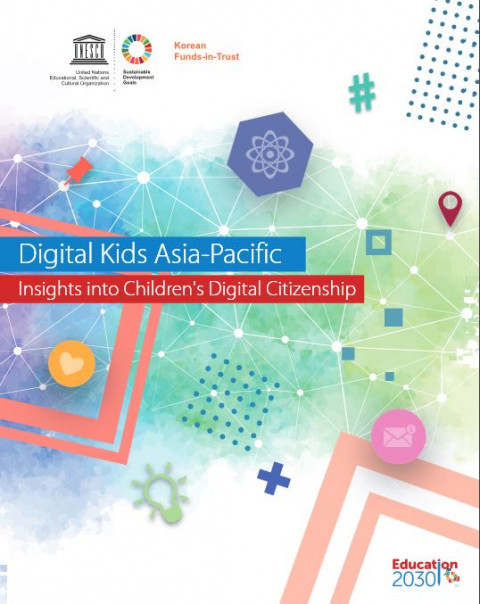 Digital kids Asia-Pacific: insights into children’s digital citizenship Year of publication: 2019 Author: Taeseob Shin | Hyeyoung Hwang | Jonghwi Park | Jian Xi Teng | Toan Dang Corporate author: UNESCO Bangkok This report responds to the growing needs of Member States in the Asia-Pacific region to understand children’s knowledge, behaviour and attitudes in a hyper-connected digital world. It aims to create a data-driven, conducive educational and policy environment that maximizes opportunities that Information and Communications Technology (ICT) offers, while minimizing potential threats that the same may pose. The report was also developed in the context of the Education 2030 Agenda identifying digital skills as one of the key competencies for youth and adults to achieve and monitor until 2030.
  Alternative bilingual Miskito-Spanish intercultural literacy education linked to the exercise of citizenship and community production Year of publication: 2008 Corporate author: Regional Literacy and CONFINTEA VI Preparatory Conference in Latin America and the Caribbean: From Literacy to Lifelong Learning: Towards the Challenges of the 21st Century, Mexico City, 2008 The Alternative Bilingual Intercultural Literacy Education project is carried out in five rural indigenous communities and eleven urban neighbourhoods of Bilwi (Puerto Cabezas) in the North Atlantic Autonomous Region (RAAN) of Nicaragua. In this region, illiteracy is the result of poverty, historical social exclusion and the lack of any official or State programme of adult literacy education in the Miskito language. This constitutes a negation of the right to bilingual intercultural education of the young and adult indigenous population and an obstacle to individual, social and regional development. The project provides literacy classes for young people and adults in their mother tongue Miskito and in Spanish, and deals with intercultural themes of their world view, the environment and indigenous rights. In Nicaragua, this experiment is a unique and alternative model of literacy provision in Miskito, with a Miskito-Spanish bilingual intercultural curriculum of its own. The texts have been produced by authors from the Miskito ethnic group, with contents determined on the basis of a needs analysis and the identification of fundamental features of the Miskito world view. Éducation Interculturelle bilingue Miskito-Espagnol liée à l'exercice de la citoyenneté et de la communauté production Year of publication: 2008 Corporate author: Regional Literacy and CONFINTEA VI Preparatory Conference in Latin America and the Caribbean: From Literacy to Lifelong Learning: Towards the Challenges of the 21st Century, Mexico City, 2008 Le projet de l'éducation interculturelle bilingue est réalisée dans cinq communautés autochtones rurales et onze quartiers urbains de Bilwi (Puerto Cabezas) dans la région de l'Atlantique Nord autonome (RAAN) du Nicaragua. Dans cette région, l'analphabétisme est le résultat de la pauvreté, l'exclusion sociale historique et l'absence de tout programme officiel ou de l'Etat de l'alphabétisation des adultes dans la langue Miskito. Ceci constitue une négation du droit à l'éducation interculturelle bilingue des jeunes et des adultes population indigène et un obstacle au développement individuel, social et régional. Le projet offre des cours d'alphabétisation pour les jeunes et les adultes dans leur Miskito langue maternelle et en espagnol, et traite des thèmes interculturels de leur vision du monde, l'environnement et les droits des autochtones. Au Nicaragua, cette expérience est un modèle unique et alternatif de la prestation de l'alphabétisation en Miskito, avec un bilingue Miskito-espagnol curriculum interculturel propre. Les textes ont été rédigés par des auteurs du groupe ethnique Miskito, avec des contenus déterminés sur la base d'une analyse des besoins et l'identification des caractéristiques fondamentales de la vision du monde Miskito.
 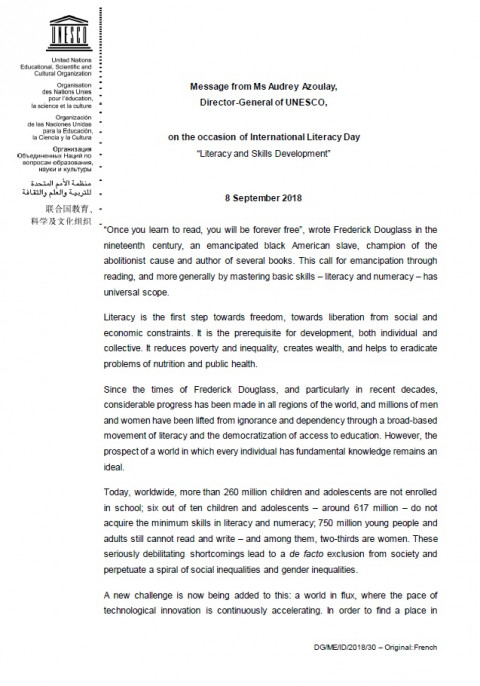 Message from Ms Audrey Azoulay, Director-General of UNESCO, on the occasion of International Literacy Day, 8 September 2018 Year of publication: 2018 Corporate author: UNESCO. Director-General, 2017-2025 (Azoulay, A.) This message was delivered by Audrey Azoulay, Director-General of UNESCO, on the occasion of the International Day of Literacy, on 8 September 2018.