
Resources
Explore a wide range of valuable resources on GCED to deepen your understanding and enhance your research, advocacy, teaching, and learning.
6 Results found
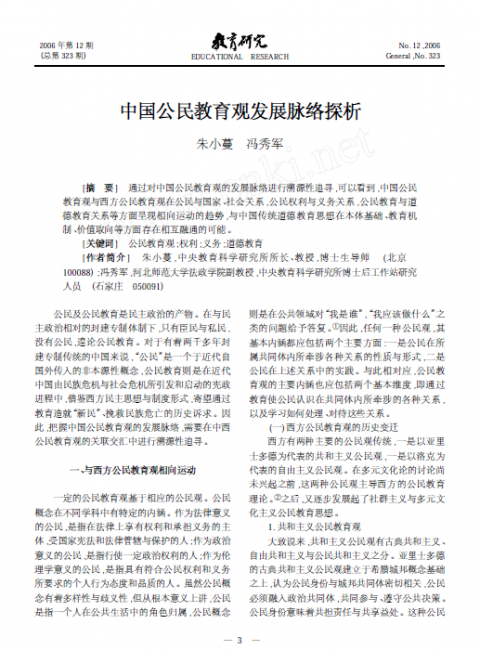 Exploration on the Developmental Track of Chinese Civil Educational Outlook Year of publication: 2006 Author: Zhu Xiaoman, Feng Xiujun By tracking down the development of Chinese civil education outlook, we can see that Chinese civil educational outlook and western civil educational outlook show the trend of moving vis-à-vis in the relations among the citizens, the country and social relations, between civil rights and duties and between civil education and moral education. They have the possibility of mutual congelation with Chinese traditional moral educational ideology in ontological foundation, educational mechanism and value orientation. 中国公民教育观发展脉络探析 Year of publication: 2006 Author: Zhu Xiaoman, Feng Xiujun 通过对中国公民教育观的发展脉络进行溯源性追寻, 可以看到,中国公民教育观与西方公民教育观在公民与国家、社会关系,公民权利与义务关系,公民教育与道德教育关系等方面呈现相向运动的趋势,与中国传统道德教育思想在本体基础、教育机制、价值取向等方面存在相互融通的可能。
 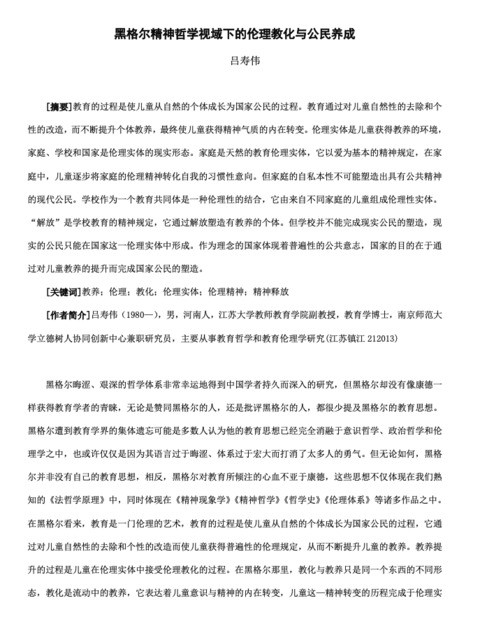 Ethical Civilization and the Cultivation of Citizens in the Perspective of Hegel’s Philosophy of Spirit (Ethical Education Research; No.2, 2019) Year of publication: 2019 Author: 吕寿伟 The process of education is to make children grow from natural individuals to national citizens. Education constantly improves individual upbring through the removal of children’s nature and the transformation of their individuality, and ultimately makes the inner change of children’s spirit. Ethical entities are the environment for children to be nurtured, and families, schools and states are the realistic forms. Family is the natural ethical entity of education, which takes love as the basic spiritual rule. In family, children gradually transform the family’s ethical spirit into the habitual intention of self. But the selfish nature of the family cannot create a modern citizen with a public spirit. The school, as an educational community, is an ethical combination which consists of children from different families. “Emancipation”,which is the spiritual rule of school education, creates educated individuals. But school cannot shape the real citizens, which can only be formed in the ethical entity of the country. The state, as a concept, embodies the common will of the public. The purpose of the state is to complete the shaping of the national citizens through the promotion of children' upbring. 黑格尔精神哲学视域下的伦理教化与公民养成 (道德教育研究; No.2, 2019) Year of publication: 2019 Author: 吕寿伟 教育的过程是使儿童从自然的个体成长为国家公民的过程。教育通过对儿童自然性的去除和个 性的改造,而不断提升个体教养,最终使儿童获得精神气质的内在转变。伦理实体是儿童获得教养的环境, 家庭、学校和国家是伦理实体的现实形态。家庭是天然的教育伦理实体,它以爱为基本的精神规定,在家 庭中,儿童逐步将家庭的伦理精神转化自我的习惯性意向。但家庭的自私本性不可能塑造出具有公共精神 的现代公民。学校作为一个教育共同体是一种伦理性的结合,它由来自不同家庭的儿童组成伦理性实体。 “解放”是学校教育的精神规定,它通过解放塑造有教养的个体。但学校并不能完成现实公民的塑造,现 实的公民只能在国家这一伦理实体中形成。作为理念的国家体现着普遍性的公共意志,国家的目的在于通 过对儿童教养的提升而完成国家公民的塑造。
 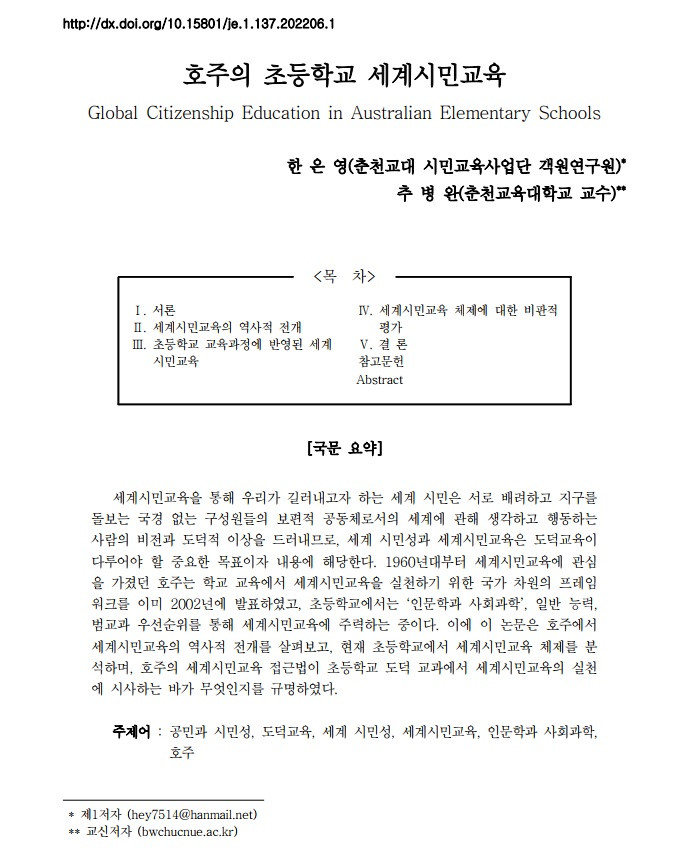 Global Citizenship Education in Australian Elementary Schools(Journal of Ethics; Vol. 137, No 1) Year of publication: 2022 Author: 한은영 | 추병완 Corporate author: 한국윤리학회 Global citizens think and act about the world as a universal community of borderless members who care for each other and are dedicated to taking care of the earth. Considering these visions and moral ideals, global citizenship education is an important goal and content of moral education. However, at present, we do not have a framework for dealing with global citizenship education in moral education. In this regard, Australia is the country we should pay attention to. Australia declared a national statement for global citizenship education in 2002. Since 2009, it has been reflected in the Australian curriculum. This article examines the historical development of global citizenship education in Australia, analyzes the current systems of global citizenship education system in primary schools, and investigates what Australia's approach to global citizenship education suggests for elementary moral education in Korea. In conclusion, we proposed three things. First, we must develop and apply a framework for the practice of global civic education in moral education. Second, we should emphasize the aspects of knowledge and understanding, skills and processing, behavior and participation as well as values and attitudes. Third, we must seek a balance between moderate global citizenship education and critical global citizenship education. 호주의 초등학교 세계시민교육(윤리연구; Vol. 137, No 1) Year of publication: 2022 Author: 한은영 | 추병완 Corporate author: 한국윤리학회 세계시민교육을 통해 우리가 길러내고자 하는 세계 시민은 서로 배려하고 지구를 돌보는 국경 없는 구성원들의 보편적 공동체로서의 세계에 관해 생각하고 행동하는 사람의 비전과 도덕적 이상을 드러내므로, 세계 시민성과 세계시민교육은 도덕교육이 다루어야 할 중요한 목표이자 내용에 해당한다. 1960년대부터 세계시민교육에 관심을 가졌던 호주는 학교 교육에서 세계시민교육을 실천하기 위한 국가 차원의 프레임워크를 이미 2002년에 발표하였고, 초등학교에서는 ‘인문학과 사회과학’, 일반 능력, 범교과 우선순위를 통해 세계시민교육에 주력하는 중이다. 이에 이 논문은 호주에서 세계시민교육의 역사적 전개를 살펴보고, 현재 초등학교에서 세계시민교육 체제를 분석하며, 호주의 세계시민교육 접근법이 초등학교 도덕 교과에서 세계시민교육의 실천에 시사하는 바가 무엇인지를 규명하였다.