
Resources
Explore a wide range of valuable resources on GCED to deepen your understanding and enhance your research, advocacy, teaching, and learning.
19 Results found
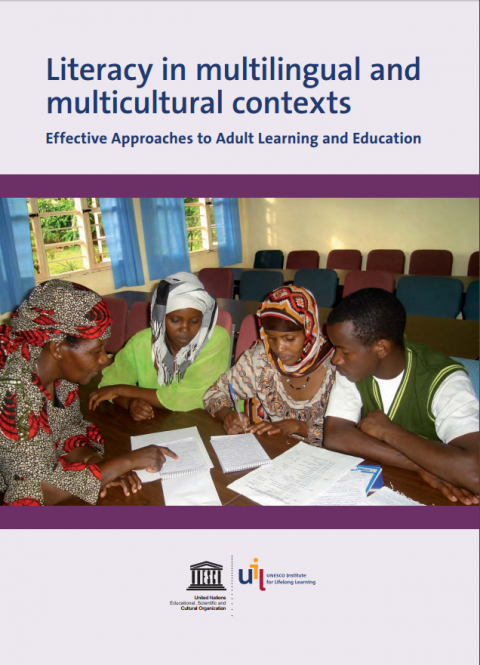 Literacy in multilingual and multicultural contexts: effective approaches to adult learning and education Year of publication: 2016 Author: Ulrike Hanemann, Cassandra Scarpino All of the literacy programmes featured in this publication offer valuable experiences and lessons on how the challenges posed by linguistic and cultural diversity can be productively addressed by harnessing the potential of language and culture as enriching resources in the process of literacy teaching and learning. A major lesson that has emerged over the years is that the use of local languages as the medium of instruction enhances the effectiveness and efficiency of the learning process in developing literacy, numeracy and (second or more) language skills. However, mother tongue-based literacy not only facilitates the learning process, but is also an important symbol of identity, unity and self-determination. It is closely intertwined with culture and local values, wisdom, worldviews and tradition. A number of the featured programmes demonstrate that language and culture in education are highly political. Respect for all languages and cultures, and their equal treatment, can play a critical role in fostering national cohesion. In some cases, this is contributing to rebuilding peace in post-conflict communities. Literacy programmes that contribute to the preservation of linguistic and cultural diversity should, also, be viewed as integral to sustainable development.
  Kit de Plaidoyer pour la promotion de l'éducation multilingue: y compris les exclus Year of publication: 2007 Corporate author: UNESCO Bangkok
 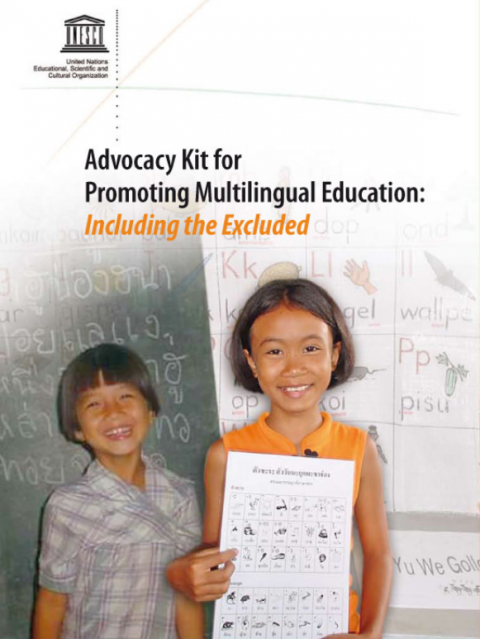 Advocacy kit for promoting multilingual education: including the excluded Year of publication: 2007 Corporate author: UNESCO Bangkok Who Can Use This Kit? This kit was prepared for all of those who want to ensure that “Education for All” does, indeed, include everyone! The kit will be especially valuable for policy makers, education practitioners and specialists who want to improve access to and quality of education for those excluded by language. It will also be helpful for speakers of ethnic minority languages who want to improve the education situation in their own communities.This kit is designed to raise awareness on the importance of mother tongue-based multilingual education (MLE). It presents key arguments and facts about MLE and provides important insights about the value and benefits of providing education in learners’ mother tongue. The kit also presents ideas, research findings and concrete examples that you can use to think about your own situation and suggests steps for taking actions to make your school system more responsive to linguistic diversity.The kit is not a definitive textbook, and it will not have an answer for every problem that you might face. To help you as much as possible, at the end of each booklet we have included lists of references. In addition, each booklet contains a glossary of terms and, at the front of each booklet is a one-page summary of its contents.How Can You Use This Kit? This kit contains three main booklets. Each booklet has a designated audience: 1) policy makers, 2) education programme planners and practitioners and 3) community members. Please remember that developing MLE requires contributions from everyone at all levels. For that reason, we encourage you to use all three booklets along with other available resources as you work together to plan, implement and sustain your MLE programmes.This kit can be used in many different ways. For those who are already involved in MLE programmes, you might use these ideas to help you to promote mother tongue instruction and strengthen your programme. Those who are not familiar with multilingual education but want to improve educational access for minority language students might use these booklets to identify specific points that they can investigate and discuss in their own contexts.
 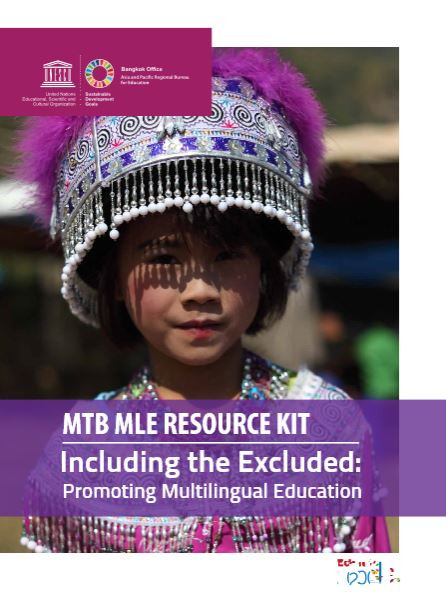 MTB MLE resource kit: Including the excluded: promoting multilingual education Year of publication: 2016 Author: Susan Malone Corporate author: UNESCO Bangkok Who Can Use this Resource Kit?This MTB MLE Resource Kit is for people who are committed to the idea that all children have the right to quality education in a language they speak and understand. MTB MLE programmes that are sustained within the formal education system require contributions from all stakeholders, working together and supporting one another. The next three booklets were developed for three specific stakeholder groups: policy makers, programme implementers and community members. These three booklets, with the case studies, provide a “big picture” of successful MTB MLE programmes and suggestions for the roles each group can take as they plan, implement and maintain their programmes. How Can You Use this Resource Kit?Each booklet is organized around key questions about MTB MLE that are frequently asked by policy makers, implementers and community members. Responses to each question include examples of specific activities that are part of successful MTB MLE programmes in a variety of contexts. Working together, stakeholders can identify the specific activities that are best suited for their own situation and make the best use of all available resources. Advocacy kit for promoting multilingual education: including the excluded Year of publication: 2007 Corporate author: UNESCO Bangkok This kit was prepared for all of those who want to ensure that “Education for All” does, indeed, include everyone! The kit will be especially valuable for policy makers, education practitioners and specialists who want to improve access to and quality of education for those excluded by language. It will also be helpful for speakers of ethnic minority languages who want to improve the education situation in their own communities. This kit is designed to raise awareness on the importance of mother tongue-based multilingual education (MLE). It presents key arguments and facts about MLE and provides important insights about the value and benefits of providing education in learners’ mother tongue. The kit also presents ideas, research findings and concrete examples that you can use to think about your own situation and suggests steps for taking actions to make your school system more responsive to linguistic diversity. The kit is not a definitive textbook, and it will not have an answer for every problem that you might face. To help you as much as possible, at the end of each booklet we have included lists of references. In addition, each booklet contains a glossary of terms and, at the front of each booklet is a one-page summary of its contents. This kit contains three main booklets. Each booklet has a designated audience: 1) policy makers, 2) education programme planners and practitioners and 3) community members. Please remember that developing MLE requires contributions from everyone at all levels. For that reason, we encourage you to use all three booklets along with other available resources as you work together to plan, implement and sustain your MLE programmes. This kit can be used in many different ways. For those who are already involved in MLE programmes, you might use these ideas to help you to promote mother tongue instruction and strengthen your programme. Those who are not familiar with multilingual education but want to improve educational access for minority language students might use these booklets to identify specific points that they can investigate and discuss in their own contexts. MTB MLE resource kit: Including the excluded: promoting multilingual education (chi) Year of publication: 2016 Author: Susan Malone Corporate author: UNESCO Bangkok Who Can Use this Resource Kit?This MTB MLE Resource Kit is for people who are committed to the idea that all children have the right to quality education in a language they speak and understand. MTB MLE programmes that are sustained within the formal education system require contributions from all stakeholders, working together and supporting one another. The next three booklets were developed for three specific stakeholder groups: policy makers, programme implementers and community members. These three booklets, with the case studies, provide a “big picture” of successful MTB MLE programmes and suggestions for the roles each group can take as they plan, implement and maintain their programmes. How Can You Use this Resource Kit?Each booklet is organized around key questions about MTB MLE that are frequently asked by policy makers, implementers and community members. Responses to each question include examples of specific activities that are part of successful MTB MLE programmes in a variety of contexts. Working together, stakeholders can identify the specific activities that are best suited for their own situation and make the best use of all available resources.
 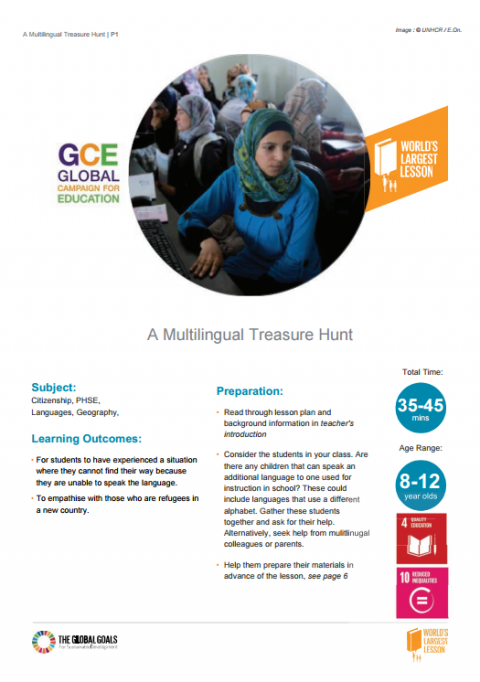 A Multilingual Treasure Hunt Corporate author: United Nations Children's Fund (UNICEF) World’s Largest Lesson is a collaborative education project to support the announcement of the United Nations Global Goals for Sustainable Development. Learning outcomes of the project: • For students to have experienced a situation where they cannot find their way because they are unable to speak the language. • To empathise with those who are refugees in a new country. Global Citizenship and Lingual Identity: The Ability to Perform in Different Lingual Settings Year of publication: 2011 Author: Ann-Christin Torpsten Corporate author: SAGE Publications The aim of this article is to interpret second-language pupils’ encounter with the Swedish school regarding first- and second-language learning. An empirical context called experienced learning is investigated by interpreting student teachers’ oral and written narrated learning memories. Using a life-story approach, the interpretation focuses on lingual skills, lingual identity and citizenship. The study looks at participation in Swedish as a second language and mother tongue education when the subjects encountered the Swedish school system. Participating in those lessons is described as positive. Participating made it easier to improve skills in the second language and mother tongue. Mother tongue skills were transferred to the second-language improvement. It became much easier to continue developing the second language when skills in the mother tongue increased. Language skills were positive for continued learning, linguistic development, development of bilingualism and multilingualism. Through widened linguistic horizons it becomes possible to develop identity as multilingual persons. When skills increase in different languages such as Swedish as a second language and mother tongue, the subjects become aware of their identities as multilingual persons. They become aware of their possibilities of being active, multicultural, global citizens. Their ability to perform in different lingual settings becomes visible. Citoyenneté mondiale et Identité linguale : la capacité d'exécuter dans différents contextes linguales Year of publication: 2011 Author: Ann-Christin Torpsten Corporate author: SAGE Publications Le but de cet article est d'interpréter la rencontre des élèves de langue seconde à l'école suédoise au sujet de première et de l'apprentissage de la langue seconde. Un contexte empirique appelé apprentissage expérimenté est étudié en interprétant des souvenirs d'apprentissage orales et écrites narrés des enseignants aux étudiants. En utilisant une approche histoire de vie, l'interprétation se concentre sur les compétences linguales, l'identité et la citoyenneté lingual. L'étude se penche sur la participation en suédois comme langue seconde et éducation en langue maternelle lorsque les sujets ont rencontré le système scolaire suédois. La participation à ces leçons est décrit comme positif. La participation a rendu plus facile d'améliorer les compétences dans la langue seconde et langue maternelle. Compétences en langue maternelle ont été transférés à l'amélioration de la langue seconde. Il est devenu beaucoup plus facile de continuer à développer la deuxième langue lorsque les compétences dans la langue maternelle ont augmenté. Les compétences linguistiques ont été positifs pour l'apprentissage continu, le développement linguistique, le développement du bilinguisme et le multilinguisme. A travers élargi les horizons linguistiques, il devient possible de développer une identité en tant que personnes multilingues. Lorsque les compétences augmentent dans différentes langues comme le suédois comme langue seconde et la langue maternelle, les sujets prennent conscience de leur identité en tant que personnes multilingues. Ils prennent conscience de leurs possibilités d'être multiculturelles, des citoyens actifs. Leur capacité à effectuer dans différents contextes linguales devient visible.
  Mother Tongue-Based Multilingual Education: The Key to Unlocking SDG 4 - Quality Education for All Year of publication: 2017 Author: Matt Wisbey Corporate author: UNESCO Bangkok This brochure, designed as a bright and bold resource to be used with policy makers and other key stakeholders, explores the reasons why mother tongue-based multilingual education (MTB-MLE) is the key to quality lifelong learning opportunities for all. Linking the key elements of MTB-MLE with SDG4’s targets, it outlines the benefits for both individual learners and society as a whole.