
Resources
Explore a wide range of valuable resources on GCED to deepen your understanding and enhance your research, advocacy, teaching, and learning.
3 Results found
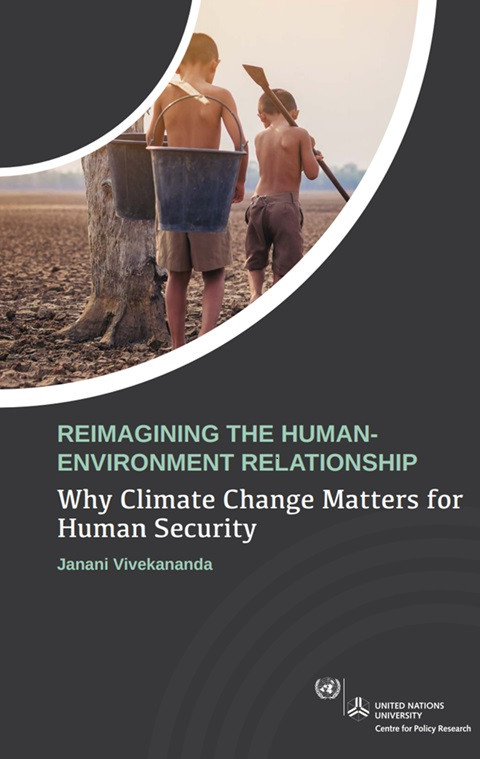 Why Climate Change Matters for Human Security Year of publication: 2022 Author: Janani Vivekananda Corporate author: United Nations University | United Nations Environment Programme (UNEP) This paper outlines the state of knowledge regarding security risks related to climate change, synthesizing the existing scientific evidence to set out five broad pathways of risk. Climate change itself is rarely a direct cause of conflict. Yet, there is ample evidence that its effects exacerbate important drivers and contextual factors of conflict and fragility, thereby challenging the stability of states and societies. Climate change impacts such as coral bleaching, diversity loss, and erratic rainfall can stress livelihoods and drive displacement, increase resource conflicts, and challenge the security and stability of people and states worldwide. Managing these security risks requires action across the entire impact chain: work to mitigate climate change; reducing its consequences on ecosystems; adapting socioeconomic systems; better management of climate-induced heightened resource competition; and strengthening governance and conflict management institutions. And every dimension of the response must be conflict-sensitive and climate proof. Without the right responses, climate change will mean more fragility, less peace and less security. But this paper sets out illustrative examples of how, with a greater understanding of how climate change interacts with social, political, economic and environmental drivers of conflict and fragility, we will be better placed to make the kind of risk-informed decisions is integral to achieving international peace and security.
  Global Resources Outlook: 2024 Bend the Trend; Pathways to a Liveable Planet as Resource Use Spikes Year of publication: 2024 Author: Hans Bruyninckx, Steve Hatfield-Dodds, Stefanie Hellweg, Heinz Schandl Corporate author: United Nations Environment Programme (UNEP) | International Resource Panel (IRP) The world is in the midst of a triple planetary crisis of climate change, biodiversity loss and pollution and waste. The global economy is consuming ever more natural resources, while the world is not on track to meet the Sustainable Development Goals. The scientific community has never before been more aligned or more resolute on the need for urgent global transformation towards the sustainable use of resources. This 2024 edition of the Global Resources Outlook sheds light on how resources are essential to the effective implementation of the Agenda 2030 and multilateral environmental agreements to tackle the triple planetary crisis. The report brings together the best available data, modelling and assessments to analyse trends, impacts and distributional effects of resource use. It builds on more than 15 years of work by the International Resource Panel, including scientific assessments and inputs from countries, a vast network of stakeholders in the field and regional experts. The report illustrates how, since the 2019 edition of this report, rising trends in global resource use have continued or accelerated. The report also shows how demand for resources is expected to continue increasing in the coming decades. This means that, without urgent and concerted action, by 2060 resource extraction could rise by 60% from 2020 levels – driving increasing damage and risks. However, this fate is not sealed. The report also describes the potential to turn negative trends around and put humanity on a trajectory towards sustainability. For that, bold policy action is critical to phase out unsustainable activities, speed up responsible and innovative ways of meeting human needs and create conditions conducive to social acceptance and equity within the necessary transitions. This includes urgent action to embed resources in the delivery of multilateral environmental agreements, define sustainable resource use paths and roll out appropriate financial, trade and economic incentives. The pathway towards sustainability is increasingly steep and narrow, and the window of opportunity is closing. The science is clear: The key question is no longer whether a transformation towards global sustainable resource consumption and production is necessary, but how to make it happen now. Addressing this reality, based on evolving concepts of a just transition, is an essential part of any credible and justifiable way forward.
 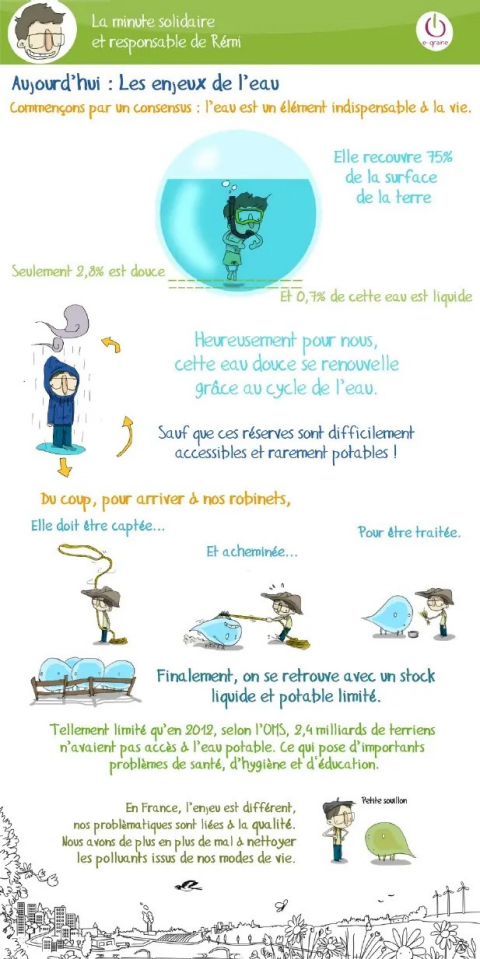 La minute solidaire et responsable de Remi Year of publication: 2019 Corporate author: E-graine 3 bandes dessinées en ligne pour sensibiliser sur les questions environnementales : une sur l'eau, une sur l'empreinte écologique et une sur les déchets. 3 online comic strips to raise awareness of environmental issues: one on water, one on the ecological footprint and one on waste.