
Resources
Explore a wide range of valuable resources on GCED to deepen your understanding and enhance your research, advocacy, teaching, and learning.
7 Results found
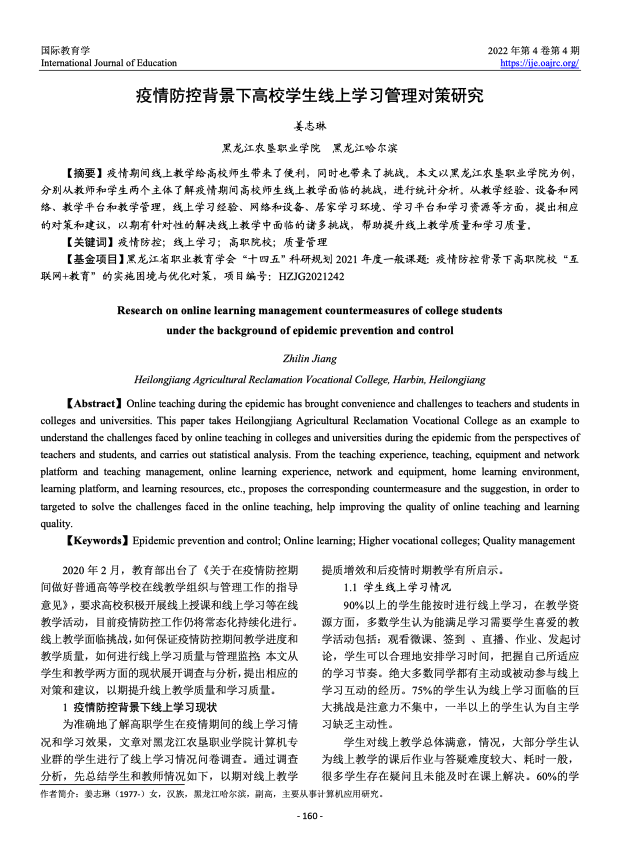 疫情防控背景下高校学生线上学习管理对策研究 Year of publication: 2022 Author: 姜志琳 疫情期间线上教学给高校师生带来了便利,同时也带来了挑战。本文以黑龙江农垦职业学院为例,分别从教师和学生两个主体了解疫情期间高校师生线上教学面临的挑战,进行统计分析。从教学经验、设备和网络、教学平台和教学管理,线上学习经验、网络和设备、居家学习环境、学习平台和学习资源等方面,提出相应的对策和建议,以期有针对性的解决线上教学中面临的诸多挑战,帮助提升线上教学质量和学习质量。
  School Closures and Regional Policies to Mitigate Learning Loss due to COVID-19: A Focus on the Asia-Pacific Year of publication: 2021 Corporate author: UNESCO Institute for Statistics (UIS) Global school closures as a result of COVID-19 have caused learning losses for millions of children despite efforts to deploy remote learning options. Greater economic insecurity among families may also affect school enrolment as many struggle to pay school fees, or require children to work to supplement family income. Ultimately, this will lead to rising dropout rates, estimated to be as much as 4% in a region where 128 million children and young people were already out of school before COVID-19. The largest number of learners at risk reside in South and West Asia.Together, the education and economic fallout from the pandemic threaten progress toward the Sustainable Development Goal for education (SDG 4). Even prior to the COVID-19 disruptions, progress towards SDG 4 was lagging in many countries in the Asia-Pacific and without significant contributions to education finance, the pandemic threatens to push the region even further behind.This report breaks down the effects of school closures. It considers, for example, how many schools were closed, and when, across the Asia-Pacific, and the effects on different levels of education from early childhood education, through to primary and secondary school. The report analyses country efforts to implement remote learning, and strategies to mitigate learning losses as the proportion of students expected to fall below minimum proficiency levels is expected to rise.To achieve SDG 4, all children and young people, and especially those in marginalized groups, need support to get the education they need and deserve.
  Personalized Learning within Teacher Education: A Framework and Guidelines Year of publication: 2020 Corporate author: UNESCO International Bureau of Education (IBE) This paper explores the theoretical and practice elements that together inform the concept of personalised learning. These insights are then used to develop a Framework for Personalized Learning within Teacher Education. In addition, the final chapter outlines pedagogical strategies to support the development of personalised learning that were tested during the project within the participating universities.The Framework and Guidelines are intended for use by to teacher educators and their students, as well as by teachers and students in schools, to support the on‐going shift towards a personalised learning and collaborative paradigm which forefronts learner agency and autonomy and encourages learners of all ages to assume increased responsibility for their own learning and achievements.
 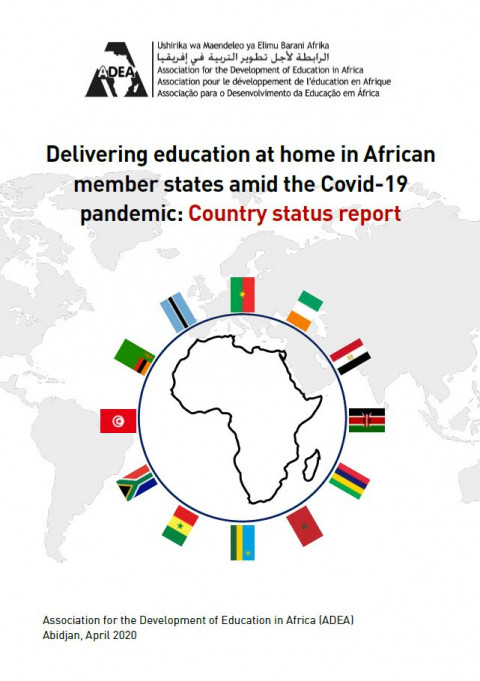 Assurer l’éducation à domicile dans les États membres africains dans le contexte de la pandémie de COVID-19 : rapport sur la situation dans les pays Year of publication: 2020 Corporate author: Association for the Development of Education in Africa (ADEA) Depuis son émergence à la fin de 2019, la maladie à coronavirus 2019 (COVID-19) est devenue une pandémie, affectant fortement la vie de milliards de personnes à travers le monde, avec un impact énorme prévu sur l'économie mondiale et l'Afrique en particulier. L'éducation est l'un des secteurs les plus touchés, la fermeture des établissements d'enseignement dans de nombreux pays africains risquant d'affecter négativement la qualité de l'éducation.Afin d'obtenir une vision plus claire de l'état de l'apprentissage au cours de cette période et de mieux soutenir les pays dans l'immédiat, à court et à long terme, l'ADEA a engagé en mars 2020 certains des pays africains les plus touchés pour schématiser la situation nationale du secteur de l'éducation. Ce qui précède est un résumé des commentaires reçus par l'Afrique du Sud, le Burkina Faso, la Côte d'Ivoire, l'Égypte, le Ghana, le Kenya, l’île Maurice, le Maroc, le Rwanda, le Sénégal, la Tunisie et la Zambie en termes de stratégies nationales, de plateformes, d'outils ou d'applications d’apprentissage, de lacunes et défis, d’engagement des partenaires, de bonnes pratiques et d’enseignements tirés avec quelques recommandations. Delivering Education at Home in African Member States Amid the Covid-19 Pandemic: Country Status Report Year of publication: 2020 Corporate author: Association for the Development of Education in Africa (ADEA) Since its emergence in late 2019, the coronavirus disease 2019 (COVID-19) has evolved into a pandemic, heavily affecting the lives of billions of people across the world with an anticipated huge impact on the global economy and Africa in particular. Education is one of the sectors heavily affected, with the closure of learning institutions in many African countries likely to negatively affect the education quality.In order to obtain a clearer view of the status of learning during this period, and to better support countries in the immediate, short and long term, ADEA engaged some of the most affected African countries in March 2020 to map the national situation in the education sector. The foregoing is a synopsis of the feedback from Burkina Faso, Côte d’Ivoire, Egypt, Ghana, Kenya, Mauritius, Morocco, Rwanda, Senegal, South Africa, Tunisia, and Zambia in terms of national strategies, platforms and tools or applications, gaps and challenges, partner engagement, good practices and lessons learnt with some recommendations.
  A Framework to Guide an Education Response to the COVID-19 Pandemic of 2020 Year of publication: 2020 Author: Fernando Reimers | Andreas Schleicher Corporate author: Organisation for Economic Co-operation and Development (OECD) This report aims at supporting education decision making to develop and implement effective education responses to the COVID-19 Pandemic. The report explains why the necessary social isolation measures will disrupt school-based education for several months in most countries around the world. Absent an intentional and effective strategy to protect opportunity to learn during this period, this disruption will cause severe learning losses for students.The report proposes that leaders of education systems and organizations develop plans for the continuation of education through alternate modalities, during the period of necessary social isolation. It offers a framework of areas to be covered by such plans. Un cadre pour guider une réponse éducative à la Covid-19 en cas de pandémie de 2020 Year of publication: 2020 Author: Fernando Reimers | Andreas Schleicher Corporate author: Organisation for Economic Co-operation and Development (OECD) Ce rapport vise à appuyer la décision de l'éducation faisant de développer et mettre en œuvre des réponses éducatives efficaces au Covid-19 en cas de pandémie. Le rapport explique pourquoi les mesures d'isolement social nécessaires perturberont l'éducation en milieu scolaire pendant plusieurs mois dans la plupart des pays à travers le monde. En l'absence d'une stratégie délibérée et efficace pour protéger l'occasion d'apprendre au cours de cette période, cette perturbation entraîne des pertes sévères d'apprentissage pour les étudiants.Le rapport propose que les dirigeants des systèmes d'éducation et les organisations à élaborer des plans pour la poursuite de l'éducation des modalités alternatives, au cours de la période d'isolement social nécessaire. Il offre un cadre de zones à couvrir par ces plans.