
Resources
Explore a wide range of valuable resources on GCED to deepen your understanding and enhance your research, advocacy, teaching, and learning.
65 Results found
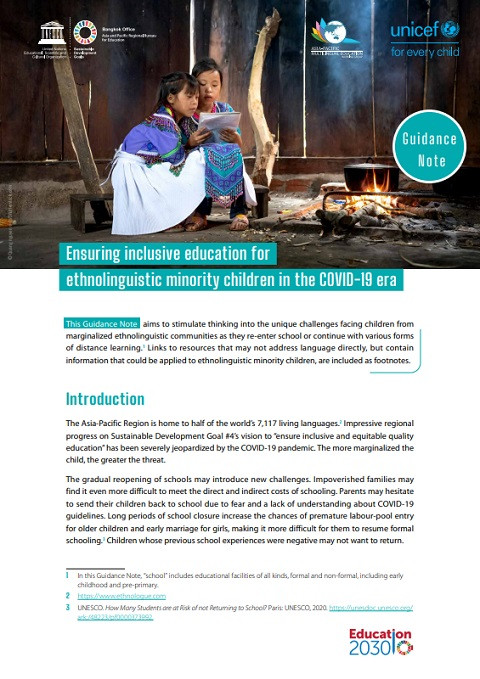 Ensuring Inclusive Education for Ethnolinguistic Minority Children in the COVID-19 Era: Guidance Note Year of publication: 2021 Corporate author: UNESCO Bangkok This Guidance Note aims to stimulate thinking into the unique challenges facing children from marginalized ethnolinguistic communities as they re-enter school or continue with various forms of distance learning. Links to resources that may not address language directly, but contain information that could be applied to ethnolinguistic minority children, are included as footnotes.
  Research Report: A Comparative Study on Hybrid Learning in Schools Year of publication: 2024 Corporate author: UNESCO International Bureau of Education (IBE) During the COVID-19 lockdown, policymakers and educators faced an unprecedented challenge disrupting all levels of education. The initial optimism about replacing physical classes with virtual lessons diminished as complex interconnected issues emerged. To address the need for continuous and sustainable learning, school systems implemented variations of hybrid learning during the pandemic, seeking to integrate physical and virtual classes. These approaches prompted this comparative study led by UNESCO-IBE. The initial phase of this study involved collecting and analysing data on hybrid strategies from six countries. The research aimed to examine factors influencing hybrid learning implementation during the lockdown, with a subsequent focus on developing and validating a practical Hybrid Learning Framework for Schools. The cross-case analysis was designed not to rank or compare, but to understand and connect different scenarios and contexts. Phase I focuses on current hybrid learning practices and influencing factors, while Phases II and III will concentrate on using the information gathered to create and validate a Hybrid Learning Framework for Schools. Hybrid learning is not just a response to pandemics but also serves as a viable solution for other scenarios where full school attendance is difficult. Aligned with UNESCO-IBE’s overarching vision of a comprehensive, personalized, and democratized curriculum accessible to all, hybrid learning facilitates inclusive education across diverse regions, overcoming geographical and temporal limitations. The approach aims to unlock the unique potential of every learner, fostering a more flexible educational environment.Published in February 2024 by the UNESCO International Bureau of Education (IBE) with support from the European Union.
  Policy Brief: The Impact of Covid-19 on Women Year of publication: 2020 Corporate author: United Nations Entity for Gender Equality and the Empowerment of Women (UN Women) | United Nations (UN) The year 2020, marking the twenty-fifth anniversary of the Beijing Platform for Action, was intended to be ground-breaking for gender equality. Instead, with the spread of the COVID-19 pandemic, even the limited gains made in the past decades are at risk of being rolled back. The pandemic is deepening pre-existing inequalities, exposing vulnerabilities in social, political and economic systems which are in turn amplifying the impacts of the pandemic.Across every sphere, from health to the economy, security to social protection, the impacts of COVID-19 are exacerbated for women and girls simply by virtue of their sex.This policy brief by the UN Secretary-General explores how women and girls’ lives are changing in the face of COVID-19, and outlines suggested priority measures to accompany both the immediate response and longer-term recovery efforts.
  التربية والتعليم والتعلم والمعرفة في عالم ما بعد كوفيد- 19 : تسع أفكار للعمل العام Year of publication: 2020 Corporate author: UNESCO ستكون للقرارات التي یجري اتخاذھا الآن في سیاق جائحة فیروس كورونا (كوفید-19 (عواقب طویلة الأجل على مستقبل التربیة والتعلیم. وتقدم اللجنة الدولیة المعنیة بمستقبل التربیة والتعلیم في ھذا التقریر تسع أفكار رئیسیة لمواجھة الأزمة الناجمة عن جائحة كوفید-19 وعواقبھا، مع التمسك بالمبادئ الأساسیة ومواطن القوة ُ ُظم التعلیم. ویجب إیلاء ً غیر مسبوق في الاقتصادات والمجتمعات وكذلك في ن المعروفة بینما نواجھ اضطرابا التفاعل بین البشر ورفاھھم الأولویة عند العمل على وضع تصور جدید للتربیة والتعلیم وتحدیثھما، ویجب أن ُفسح یتزامن ذلك مع الالتزام بالتضامن على الصعید العالمي ورفض استمرار أوجھ ومستویات التفاوت التي أ المجال لبروزھا في عالمنا المعاصر. 后疫情世界的教育: 推进公共行动的九个构想 “教育的未来”国际委员会 Year of publication: 2020 Corporate author: UNESCO 在冠状病毒病(Covid-19)疫情背景的当下作出的决定,将对教育的未来产生深远的影响。在本报告中,“教育的未来”国际委员会提出了应对Covid-19危机及其后果的九个关键构想。报告认为,当面临经济、社会以及教育体系遭到前所未有破坏的情况时,我们必须坚持核心原则,继续发挥固有优势。在振兴和重塑教育时,必须优先考虑人际互动和人的福祉问题。同时,还必须致力于全球团结,不能接受当今世界出现如此程度的不平等。 La educación en un mundo tras la COVID: Nueve ideas para la acción pública Year of publication: 2020 Corporate author: UNESCO Las decisiones que se tomen en este momento en el contexto de la pandemia de COVID-19 tendrán consecuencias a largo plazo para los futuros de la educación. En este informe, la Comisión internacional sobre Los futuros de la educación presenta nueve ideas clave para sortear la crisis de la COVID-19 y sus secuelas, partiendo de la premisa de que debemos basarnos en los principios básicos y en los puntos fuertes con los que ya contamos al enfrentarnos a una perturbación sin precedentes de las economías, las sociedades y los sistemas de educación. En la renovación y el replanteamiento de la educación se debe otorgar prioridad a la interacción y el bienestar humanos. Esto ha de ir también acompañado de un compromiso con una solidaridad mundial que no acepte los niveles de desigualdad que se ha dejado surgir en el mundo contemporáneo. Образование в мире, пережившем пандемию COVID-19: Девять идей для коллективных действий Year of publication: 2020 Corporate author: UNESCO Решения, принимаемые сегодня в контексте пандемии Covid-19, будут иметь долгосрочные последствия для будущего образования. В этом докладе Международная комиссия по перспективам образования представляет девять ключевых идей для преодоления вызванного пандемией COVID-19 кризиса и его последствий, будучи убеждена в том, что в этот период беспрецедентных потрясений, затронувших экономику, общество и системы образования, мы должны опираться на основополагающие принципы и известные нам преимущества. В ходе обновления и переосмысления системы образования первоочередное внимание должно уделяться человеческим взаимоотношениям и благополучию. Необходима также приверженность глобальной солидарности, которая не будет мириться со сложившимися в современном мире показателями неравенства. Education in a Post-COVID World: Nine Ideas for Public Action Year of publication: 2020 Corporate author: UNESCO Decisions made today in the context of the COVID-19 pandemic will have longterm consequences for the futures of education. In this report the International Commission on the Futures of Education presents nine key ideas for navigating through the COVID-19 crisis and its aftermath, contending that we must build on core principles and known strengths as we face unprecedented disruption to economies, societies and education systems. In the renewal and reimaging of education human interaction and wellbeing must be given priority. This must also be accompanied by a commitment to global solidarity that does not accept the levels of inequality that have been permitted to emerge in the contemporary world L’éducation dans un monde post-Covid: Neuf idées pour l’action publique Year of publication: 2020 Corporate author: UNESCO Les décisions prises aujourd’hui dans le cadre de la pandémie du Covid-19 auront des conséquences à long terme sur les futurs de l’éducation. Dans ce rapport, la Commission internationale sur Les futurs de l’éducation présente neuf idées essentielles pour dépasser la crise de Covid-19 et appréhender ses répercussions. Rapport dans lequel elle affirme également que nous devons nous appuyer sur des principes fondamentaux et des atouts connus alors que nous sommes confrontés à des perturbations sans précédent des économies, des sociétés et des systèmes éducatifs. Dans le renouvellement et le réaménagement de l’éducation, la priorité doit être donnée à l’interaction humaine et au bien-être. Cela doit également s’accompagner d’un engagement en faveur d’une solidarité mondiale qui refuse les niveaux d’inégalité qui caractérisent le monde actuel.
 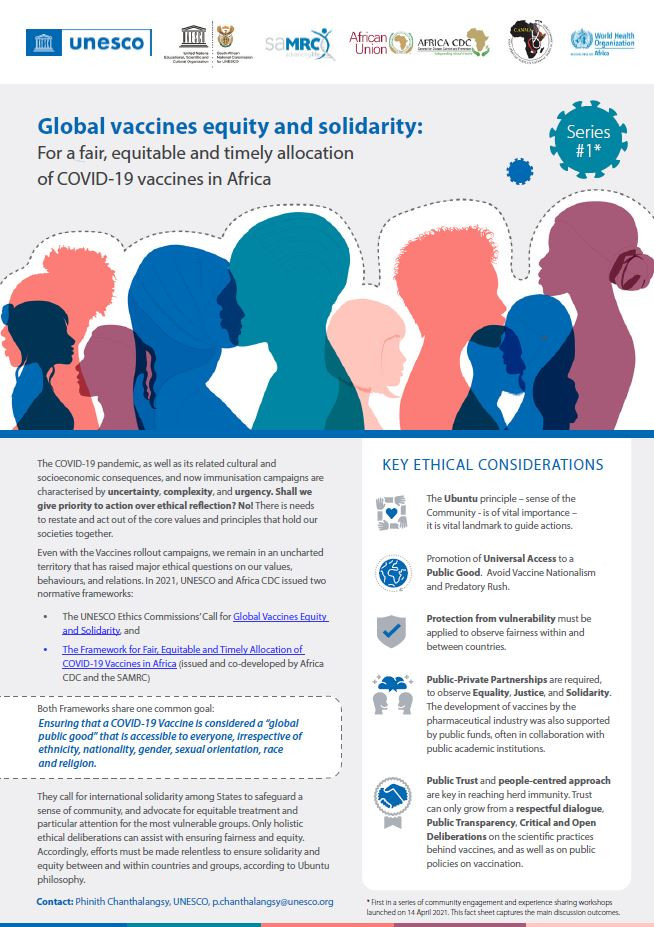 Global Vaccines Equity and Solidarity: For a Fair, Equitable and Timely Allocation of COVID-19 Vaccines in Africa; Series #1 Year of publication: 2021 Corporate author: UNESCO Harare African populations have been side-lined through the COVID-19 Vaccination roll-out process. A vaccination timeline taking Africa into 2023 would be unethical. African countries need to invest in their own structures and stop relying on colonial structures. There is a moral obligation to safeguard the population through equal distribution. This not only makes moral and ethical sense but also scientific and economic sense as a slow roll out in Africa will impact the rest of the world. First in a series of community engagement and experience sharing workshops launched on 14 April 2021. This fact sheet captures the main discussion outcomes.