
Resources
Explore a wide range of valuable resources on GCED to deepen your understanding and enhance your research, advocacy, teaching, and learning.
65 Results found
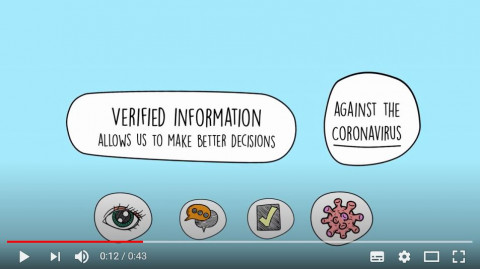 How to Stop Misinformation in Times of Coronavirus? Year of publication: 2020 Corporate author: United Nations Development Programme (UNDP) | UNESCO Learn how to identify unverified content you receive on your cell phone and avoid spreading information on social media that has not been checked by credible sources. Caring for reliable information is everyone's responsibility, and helps us make better decisions.Learn more about this campaign by UNESCO and UNDP at:https://en.unesco.org/news/disinformation-silent-weapon-times-pandemic
 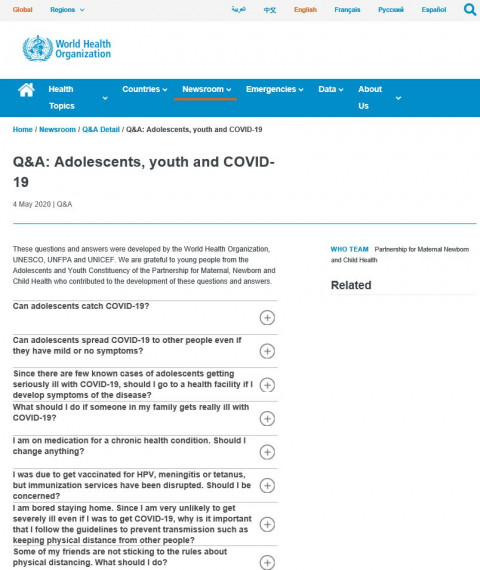 Q&A: Adolescents, Youth and COVID-19 Year of publication: 2020 Corporate author: World Health Organization (WHO) | UNESCO | United Nations Population Fund (UNFPA) | United Nations Children's Fund (UNICEF) As part of UNESCO’s work in promoting better health and well-being for all children and young people, it has contributed to the development of a practical guide in a ‘questions and answers’ (Q&A) format on children and adolescents and COVID-19. This work was led by the World Health Organization, in collaboration with the Adolescents and Youth Constituency of the Partnership for Maternal, Newborn and Child Health, UNESCO, UNFPA, and UNICEF.The Q&A provide children and adolescents with accurate, non-judgmental information and advice around COVID-19, including how to help stop the spread of the virus, what to do if they develop symptoms of the disease, and how to best manage their health and well-being during the confinement period and after. It considers children and young people as critical actors in the response to COVID-19, not as passive beneficiaries.
  Education in a Post-COVID World: Additional Considerations (In-Progress Reflection; No.43, 2021) Year of publication: 2021 Author: Renato Opertti Corporate author: UNESCO International Bureau of Education (IBE) This discussion document analyses some implications of the ideas proposed in the seminal UNESCO document “Education in a post-COVID world: Nine ideas for public action” (2020). Based on the work of the International Commission on the Futures of Education, the documents’ contributors included prominent figures with a wide range of professional and policy experience who hail from various regions of the world. The set of nine interconnected ideas illuminates the way forward toward the transformation of education and education systems and a reimagined future seen through a progressive lens. On one hand, it reaffirms basic principles, understandings, and commitments with regard to education as a global common good and universal human right; it also articulates the need to both reinvent multilateralism for a new global order and, crucially, to mobilize ideas and funding for transforming education. On the other hand, the document advocates for a comprehensive educational agenda, including the following critical issues: (i) visualizing educators as decision-makers in educational systems; (ii) appreciating students as active actors with rights; (iii) recognizing the value and specificity of the school space; (iv) addressing the dilemmas around technology’s ability to serve as an equalizer of opportunities; and (v) revisiting educational content for the sustainability of younger generations. L’éducation dans un monde post-Covid: considérations supplémentaires (Réflexion en cours; No. 43, 2021) Year of publication: 2021 Author: Renato Opertti Corporate author: UNESCO International Bureau of Education (IBE) Ce document de discussion analyse certaines implications des idées proposées dans le document initial « L’éducation dans un monde post-COVID : Neuf idées pour l’action publique » (2020) produit par la Commission internationale sur les futurs de l’éducation. Parmi les contributeurs de ce document figurent des experts éminents ayant une large expérience professionnelle et politique, provenant de diverses régions du monde. L’ensemble de ces neuves idées interconnectées éclaire la voie à suivre pour transformer l’éducation et les systèmes éducatifs et concevoir l’avenir dans une optique progressiste. D’une part, il réaffirme les principes de base, la compréhension et les engagements concernant l’éducation en tant que bien commun mondial et droit de l’homme universel ; il exprime également la nécessité de réinventer le multilatéralisme pour un nouvel ordre mondial et, surtout, de mobiliser des idées et des fonds pour transformer l’éducation. D’autre part, le document plaide en faveur d’un programme éducatif global, incluant les questions critiques suivantes: (i) visualiser les éducateurs comme des décideurs dans les systèmes éducatifs ; (ii) considérer les étudiants comme des acteurs actifs ayant des droits ; (iii) reconnaître la valeur et la spécificité de l’espace scolaire ; (iv) aborder les dilemmes autour de la capacité de la technologie à combler les inégalités ; et (v) revoir les contenus d’enseignement pour la durabilité des jeunes générations. Educación en un mundo post-COVID: consideraciones adicionales (Reflexiones en Progreso; No.43, 2021) Year of publication: 2021 Author: Renato Opertti Corporate author: UNESCO International Bureau of Education (IBE) Este documento de discusión analiza algunas implicaciones de las ideas propuestas en el documento seminal “Educación en un mundo post-COVID: Nueve ideas para la acción pública” (2020) producido por la Comisión Internacional sobre el Futuro de la Educación. Entre los colaboradores del informe se encuentran destacadas figuras con una amplia experiencia profesional y política procedentes de diversas regiones del mundo. El conjunto de nueve ideas interconectadas ilumina el camino a seguir hacia la transformación de la educación y los sistemas educativos y hacia un futuro reinventado visto a través de una lente progresista. Por un lado, reafirma los principios, entendimientos y compromisos básicos con respecto a la educación como bien común global y derecho humano universal. También, articula la necesidad tanto de reinventar el multilateralismo para un nuevo orden global como, fundamentalmente, de movilizar ideas y financiación para transformar la educación. Por otro lado, el documento aboga por una agenda educativa integral que incluya los siguientes aspectos críticos: (i) visualizar a los educadores como tomadores de decisiones en los sistemas educativos; (ii) valorar a los estudiantes como agentes activos con derechos; (iii) reconocer el valor y la especificidad del espacio escolar; (iv) abordar los dilemas en torno a la capacidad de la tecnología para servir como igualadora de oportunidades; y (v) revisar los contenidos educativos para la sostenibilidad de las generaciones más jóvenes.
  International Understanding and Cooperation in Education in the Post-Corona World Year of publication: 2020 Author: Dongjoon Jo | Edward Vickers | Dina Kiwan | Fei Yan | Kyujoo Seol | Kyoko Nakayama Corporate author: APCEIU Research Report of International Understanding and Cooperation in Education in the Post-Corona World APCEIU has published a report, including research studies from 6 experts in order to figure out the role of education in promoting international understanding and cooperation in the education sector in the post-pandemic world. Through this research project, APCEIU mainly sought to answer the following questions; ▲What will be the implications of COVID-19 for international exchange and cooperation especially in education?▲What should we as educators, researchers, and practitioners do to counter the rise of populist nationalism?▲What should be the focus and direction of international cooperation in education during and after the pandemic in order to promote international understanding and GCED? This research project is expected to provide insightful views on the desirable direction for international understanding and cooperation in the education sector. Table of Contents 1. The development of UNESCO’s exchange programmes and their possible rearrangements in the post-pandemic years (Dong-Joon Jo, Professor at Department of Political Science and International Relations, Seoul National University, Korea) 2. ‘Rethinking Schooling’ once again: Post-corona challenges for education for peace and sustainability in Asia (Edward Vickers, Professor of Comparative Education at Kyushu University, Japan) 3. Race, gender, disability, and their intersections under the impact of COVID-19 (Dina Kiwan, Professor in Comparative Education, University of Birmingham, United Kingdom) 4. Competition or cooperation: Configuring ‘International’ in Chinese school textbooks (Fei Yan, Post-Doctoral Research Fellow, South China University, China) 5. The implications of democratic citizenship education and global citizenship education in South Korea for the post-corona era (Kyujoo Seol, Professor of Social Studies Education, Kyeongin National University of Education, Korea) 6. What can we learn from the pandemic of COVID-19?: An attempt to develop teaching materials for international understanding and cooperation based on Japanese educational issues (Kyoko Nakayama, Professor of Social Studies Education and Multicultural Education, Teikyo University, Japan)
 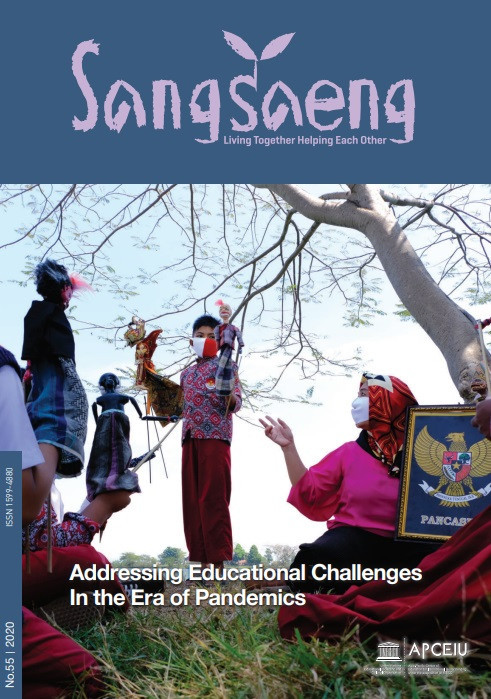 Addressing Educational Challenges In the Era of Pandemics (SangSaeng no.55, 2020) Year of publication: 2023 Corporate author: APCEIU With the prolonged COVID-19 pandemic, the global crisis has further aggravated various multifaceted challenges to humanity. We are forced to prepare for another paradigm shift or, in other words, a “New Normal.” With this in mind, the 55th edition of SangSaeng focuses on “Addressing Educational Challenges in the Era of Pandemics.” Contents03 Editor’s Note04 Special ColumnTowards Sustainability: Implications of Pandemic and How to Create the Future We All Want / Jae C. Choe 08 FOCUS: Addressing Educational Challenges in the Era of Pandemics08 Rethinking Education in the Shadow of the Pandemic / Edward Vickers12 Reimagining Education System to Reduce Social Inequalities / Paul R. Carr16 Reshaping Kenya for Beyond COVID / Jane Wanjiru Nyaga19 Rethinking Human Rights Education in the Pandemic / Abraham Magendzo K.22 Prioritizing GCED in Recovery of Pandemic: Challenges and Opportunities / Romina Kasman 26 Best Practices26 Loxo Yakaar: Hands of Hope / Karima Grant and Chakera McIntosh29 Care for Tomorrow Starts Today / Tina Trdin 32 Special ReportReport on the Round Table: “Next Normal” We Make / IGCED, APCEIU 36 Story TimeHow Do You Paint? / Recka Olasiman 38 Peace in My MemoryGive Me Peace on Earth / Libby Giles 41 Understanding the Asia-Pacific RegionWater Heritage in Southeast Asia / Karen Chin Ai Ying 45 GCED Youth NetworkMeaningful Spaces to Exchange and Learn Together / GCED Youth Network Core Group 48 LetterPromoting GCED in Sri Lanka / Deshamanya A.L.S. Abeywickrama 50 APCEIU in Action
 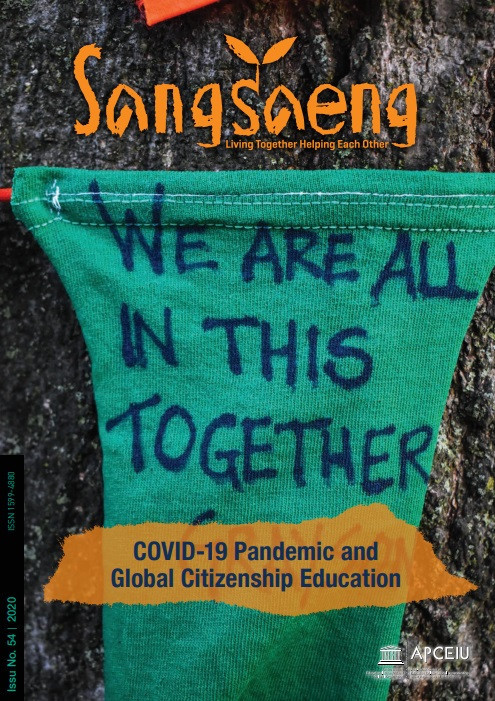 COVID-19 Pandemic and Global Citizenship Education (SangSaeng no.54, 2020) Year of publication: 2023 Corporate author: APCEIU Considering the significance of the global pandemic crisis, the 54th edition of SangSaeng focuses on the “COVID-19 Pandemic and Global Citizenship Education.” This issue invites readers to explore how the pandemic has affected the global community and reflect on how we should and can work together to address our common, multifaceted challenges while enhancing global citizenship and solidarity. Contents03 Editor’s Note04 Special Column What Changes Do We Want in the Post-Coronavirus World? / Hyun Mook Lim 08 FOCUS: COVID-19 Pandemic and Global Citizenship Education08 Reflecting on Global Citizenship Education in the Era of the Pandemic / Soon-Yong Pak12 Choosing Our Post-Pandemic World / Ilan Kelman16 Political Economy of COVID-19 and Global Cooperation / Chang-Yup Kim21 Peace in the Time of Global Pandemic / Yonas Adaye Adeto25 The Pandemic Stall of 2020 / Virginia A. Miralao30 Marine Conservation Efforts in Uncertain Times / Kerstin Forsberg35 Plague, Prejudice and Protest: The Role of Education in Pandemic World / Lynn Davies39 Media and Information Literacy Matters in Preparing for Post-Pandemic World / Divina Frau-Meigs 44 GCED Youth NetworkYouth Voices on the COVID-19 Pandemic and a New Work / Diego Manrique, Tshering Zangmo and Zanji Sinkala in collaboration with Hadi Althib 50 APCEIU in Action
  [Summary] Global Citizenship Education Forum: Sharing Stories of Empowering Citizens to Tackle Global-Local Challenges Year of publication: 2022 Corporate author: Permanent Delegation of the Republic of Korea to UNESCO | Group of Friends for Solidarity and Inclusion with Global Citizenship Education | APCEIU This report shares the overview of the Global Citizenship Education Forum held under the theme ‘Sharing Stories of Empowering Citizens to Tackle Global-Local Challenges’ on Friday, 13 May 2022. The event was co-organized by the Permanent Delegation of the Republic of Korea to UNESCO and the Asia-Pacific Centre of Education for International Understanding (APCEIU) in collaboration with the Group of Friends for Solidarity and Inclusion with GCED (Afghanistan, Armenia, Austria, Bangladesh, Canada, Colombia, Italy, Jordan, Kenya, Kuwait, Philippines, Republic of Korea, Saudi Arabia, Senegal and Serbia). This report shares the summary of the event, particularly the presentations on GCED activities implemented by practitioners from Armenia, Austria, Colombia, Jordan, Kenya and the Philippines to influence more GCED programmes/initiatives on various contexts and backgrounds.
  한국국제이해교육학회 제21차 국제학술대회: 팬데믹 시대, 세계시민교육의 방향과 사명 Year of publication: 2020 Corporate author: 한국국제이해교육학회 | 유네스코 아시아태평양 국제이해교육원 제21차 한국국제이해교육학회 학술대회 자료집으로 ‘팬데믹 시대, 세계시민교육의 방향과 사명’이라는 주제로 팬데믹으로 인한 상황이 더 정의롭고 평화로우며 지속가능한 세상을 만드는데 어떤 새로운 위기를 초래하는지를 점검하고, 그 가운데 교육이 담당해야 할 과제를 다각도로 검토하였다.