
Resources
Explore a wide range of valuable resources on GCED to deepen your understanding and enhance your research, advocacy, teaching, and learning.
63 Results found
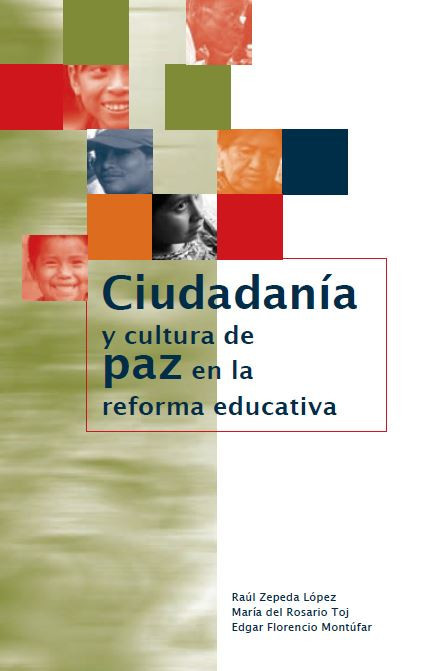 Citizenship and Culture of Peace in Educational Reform Year of publication: 2005 Author: Raúl Zepeda López, María del Rosario Toj, Edgar Florencio Montúfar Corporate author: UNESCO The concern raised by the themes and contents of civic education and the culture of peace in childhood and youth are issues that are felt in various academic sectors, in social organizations and educational authorities that sometimes translate into articles in the media, where, among other things, one speaks of "the loss of values", generally having as reference to the young generations and making invisible that this loss is mainly present in the adult generations, which are responsible for this situation. These concerns, in spite of that conscious ambiguity, are not gratuitous. They can be a starting point to become aware of the need to develop new capacities and values, the absence of which young Latin Americans identify in their political and social leaders, as has been pointed out in cited studies, carried out by UNICEF for Latin America and for Beatriz de Cazali for Guatemala. The need to respond to this concern is also present in the participants in the dialogues and municipal consensus (2000), as well as among authorities and curriculum developers of MINEDUC in the last five-years.
  Proceedings of the international congresses of: education for shared values for intercultural and interfaith understanding, (and) religion in peace and conflict: responding to militancy and fundamentalism Year of publication: 2005 Corporate author: UNESCO The results of this conference, and its direct linkages with the Associated Schools Project Network in your region, will support efforts to mould education so that it becomes more conducive to the development of world citizens, proud of their identities and able to contribute to a sustainable and peaceful future for the world’s peoples.
 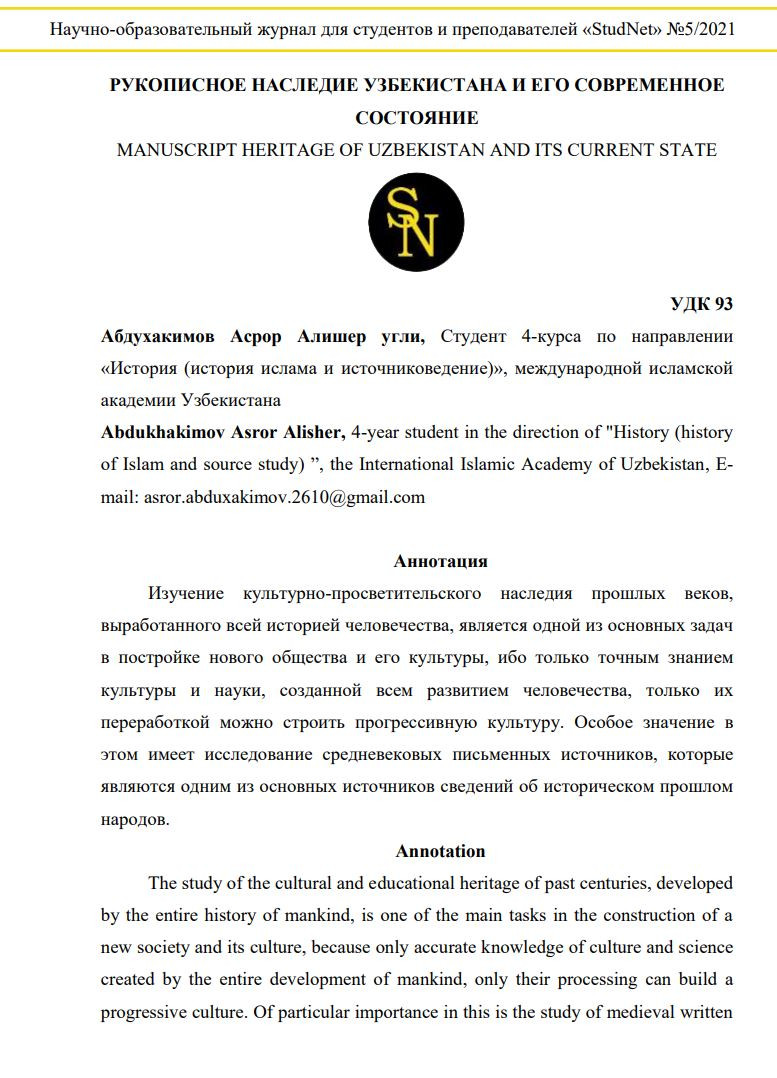 Manuscript Heritage of Uzbekistan and Its Current State Year of publication: 2021 Author: Asror Abdukhakimov The study of the cultural and educational heritage of past centuries, developed by the entire history of mankind, is one of the main tasks in the construction of a new society and its culture, because only accurate knowledge of culture and science created by the entire development of mankind, and their processing can build a progressive culture. Of particular importance in this is the study of medieval written sources, which are one of the main sources of information about the historical past of people.
  Living in a new world starts with education (SangSaeng no. 37 summer autumn 2013) Year of publication: 2013 Author: Hans van Ginkel Corporate author: APCEIU SangSaeng No. 37- How to Foster Global Citizenship? has been published. In order to help our readers better grasp the concept of global citizenship and provide useful information and new ideas, this issue deals with various aspects of global citizenship education.3 Director’s Message4 Special ColumnBuilding True Citizens for a Single Humanity8 Focus: How to Foster Global Citizenship?8 Eliminating World Challenges through Global Citizenship Education 13 Developing Global Citizens with a Global Perspective18 Living in a New World Starts with Education23 GCE in Every Corners of the World28 Best Practices28 Hands-on Hand Print for Environmental Sustainability32 Bhutan Teachers Learn New Models of Education35 Comic Relief: Song of the City36 Special ReportPaving the Way Together for Global Citizenship Education40 InterviewBuilding a Global Community out of the Ashes of Poverty42 LetterCapturing Moments of Living in Harmony44 Peace in My MemoryHow Golf Speaks about Peace47 Understanding the Asia-Pacific RegionDiscovering Locks beyond the Function of Opening and Closing50 APCEIU in Action
  Developing global citizens with a global perspective (SangSaeng no. 37 summer autumn 2013) Year of publication: 2013 Author: Misato Yamaguchi Corporate author: APCEIU SangSaeng No. 37- How to Foster Global Citizenship? has been published. In order to help our readers better grasp the concept of global citizenship and provide useful information and new ideas, this issue deals with various aspects of global citizenship education.3 Director’s Message4 Special ColumnBuilding True Citizens for a Single Humanity8 Focus: How to Foster Global Citizenship?8 Eliminating World Challenges through Global Citizenship Education 13 Developing Global Citizens with a Global Perspective18 Living in a New World Starts with Education23 GCE in Every Corners of the World28 Best Practices28 Hands-on Hand Print for Environmental Sustainability32 Bhutan Teachers Learn New Models of Education35 Comic Relief: Song of the City36 Special ReportPaving the Way Together for Global Citizenship Education40 InterviewBuilding a Global Community out of the Ashes of Poverty42 LetterCapturing Moments of Living in Harmony44 Peace in My MemoryHow Golf Speaks about Peace47 Understanding the Asia-Pacific RegionDiscovering Locks beyond the Function of Opening and Closing50 APCEIU in Action
 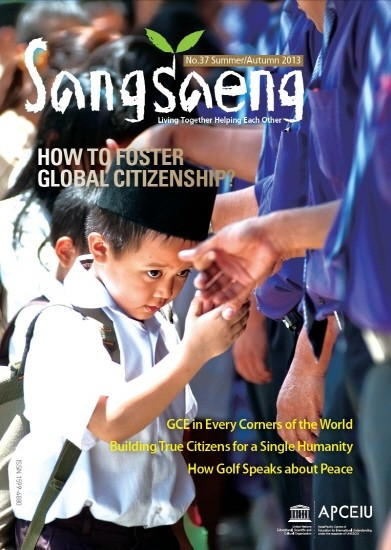 Eliminating world challenges through global citizenship education (SangSaeng no. 37 summer autumn 2013) Year of publication: 2013 Author: Kaisa Savolainen Corporate author: APCEIU SangSaeng No. 37- How to Foster Global Citizenship? has been published. In order to help our readers better grasp the concept of global citizenship and provide useful information and new ideas, this issue deals with various aspects of global citizenship education.3 Director’s Message4 Special ColumnBuilding True Citizens for a Single Humanity8 Focus: How to Foster Global Citizenship?8 Eliminating World Challenges through Global Citizenship Education 13 Developing Global Citizens with a Global Perspective18 Living in a New World Starts with Education23 GCE in Every Corners of the World28 Best Practices28 Hands-on Hand Print for Environmental Sustainability32 Bhutan Teachers Learn New Models of Education35 Comic Relief: Song of the City36 Special ReportPaving the Way Together for Global Citizenship Education40 InterviewBuilding a Global Community out of the Ashes of Poverty42 LetterCapturing Moments of Living in Harmony44 Peace in My MemoryHow Golf Speaks about Peace47 Understanding the Asia-Pacific RegionDiscovering Locks beyond the Function of Opening and Closing50 APCEIU in Action
 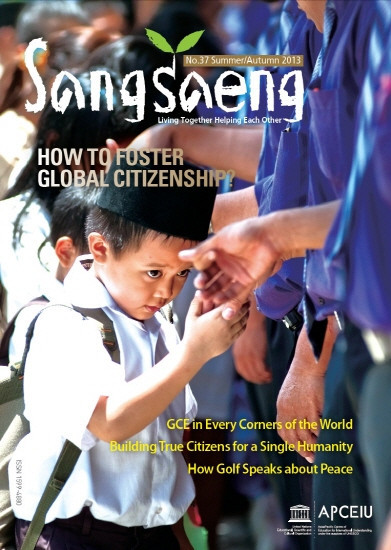 Building true citizens for a single humanity (SangSaeng no. 37 summer autumn 2013) Year of publication: 2013 Corporate author: APCEIU SangSaeng No. 37- How to Foster Global Citizenship? has been published. In order to help our readers better grasp the concept of global citizenship and provide useful information and new ideas, this issue deals with various aspects of global citizenship education.3 Director’s Message4 Special ColumnBuilding True Citizens for a Single Humanity8 Focus: How to Foster Global Citizenship?8 Eliminating World Challenges through Global Citizenship Education 13 Developing Global Citizens with a Global Perspective18 Living in a New World Starts with Education23 GCE in Every Corners of the World28 Best Practices28 Hands-on Hand Print for Environmental Sustainability32 Bhutan Teachers Learn New Models of Education35 Comic Relief: Song of the City36 Special ReportPaving the Way Together for Global Citizenship Education40 InterviewBuilding a Global Community out of the Ashes of Poverty42 LetterCapturing Moments of Living in Harmony44 Peace in My MemoryHow Golf Speaks about Peace47 Understanding the Asia-Pacific RegionDiscovering Locks beyond the Function of Opening and Closing50 APCEIU in Action
 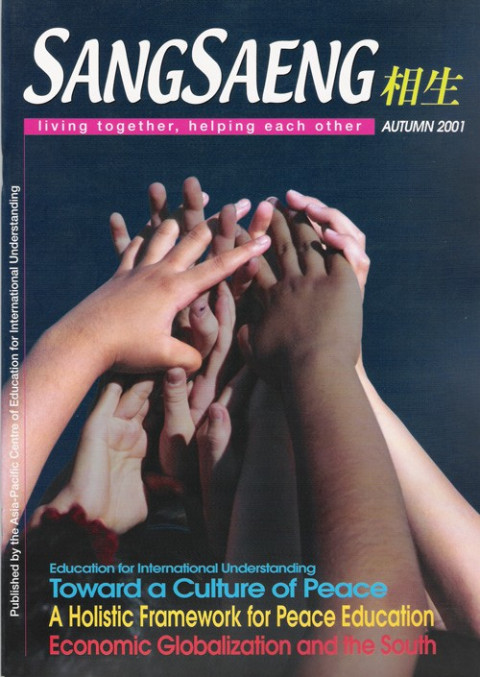 Education for international understanding: toward a culture of peace (SangSaeng vol1. autumn 2001) Year of publication: 2001 Author: Swee-Hin Toh Corporate author: APCEIU Over the past several decades of political, economic, social and cultural changes and developments throughout the world, the idea of education for international understanding (EIU) has evolved through the work of innumerable educators, researchers, institutions and organizations. Initially, the focus in school and tertiary programs tended to emphasize the need to increase the level of knowledge about other nations, societies and cultures as a key means to promote better, more “peaceful” international (economic and political) and intercultural relations. Especially in universities of the “North,” area studies of different regions and countries expanded and found their way into school-based curricula. In part, EIU was deemed important and helpful in the development of human resources needed to implement foreign aid programs. It was also a response to the increased internationalization of campuses due to the growing numbers of foreign/overseas students. By the 60s, however, a variety of social and political forces and movements were beginning to impact on this earlier focus of EIU. First, it was no longer viewed only in terms of understanding the relations between “nations” or “societies” across political and economic boundaries. EIU would need also to look closely at local and internal issues, and at problems of one’s own society that might significantly influence the direction and nature of international relations. Furthermore, conceptual perspectives on EIU began to reflect a spectrum of frameworks of understanding and analysis, from “conservative” and “liberal” to more “critical” paradigms. Underpinning the critical approaches was a questioning of the power inequities characterizing the international order of nation-states, and the need to overcome such gaps if the original vision of “world peace” was to be fulfilled. Third, the evolving theory and practice of EIU took on a host of societal, international and increasingly global issues deemed urgent at all levels of life.
 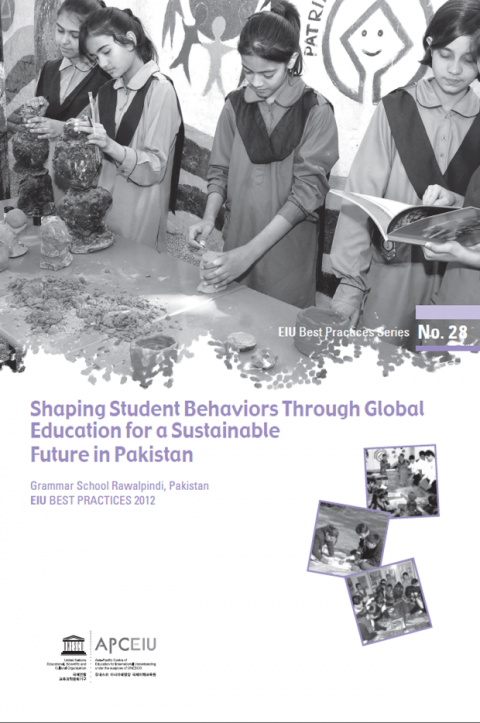 EIU Best Practice Series No. 28: Shaping student behaviors through global education for a sustainable future in Pakistan Year of publication: 2012 Author: Nasreen Iqbal Corporate author: APCEIU Issue No. 28 introduces a Global Education programme with its various activities from Grammar School Rawalpindi in Pakistan. It aims to enable and empower young people to become responsible and humane citizens to achieve a peaceful and sustainable future. It is targeted at all levels of students, including preschool level, to increase their awareness of social and civic values. The programme mainly focuses on EIU while equipping learners with conflict resolution skills, cultural and national identities and global citizenship. Also, it incorporates issues such as universal values, human rights, health, sustainable development, gender, multiculturalism, respect for minority groups, identity and self-worth, tolerance, etc. into the school ethos and curriculum so that the students will be able to perform positive changes on national as well as on international level.
 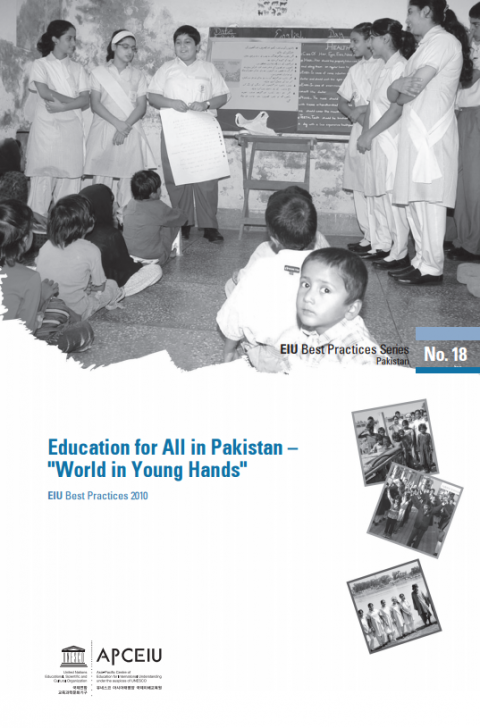 EIU Best Practices Series No.18: Education for All in Pakistan - "world in young hands" Year of publication: 2010 Author: Ayesha Saqib Corporate author: APCEIU The programme provides a student-participatory approach to face local problems that stem from ignorance and have roots in poverty. Bridging the school with the local community, Social Action Program (SAP) aims to inspire students with keen awareness on problems that threaten our community as well as to equip them with necessary tools to deal with challenges they may face. Through practices, SAP integrates EIU into curriculum that emphasizes maintaining peace and harmony among different folds of religions, ethnicity, and sects, dissipating the elements of hate and intolerance. The major areas of concern are Literacy for All, Sustainable Development, Cultural Diversity, and Peace Education.