
Resources
Explore a wide range of valuable resources on GCED to deepen your understanding and enhance your research, advocacy, teaching, and learning.
116 Results found
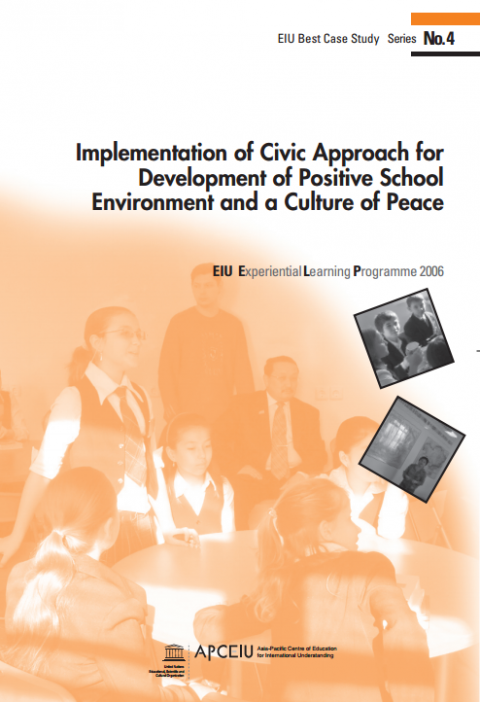 EIU Best Practices Series No. 4: Implementation of Civic Approach for Development of Positive School Environment and a Culture of Peace Year of publication: 2006 Corporate author: APCEIU This monograph is one of APCEIU's EIU Best Practices Series, which aims to encourage educators, scholars, and activists to implement and share local initiatives on EIU. The Series No.4 is an experimental research conducted by the Information and Research Center to promote culture of peace and teaching and learning outcomes that support positive development of school environment. Three pilot schools in Kazakhstan were analyzed upon implementation of teacher training workshops, instructional materials, and programs in civic and human rights education.
  EIU Best Practices Series No. 6: Practical Research on Current Issues: Studies on Global Perspectives in Schools in Japan Year of publication: 2007 Corporate author: APCEIU This monograph is one of APCEIU's EIU Best Practices Series, which aims to encourage educators, scholars, and activists to implement and share local initiatives on EIU. The Series No.6 is a research undertaken on two schools of Japan and Korea, in which students were tasked to conduct research on bilateral conflict issues and devise suggestions for peaceful resolution. Besides classroom discussions and presentations, student exchange visit further allowed active learning and engaging of issues, historical awareness and perception, and mutual understanding as global citizens.
  Common Curriculum Guide for Peace Education in Northeast Asia Year of publication: 2023 Author: Sicong Chen | Kevin Kester | Jeongmin Eom Corporate author: APCEIU Inspired by the recommendations from the study, Peace Education in Northeast Asia: A Situational Analysis (APCEIU, 2021), APCEIU coordinated a project to develop a common curriculum for peace education in Northeast Asia. This initiative was undertaken in partnership with UNESCO Multisectoral Regional Office for East Asia, UNESCO Chair on Peace Studies at Nanjing University, UNESCO Chair on Education for Peace, Social Justice and Global Citizenship at Kyushu University, Peace Education Commission of the Peace Studies Association of Japan, Japan Association for International Education, and Korean Society of Education for International Understanding. This guide serves as a framework for supporting peace education in diverse communities across Northeast Asia. Its primary function is to aid in the design and development of peace education programs tailored to various contexts within the region. It is our sincere hope that this guide will serve as a catalyst, encouraging and assisting more teachers and practitioners in the region to actively participate in our collective efforts to foster peace in and through education.
 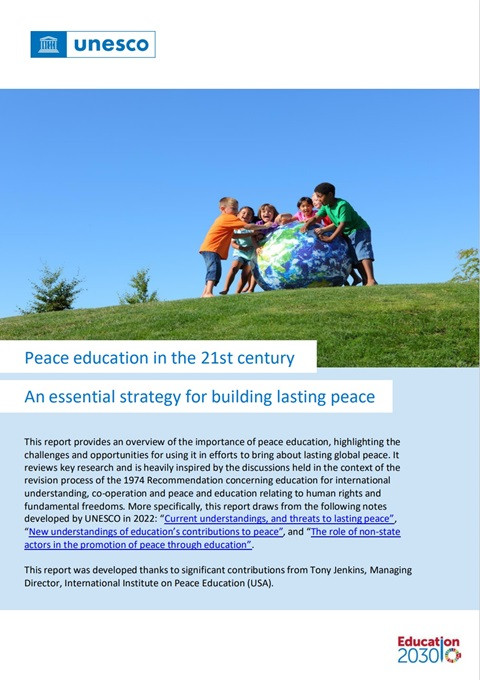 Peace Education in the 21st Century: An Essential Strategy for Building Lasting Peace Year of publication: 2024 Corporate author: UNESCO This report provides an overview of the importance of peace education, highlighting the challenges and opportunities for using it in efforts to bring about lasting global peace. It reviews key research and is heavily inspired by the discussions held in the context of the revision process of the 1974 Recommendation concerning education for international understanding, co-operation and peace and education relating to human rights and fundamental freedoms. More specifically, this report draws from the following notes developed by UNESCO in 2022: “Current understandings, and threats to lasting peace”, “New understandings of education’s contributions to peace”, and “The role of non-state actors in the promotion of peace through education”.
  Recommendation on Education for Peace, Human Rights and Sustainable Development: An Implementation Guide Year of publication: 2025 Corporate author: UNESCO There is no peace without education. With conflicts rising on so many fronts, there has never been a more urgent need for a transformed education geared towards building and sustaining peace.The Recommendation on Education for Peace and Human Rights, International Understanding, Cooperation, Fundamental Freedoms, Global Citizenship and Sustainable Development, adopted by all 194 Member States of UNESCO in 2023, articulates a humanistic and transformative vision of education that can help address contemporary and future affronts to peace. These challenges range from the resurgence of conflicts driven by systemic inequalities and injustices, the rise and spread of hate speech, racism and discrimination particularly online, to the adverse effects of digital technologies and the existential threat of climate change.UNESCO has developed this Guide as the first of several tools to assist Member States in unpacking and fully implementing the 2023 Recommendation. The Guide elaborates its contents, integrating the 2023 Recommendation’s transdisciplinary lens to connect key concepts and issues. It also provides concrete ideas and curated resources for action at different levels and types of education, while calling for a multi-stakeholder and whole-of-society approach that includes everyone and builds on existing positive efforts.The Guide is a timely addition to the pool of available collective resources to fully implement the 2023 Recommendation and foster an education that is transformative for a just and peaceful world.
  Addressing Violent Pasts through Education: A Policy Guide Year of publication: 2025 Corporate author: UNESCO Teaching about violent pasts and their legacies is a powerful way to foster sustainable peace.Education can build a nuanced understanding of complex histories, raise awareness of the roots and legacies of violence, nationally and internationally, and sensitize learners for their own agency as actors of change for reconciliation and conflict prevention.Educating about violent pasts is a challenging yet critical endeavour for policy-makers globally. It entails tailored approaches and an important support for educators to address traumatic pasts sensitively and to navigate related emotions and narratives successfully.Building on UNESCO’s programme on Global Citizenship Education, this guide offers education policy-makers a set of strategies, principles, and education practices to effectively integrate education about violent pasts into local education systems. It suggests a comprehensive approach that spans formal and informal education and aligns with the 2023 Recommendation on Education for Peace, Human Rights and Sustainable Development, opening new perspectives on history education, dialogue, and conflict transformation.