
Resources
Explore a wide range of valuable resources on GCED to deepen your understanding and enhance your research, advocacy, teaching, and learning.
15 Results found
 Psychological Counseling for People with Special Needs: Challenges and Prospects (Conference on Integrative Growth and Development in Special Education: Creating Knowledge for the Futures) Year of publication: 2022 Author: Abdulaziz Ali Alghamdi Corporate author: Umm Al-Qura University | Saudi Arabia. Ministry of Education The study aims to identify the importance of psychological counseling for people with special needs and their families and the challenges facing them and the role of the psychological counselor in guiding them, through literature and studies in this field between (2015–2022). The study concluded that people with special needs have different guiding needs in terms of accepting disability and disorders that arise due to disability and integrating them with society and the resulting challenges that require guidance intervention, which increases the importance of psychological guidance for the study sample and the role of the psychological guide for this group to be familiar with information related to disability, help them to identify the nature of his disability, treatment and fate, and help solve his psychological, social, family and study problems, whether at the level of the individual or his family. Recommendations related to the results of the study were also made.
 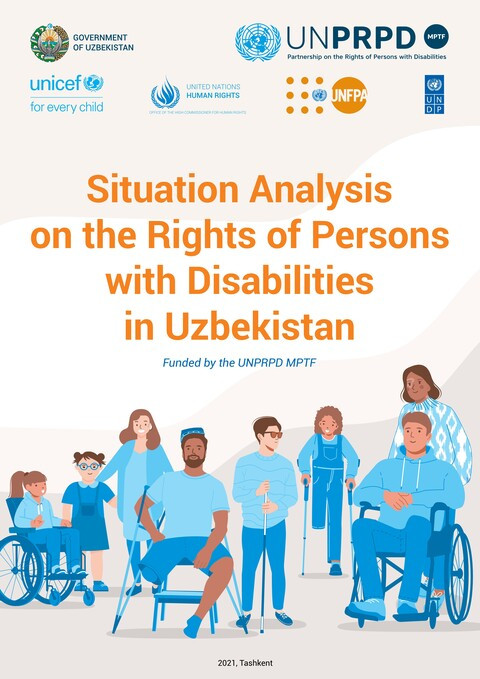 Situation Analysis on the Rights of Persons with Disabilities in Uzbekistan Year of publication: 2021 Corporate author: UNICEF Uzbekistan | United Nations Population Fund (UNFPA) | United Nations Development Programme (UNDP) | UN. Office of the United Nations High Commissioner for Human Rights (UN. OHCHR) This study is based on the results of a situation analysis of children and adults with disabilities conducted in 2019. The ambition of this Situation Analysis is not merely to point at problems but to lay ground for solutions by identifying the opportunities and catalytic forces emerging today. The report looks at the necessary preconditions for realisation of human rights of persons with disabilities, particularly women, girls, and boys with disabilities, such as a robust equality and non-discrimination framework, availability of inclusive and accessible services in the community, disability inclusive financial and coordination mechanisms, transparent monitoring and accountability systems and meaningful participation of persons with disabilities.
  Verbal Communication Difficulties and Ability to Read Mind (Theory of Mind): A Comparative Study Between Autistic Children, Children with Down Syndrome, Children with Speech Disorders and Normal Children (Novels Magazine; Vol.6, No.1) Year of publication: 2022 Author: Zaghish Warda Corporate author: Batna 1 University This study aimed to determine the nature of the relation between verbal communicative ability with its formal and functional aspects and the ability to read mind, and to search for a correlation between mind reading and the mental level in both its verbal and performance aspects, as well as searching for the existence of statistically significant differences between the five samples of the study.The study sample included 30 children of both sexes distributed into five groups, each includes six children between the ages of 5-10 years: (Autistic children, children with Down syndrome, children with formal difficulties, children with functional difficulties,normal children), and to achieve these Objectives the researcher used a test to assess mental reading and an analysis grid for verbal communication, , in addition to the verbal and visual intelligence test of Ejlal Muhammad Serri to assess the mental level .This study reached several results: a correlation between mental reading and verbal communicative ability in its formal and functional aspects, and between mind reading and the mental level in both its verbal and performance aspects, while it was found that there were no statistically significant differences between the samples of normal children, children with formal difficulties, children with functional difficulties, autistic children, and children with Down syndrome, while the differences were significant between samples of normal children, children with formal difficulties, children with functional difficulties and the two samples of autistic children, and children with Down syndrome.
  Disability Discrimination in the Digital Realm: How the ICRPD Applies to Artificial Intelligence Decision-Making Processes and Helps in Determining the State of International Human Rights Law (Human Rights Law Reivew; Volume. 23, Issue. 3) Year of publication: 2023 Author: Tetyana Krupiy | Martin Scheinin Scholars have identified challenges to protecting individuals from discrimination in contexts where organisations deploy artificial intelligence decision-making processes. While scholarship on ‘digital discrimination’ is growing, scholars have paid less attention to the impact of the use of artificial intelligence decision-making processes on persons with disabilities. This article posits that while the use of artificial intelligence technology can be beneficial for some purposes, its deployment can also construct a disability. The article demonstrates that the Convention on the Rights of Persons with Disabilities can be interpreted in a manner that confers a wide variety of human rights on persons with disabilities in the context when entities deploy artificial intelligence decision-making processes. The article proposes a test for digital discrimination based on disability and shows how it can be incorporated into the treaty through legal interpretation. Thereafter, it moves to developing an analogous general test for digital discrimination under international human rights law, applicable beyond a catalogue of protected characteristics.
 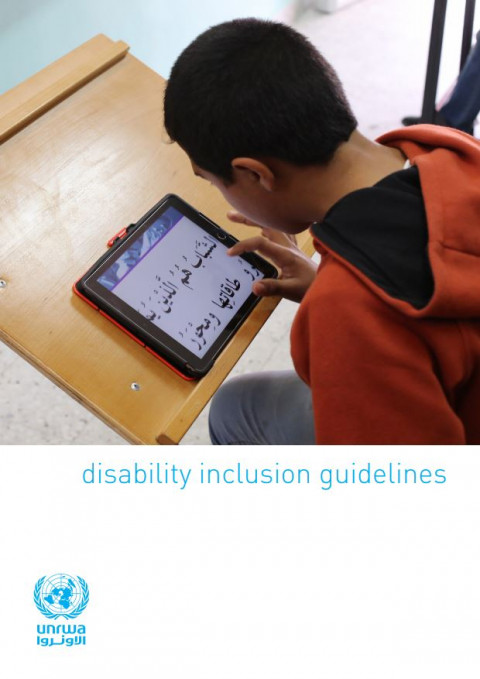 Disability Inclusion Guidelines Year of publication: 2017 Corporate author: United Nations Relief and Works Agency for Palestine Refugees in the Near East (UNRWA) These Guidelines provide information about the recommended approach to disability inclusion within UNRWA. While this document does not provide tools for identifying the particular service provision needs of persons with disabilities in a given sector or context, staff can apply the principles and recommendations in this document to develop specific project- and programme- level actions to further enhance the inclusion of persons with disabilities in UNRWA programmes and services.
  Sultan Qaboos University Students’ Attitudes towards Inclusion of Their Peers with Disabilities Year of publication: 2015 Author: Ibrahim Al Qaryouti | Jokha Al Shukaili Corporate author: Sultan Qaboos University The present study aimed to identify attitudes of students of Sultan Qaboos University towards the inclusion of disabled peers. To achieve the objective of the study, the researchers used a scale to measure students’ attitudes towards inclusion. The final version of the scale consisted of 34 items after verification of validity and reliability. The results showed no significant difference between students of colleges of science and humanities in their attitudes towards the inclusion of their disabled peers. However, there were statistically significant differences in attitudes towards the inclusion of students with disabilities in terms of gender; in favor of females’ domain and the total score. There were differences in attitudes towards the inclusion of students with disabilities among males and females in the college of science, and in favor of females on all domains of the scale.Also, there was significant interaction effect (gender by academic level). Meanwhile, the results of the study did not show statistically significant differences in attitudes between male and female students in the College of Humanities the exception was in behavioral domain, where female students’ attitudes were more positive towards inclusion than male students. In light of these results, the study recommended to study the attitudes of both administration and academic staff towards the inclusion of students with disabilities in Sultan Qaboos University.
  Inclusion of Students with Disabilities in the Regular School: The Experience of Jordan Year of publication: 2017 Author: Lama Ghoneim Corporate author: Al Fayoum Universit This paper is based on the idea of integrating students with disabilities in public schools for normal students. The researcher used the Jordanian experience to demonstrate the possibility of merging.
  Methods of Teaching People with Special Needs "Specialization in Science" Year of publication: 2010 Author: Marwa El-Baz Corporate author: Port Said University This report contains the scientific material used in the teaching methodology for people with special needs course "Specialization Science". The course was divided into multiple topics that familiarize the learner with people with special needs and methods of teaching them.
 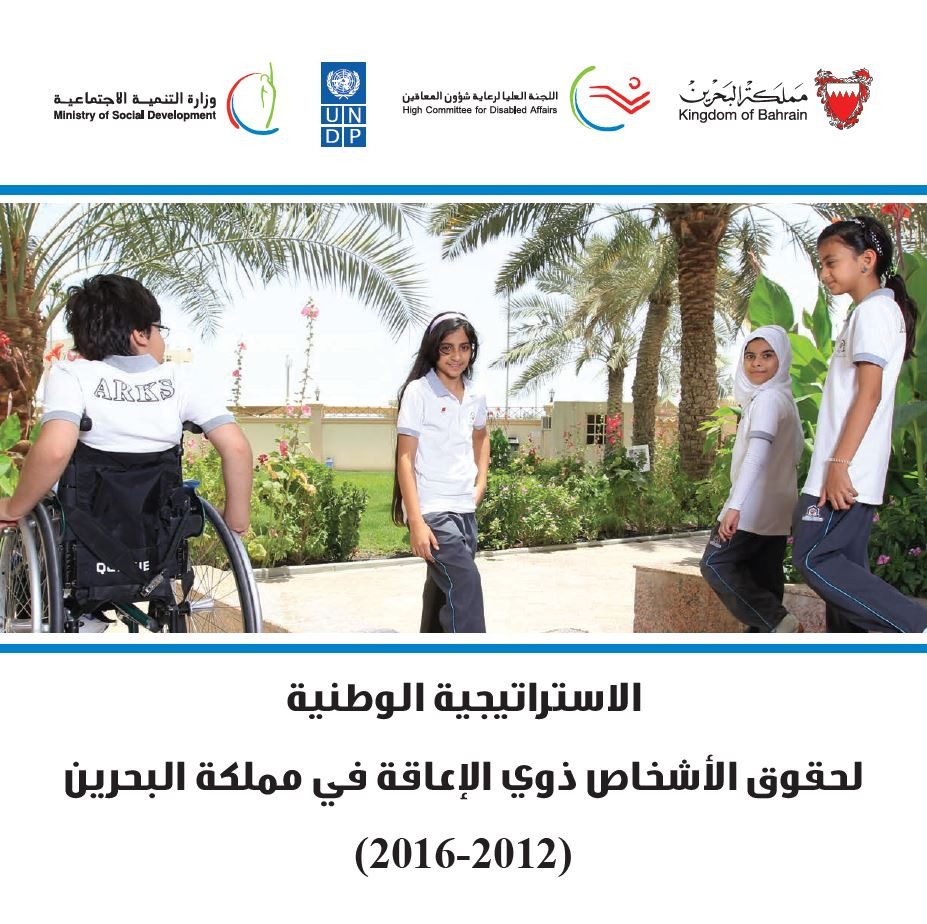 The National Strategy for the Rights of People with Disabilities in the Kingdom of Bahrain (2012-2016) Year of publication: 2012 Corporate author: Bahrain. Ministry of Social Dvelopment The document is a national strategy for the State of Bahrain with regard to the rights of persons with disabilities. This document is based on the Convention on the Rights of Persons with Disabilities, ratified by the Kingdom of Bahrain. This strategy comes in seven axes: legislation, health, rehabilitation, inclusive education, economic empowerment, social empowerment, and the media.
  Comprehensive Societal Integration of People with Disabilities in the Arab and Islamic Society (A Historical-original View) Year of publication: 2012 Author: Ibrahim Alnuqythan Corporate author: Gulf Society for Diability The file is a research paper that discusses the comprehensive integration of persons with disabilities in the Arab and Islamic world. The paper seeks to answer the following questions:- Did the disabled in the Arab-Islamic civilization have a comprehensive integration into society?What are the examples of this integration in the Arab-Islamic civilization?The paper discussed and touched on live models that show the reality of inclusion of persons with disabilities in society.