
Resources
Explore a wide range of valuable resources on GCED to deepen your understanding and enhance your research, advocacy, teaching, and learning.
7 Results found
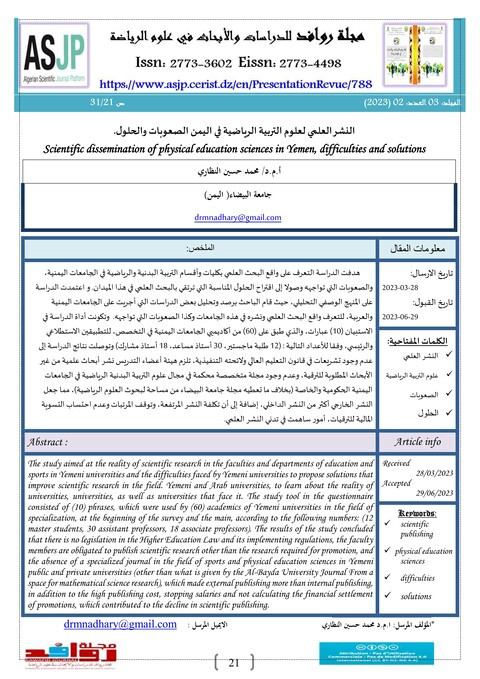 النشر العلمي لعلوم التربية الرياضية في اليمن: الصعوبات والحلول (مجلة روافد للدراسات والأبحاث في علوم الرياضة; Vol.3, No.2) Year of publication: 2023 Author: Al-Nadhari Muhammad Hussein Corporate author: M'sila University هدفت الدراسة التعرف على واقع البحث العلمي بكليات وأقسام التربية البدنية والرياضية في الجامعات اليمنية، والصعوبات التي تواجهه وصولا إلى اقتراح الحلول المناسبة التي ترتقي بالبحث العلمي في هذا الميدان. و اعتمدت الدراسة على المنهج الوصفي التحليلي، حيث قام الباحث برصد وتحليل بعض الدراسات التي أجريت على الجامعات اليمنية والعربية للتعرف واقع البحث العلمي ونشره في هذه الجامعات وكذا الصعوبات التي تواجهه. وتكونت أداة الدراسة في الاستبيان (01) عبارات، والذي طبق على (01) من أكاديميي الجامعات اليمنية في التخصص، للتطبيقين الاستطلاعي والرئيس ي، وفقا للأعداد التالية : (01 طلبة ماجستير، 01 أستاذ مساعد، 01 أستاذ مشارك) وتوصلت نتائج الدراسة إلى عدم وجود تشريعات في قانون التعليم العالي ولائحته التنفيذية، تلزم هيئة أعضاء التدريس نشر أبحاث علمية من غير الأبحاث المطلوبة للترقية، وعدم وجود مجلة متخصصة محكمة في مجال علوم التربية البدنية الرياضية في الجامعات اليمنية الحكومية والخاصة (بخلاف ما تعطيه مجلة جامعة البيضاء من مساحة لبحوث العلوم الرياضية)، مما جعل النشر الخارجي أكثر من النشر الداخلي، إضافة إلى أن تكلفة النشر المرتفعة، وتوقف المرتبات وعدم احتساب التسوية المالية للترقيات، أمور ساهمت في تدني النشر العلمي Scientific Dissemination of Physical Education Sciences in Yemen, Difficulties and Solutions (Rawafed Journal of Studies and Research in Sports Sciences; Vol.3, No.2) Year of publication: 2023 Author: Al-Nadhari Muhammad Hussein Corporate author: M'sila University The study aimed at the reality of scientific research in the faculties and departments of education and sports in Yemeni universities and the difficulties faced by Yemeni universities to propose solutions that improve scientific research in the field. Yemeni and Arab universities, to learn about the reality of universities, universities, as well as universities that face it. The study tool in the questionnaire consisted of (10) phrases, which were used by (60) academics of Yemeni universities in the field of specialization, at the beginning of the survey and the main, according to the following numbers: (12 master students, 30 assistant professors, 18 associate professors). The results of the study concluded that there is no legislation in the Higher Education Law and its implementing regulations, the faculty members are obligated to publish scientific research other than the research required for promotion, and the absence of a specialized journal in the field of sports and physical education sciences in Yemeni public and private universities (other than what is given by the Al-Bayda University Journal From a space for mathematical science research), which made external publishing more than internal publishing, in addition to the high publishing cost, stopping salaries and not calculating the financial settlement of promotions, which contributed to the decline in scientific publishing.
 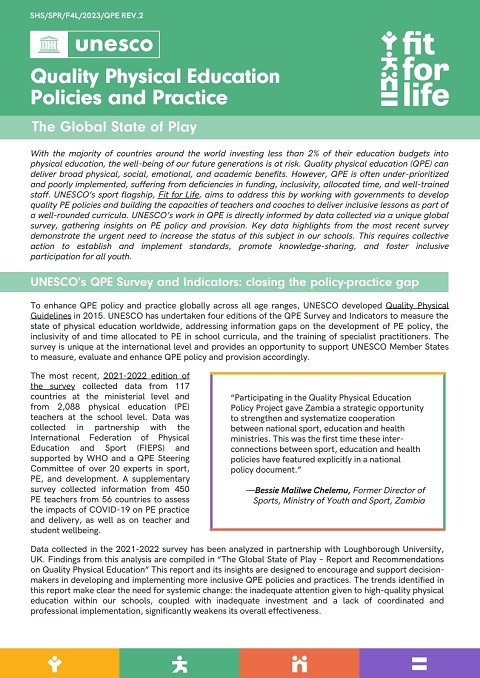 Quality Physical Education Policies and Practice: The Global State of Play Year of publication: 2023 Corporate author: UNESCO With the majority of countries around the world investing less than 2% of their education budgets into physical education, the well-being of our future generations is at risk. Quality physical education (QPE) can deliver broad physical, social, emotional, and academic benefits. However, QPE is often under-prioritized and poorly implemented, suffering from deficiencies in funding, inclusivity, allocated time, and well-trained staff. UNESCO’s sport flagship, Fit for Life, aims to address this by working with governments to develop quality PE policies and building the capacities of teachers and coaches to deliver inclusive lessons as part of a well-rounded curricula. UNESCO’s work in QPE is directly informed by data collected via a unique global survey, gathering insights on PE policy and provision. Key data highlights from the most recent survey demonstrate the urgent need to increase the status of this subject in our schools. This requires collective action to establish and implement standards, promote knowledge-sharing, and foster inclusive participation for all youth.
 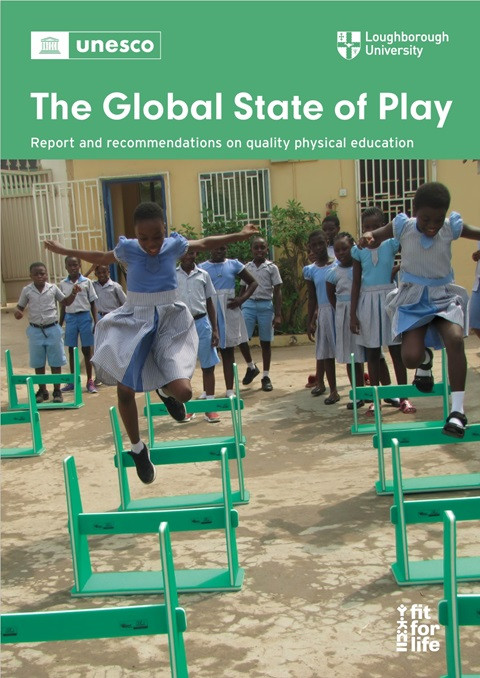 The Global State of Play: Report and Recommendations on Quality Physical Education Year of publication: 2024 Corporate author: UNESCO | Loughborough University Active lifestyles are key to ensuring both individual well-being and sustainable, social development. Quality Physical Education (QPE) plays a key role in achieving this by fostering lifelong physical activity, improving young people’s mental and emotional well-being, and developing critical life skills. UNESCO’s sport initiative, Fit for Life, advocates QPE as a cost-effective investment. Despite its potential as a core curricula subject, UNESCO data reveal that PE is often under-prioritized and due to a lack of investment in certain areas, such as staff training and facilities, potential benefits are not fully realised for students around the world. This investment gap connects directly to a delivery gap. Although 83% of countries worldwide report PE as compulsory in schools, there remain significant issues with the quality of delivery and the diversity of lesson planning within curricula:• Only 1 in 3 secondary school students worldwide meet the minimum requirement of 180 minutes of PE minutes per week set out in UNESCO’s Quality Physical Education Policy Guidelines.• Only 61.7% of schools fully include students with disabilities alongside their peers without disabilities in PE classes.• Only 7.1% of schools implement equal PE time for boys and girls, despite 54.5% of countries having policies or plans for it. Policymakers, PE practitioners and academia are encouraged to take action to implement PE policies, increase investment in PE, upskill PE teachers, enhance PE curricula and promote more equitable and inclusive PE environment.
  Making the Case For Inclusive Quality Physical Education Policy Development: A Policy Brief Year of publication: 2021 Author: Nancy McLennan Corporate author: UNESCO This evidence-based policy brief presents the benefits of investing in inclusive quality physical education (QPE) policy development. Content draws directly on findings from in-country interventions which demonstrate the value of inter-sectoral partnerships in QPE policy development and the delivery of low cost/high impact QPE programming which stands to accelerate post-COVID recovery efforts. A series of practical recommendations are included for public and private stakeholders in the sport-education ecosystem, alongside resources to support the implementation of recommendations. S’engager en faveur de l’élaboration inclusive de politiques d’éducation physique de qualité: Note de politique Year of publication: 2021 Author: Nancy McLennan Corporate author: Organisation des Nations Unies pour l'éducation, la science et la culture (UNESCO) Cette note de politique, fondée sur des faits, présente les avantages à investir dans l’élaboration inclusive de politiques d’Éducation Physique de Qualité (EPQ). Le contenu s’inspire directement des résultats issus d’interventions menées dans quatre pays, qui démontrent l’intérêt des partenariats intersectoriels dans le développement des politiques d’EPQ et de la mise en œuvre de programmes d’EPQ à faible coût/à fort impact qui devraient accélérer les efforts de rétablissement post-COVID. Cette note contient une sélection de recommandations pratiques à destination des acteurs publics et privés de l’écosystème sport-éducation, ainsi que des ressources pour soutenir la mise en œuvre de ces recommandations. En defensa de un desarrollo inclusivo de políticas de educación física de calidad: Informe de políticas Year of publication: 2021 Author: Nancy McLennan Corporate author: Organización de las Naciones Unidas para la Educación, la Ciencia y la Cultura (UNESCO) Este informe presenta los beneficios de la inversión en el desarrollo de políticas inclusivas de educación física de calidad (EFC). Su contenido se funda directamente en evidencias observadas durante intervenciones en países que demuestran la importancia de las asociaciones intersectoriales en el desarrollo de políticas de EFC y en la ejecución de programas de EFC de bajo costo y alto impacto que ayudarán a agilizar los esfuerzos de recuperación tras la COVID. Se incluye una serie de recomendaciones para socios de los sectores público y privado en el ecosistema deportivo – educativo, así como también recursos para apoyar la aplicación de las recomendaciones.