
Resources
Explore a wide range of valuable resources on GCED to deepen your understanding and enhance your research, advocacy, teaching, and learning.
40 Results found
 2014 课程标准 品格与公民教育 小学 Year of publication: 2014 Corporate author: Singapore. Ministry of Education. Student Development Curriculum Division Character and Citizenship Education (CCE) has always been at the heart of Singapore's education system. In CCE, students learn to be responsible to family and community; and understand their roles in shaping the future of nation. The emerging trends and global developments that impact the society, such as social changes, globalisation and technological advancements are taken into consideration in the development of the CCE curriculum.The goal of CCE is to inculcate values and build competencies in students to develop them to be good individuals and useful citizens. Since 1959, various key programmes have been introduced to inculcate values, habits, competencies and skills in students. Some of these programmes include Civics and Moral Education (CME, 1992), National Education (NE, 1997), Social and Emotional Learning (SEL, 2005), and learning experiences such as Co-Curricular Activities (CCA). The new CCE curriculum shifts focus from programmes to a common purpose. The desired outcomes of CCE are aligned to the Key Stage Outcomes (KSOs) and Desired Outcomes of Education (DOE). CCE is central to the Framework for 21st Century Competencies and Student Outcomes. It emphasizes the interconnectedness of the core values, social and emotional competencies and civic literacy, global awareness and cross-cultural skills that are critical for character and citizenship development of students. SUKATAN PELAJARAN 2014 PENDIDIKAN PERWATAKAN DAN KEWARGANEGARAAN SEKOLAH RENDAH Year of publication: 2014 Corporate author: Singapore. Ministry of Education. Student Development Curriculum Division Character and Citizenship Education (CCE) has always been at the heart of Singapore's education system. In CCE, students learn to be responsible to family and community; and understand their roles in shaping the future of nation. The emerging trends and global developments that impact the society, such as social changes, globalisation and technological advancements are taken into consideration in the development of the CCE curriculum.The goal of CCE is to inculcate values and build competencies in students to develop them to be good individuals and useful citizens. Since 1959, various key programmes have been introduced to inculcate values, habits, competencies and skills in students. Some of these programmes include Civics and Moral Education (CME, 1992), National Education (NE, 1997), Social and Emotional Learning (SEL, 2005), and learning experiences such as Co-Curricular Activities (CCA). The new CCE curriculum shifts focus from programmes to a common purpose. The desired outcomes of CCE are aligned to the Key Stage Outcomes (KSOs) and Desired Outcomes of Education (DOE). CCE is central to the Framework for 21st Century Competencies and Student Outcomes. It emphasizes the interconnectedness of the core values, social and emotional competencies and civic literacy, global awareness and cross-cultural skills that are critical for character and citizenship development of students. 2014 syllabus: character and citizenship education: primary Year of publication: 2014 Corporate author: Singapore. Ministry of Education. Student Development Curriculum Division Character and Citizenship Education (CCE) has always been at the heart of Singapore's education system. In CCE, students learn to be responsible to family and community; and understand their roles in shaping the future of nation. The emerging trends and global developments that impact the society, such as social changes, globalisation and technological advancements are taken into consideration in the development of the CCE curriculum.The goal of CCE is to inculcate values and build competencies in students to develop them to be good individuals and useful citizens. Since 1959, various key programmes have been introduced to inculcate values, habits, competencies and skills in students. Some of these programmes include Civics and Moral Education (CME, 1992), National Education (NE, 1997), Social and Emotional Learning (SEL, 2005), and learning experiences such as Co-Curricular Activities (CCA). The new CCE curriculum shifts focus from programmes to a common purpose. The desired outcomes of CCE are aligned to the Key Stage Outcomes (KSOs) and Desired Outcomes of Education (DOE). CCE is central to the Framework for 21st Century Competencies and Student Outcomes. It emphasizes the interconnectedness of the core values, social and emotional competencies and civic literacy, global awareness and cross-cultural skills that are critical for character and citizenship development of students.
 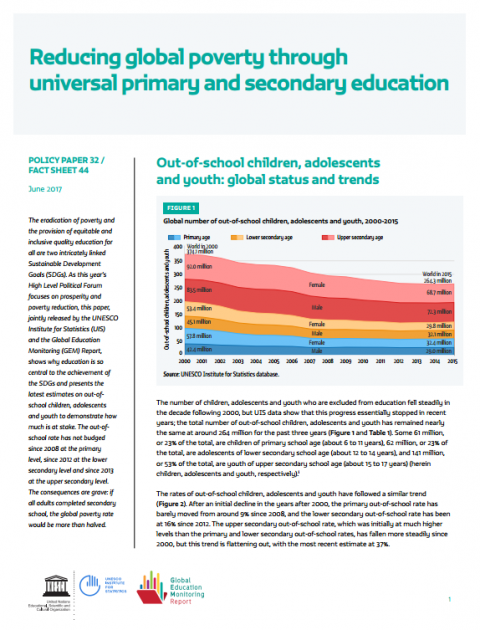 Reducing global poverty through universal primary and secondary education Year of publication: 2017 Corporate author: UNESCO The eradication of poverty and the provision of equitable and inclusive quality education for all are two intricately linked Sustainable Development Goals (SDGs). As this year’s High Level Political Forum focuses on prosperity and poverty reduction, this paper, jointly released by the UNESCO Institute for Statistics (UIS) and the Global Education Monitoring (GEM) Report, shows why education is so central to the achievement of the SDGs and presents the latest estimates on out-ofschool children, adolescents and youth to demonstrate how much is at stake. The out-ofschool rate has not budged since 2008 at the primary level, since 2012 at the lower secondary level and since 2013 at the upper secondary level. The consequences are grave: if all adults completed secondary school, the global poverty rate would be more than halved.
 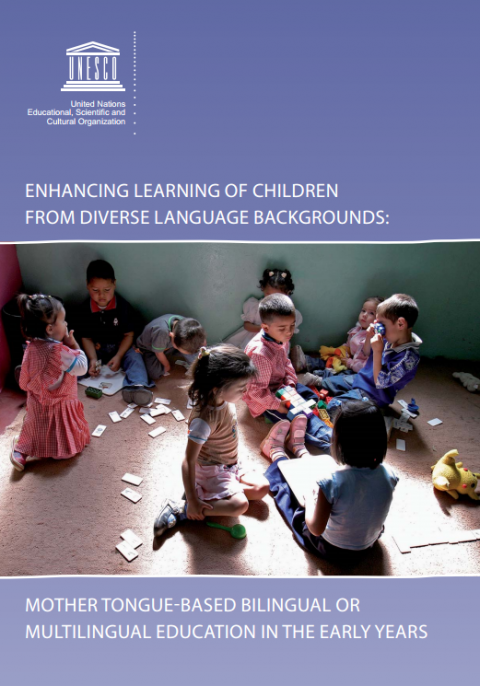 Enhancing learning of children from diverse language backgrounds: mother tongue-based bilingual or multilingual education in the early years Year of publication: 2011 Author: Jessica Ball Corporate author: UNESCO This literature review discusses mother tongue based bilingual or multilingual education for children starting in early childhood. The report: (1) informs policy-makers of existing research and practices in mother-tongue instruction in early childhood and early primary school years; and (2) raises awareness of the value of maintaining the world’s languages and cultures by promoting and resourcing mother tongue-based education for young children. This analysis of current literature is framed within UNESCO’s mandate and strong commitment to quality education for all and to cultural and linguistic diversity in education (UNESCO, 2003a). This discussion is especially timely, given the slow and uneven progress (UNESCO, 2000) in meeting international targets for universal education articulated in the Education for All Goals 1 (ECCE), Goal 2 (Primary Education), and Goal 6 (Quality of Education) (World Declaration on Education for All, 1990).1 Impetus for the current report is provided by the UNESCO (2008a) ‘Global Monitoring Report on Education for All: Will we make it?’ The 2008 GMR report calls for unwavering political will to ensure that education from early childhood onwards is a priority of national governments, civil society and the private sector in order to ensure educational inclusion for the 72 million children out of school and to reduce the numbers of young learners who leave school without acquiring essential skills and knowledge. The report calls for increased investments in the provision of pre-primary education for children aged 3 and above, and for policy measures to provide care and education to children below age 3. UNESCO (2007a) emphasizes the role of early childhood care and development in laying the foundation for learning and setting the stage for successful engagement in formal education. UNESCO has encouraged mother tongue instruction in early childhood and primary education since 1953 (UNESCO, 1953). Yet, monolingualism in official or dominant languages is still the norm around the world (Arnold, Bartlett, Gowani, & Merali, 2006; Wolff & Ekkehard, 2000). In its report, ‘Strong Foundations: Early Childhood Care and Education’, UNESCO (2007a) points out the overlooked advantages of multilingual education in the early years. When children are offered opportunities to learn in their mother tongue, they are more likely to enrol and succeed in school (Kosonen, 2005) and their parents are more likely to communicate with teachers and participate in their children’s learning (Benson, 2002). Mother tongue based education especially benefits disadvantaged groups, including children from rural communities (Hovens, 2002), and girls, who tend to have less exposure to an official language and tend to stay in school longer, achieve better, and repeat grades less oft en when they are taught in their mother tongue (UNESCO Bangkok, 2005). Renforcer l'apprentissage des enfants issus de milieux linguistiques diverses: basée sur la promotion de l'enseignement en langue maternelle ou de l'éducation bilingue multilingue Year of publication: 2011 Author: Jessica Ball Corporate author: UNESCO Cette revue de la littérature aborde la langue maternelle basée éducation bilingue ou multilingue pour les enfants à partir de la petite enfance. Le rapport: (1) informe les décideurs de la recherche et des pratiques en enseignement en langue maternelle dans la petite enfance et les premières années de l'école primaire existante; et (2) soulève conscience de la valeur du maintien des langues et des cultures du monde par la promotion et de ressourcement mère éducation fondée sur la langue, pour les jeunes enfants. Cette analyse de la littérature actuelle est encadrée au sein de l'UNESCO mandat et engagement fort à l'éducation de qualité pour tous et à la diversité culturelle et linguistique dans l'éducation (UNESCO, 2003a). Cette discussion est particulièrement opportune, compte tenu des progrès lents et inégaux (UNESCO, 2000) pour atteindre les objectifs internationaux pour l'Éducation Universelle énoncée dans l'Éducation Pour Tous les Objectifs 1, Objectifs 2 (enseignement primaire), et Objectifs 6 (qualité de l'éducation ) (déclaration mondiale sur l'éducation pour tous, 1990) .1 Impetus pour le rapport actuel est fourni par l'UNESCO (2008a) «Rapport mondial de suivi sur l'éducation pour tous: Allons-nous faire?» le rapport GMR 2008 appelle à une volonté politique sans faille veiller à ce que l'éducation de la petite enfance est en avant une priorité des gouvernements nationaux, la société civile et le secteur privé afin d'assurer l'insertion scolaire pour les 72 millions d'enfants de l'école et de réduire le nombre de jeunes apprenants qui quittent l'école sans avoir acquis les compétences essentielles et de la connaissance.
 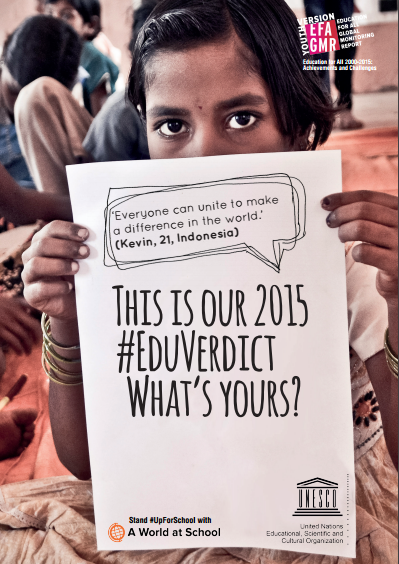 Education for All 2000-2015: Achievements and Challenges; Education for All Global Monitoring Report, 2015; Youth Version Year of publication: 2015 Corporate author: UNESCO This report highlights the progress and challenges of education that countries have faced over 15 years, brining together the voices of young people to show how Education for All (EFA) has affected their lives and hope for the future. L'Education pour tous 2000-2015: progrès et enjeux, rapport mondial de suivi sur l'EPT, 2015, youth version Year of publication: 2015 Corporate author: UNESCO This report highlights the progress and challenges that countries have faced over 15 years, brining together the voices of young people to show how Education for All (EFA) has affected their lives. La Educación para Todos, 2000-2015: logros y desafíos, informe de seguimiento de la EPT en el mundo, 2015: youth version Year of publication: 2015 Corporate author: UNESCO This report highlights the progress and challenges that countries have faced over 15 years, brining together the voices of young people to show how Education for All (EFA) has affected their lives.
  Regional overview: Central and Eastern Europe and Central Asia Year of publication: 2015 Corporate author: UNESCO Central and Eastern Europe (CEE) and Central Asia (CA) have both made significant advances towards Education for All (EFA) since 1999. However, the 2015 EFA Global Monitoring Report shows that despite progress, Education For All remains unfinished business, including in Central and Eastern Europe and in Central Asia. This must be taken into account in the post-2015 agenda.