
Resources
Explore a wide range of valuable resources on GCED to deepen your understanding and enhance your research, advocacy, teaching, and learning.
4 Results found
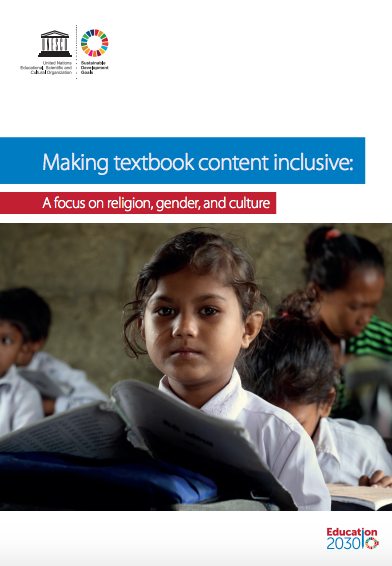 Making Textbook Content Inclusive: A Focus on Religion, Gender, and Culture Year of publication: 2017 Corporate author: UNESCO UNESCO has been working on textbook development issues since its inception in 1945 as part of its fundamental mandate to “build peace in the minds of men and women.” The present guide’s primary task is to enable its users to address and counter stereotypes in a variety of educational contexts, through teaching and learning materials. The three key issues – religion, gender and culture – were chosen for their common link to the concept of human diversity. These three potentially controversial topics are important aspects of inclusive education because they help shape the learning environment of a school as well as its educational practices.The guide was intentionally written in a simple, practical style so as to be immediately accessible to textbook developers, adopters, and users, even those who are working on their own. Although it is designed primarily for textbook authors, curriculum developers, and teachers, it might also be particularly useful for publishers, political stakeholders, and teacher educators. Pour des manuels scolaires au contenu inclusif Year of publication: 2017 Corporate author: UNESCO UNESCO has been working on textbook development issues since its inception in 1945 as part of its fundamental mandate to “build peace in the minds of men and women.” The present guide’s primary task is to enable its users to address and counter stereotypes in a variety of educational contexts, through teaching and learning materials. The three key issues – religion, gender and culture – were chosen for their common link to the concept of human diversity. These three potentially controversial topics are important aspects of inclusive education because they help shape the learning environment of a school as well as its educational practices.The guide was intentionally written in a simple, practical style so as to be immediately accessible to textbook developers, adopters, and users, even those who are working on their own. Although it is designed primarily for textbook authors, curriculum developers, and teachers, it might also be particularly useful for publishers, political stakeholders, and teacher educators.
  International Symposium on Cultivating Wisdom, Harvesting Peace: Educating for a Culture of Peace through Values, Virtues, and Spirituality of Diverse Cultures, Faiths, and Civilizations; Symposium Recommendations Year of publication: 2005 Corporate author: Griffith University. Multi-Faith Centre On the 10-13th August 2005, over 120 delegates from 25 countries gathered at the International Symposium to share their inspirational insights and experiences on the theme of “Cultivating Wisdom, Harvesting Peace.” The Symposium was organized and hosted by the Multi-Faith Centre of Griffith University, Brisbane, Australia with the support of Pure Land Learning College, UNESCO and various UNESCO National Commissions, centres or offices, and numerous faith, interfaith, educational and civil society organizations and institutions. Reflecting a diversity of cultures, faiths and spirituality traditions, the delegates presented rich and empowering stories as well as critical analyses of how communities, institutions, civil society organizations, and international or global agencies have organized educational projects and programs to address the root causes of violence and conflicts and build a culture of peace at all levels of life. Over four intensive days of inter-faith and intra-faith dialogue, the Symposium participants engaged with humility and passion in sharing their wisdoms on ways to promote mutual understanding, solidarity, and cooperation across cultures and national boundaries. While recognizing that differences between faiths and cultures need to be understood, the dialogue also clearly showed that all faiths, cultures, and civilizations have, at their core, key values, virtues, and ethical principles that inspire and sustain peaceful relationships, communities and societies.The Symposium also highlighted the urgent need for exemplars and possibilities for transforming principles, values and visions into personal and social actions and practices in all the multiple dimensions of a culture of peace. In this first decade of the 21st century, it is clear that there are still many formidable challenges of building peace posed by prevailing realities of conflicts and violence in local, national, international and global contexts. The Symposium on “Cultivating Wisdom, Harvesting Peace” was therefore a most timely and relevant event, not only for promoting the urgent dialogue needed, but also most importantly in proposing constructive policies for educational transformation worldwide. This Summary of the Symposium Recommendations will hopefully be a very helpful document for the implementation of effective and creative strategies and practices of educating for wisdom towards a culture of peace. It is offered to government leaders, policy makers, educators, and leaders and members of diverse faith and interfaith institutions and communities in all societies and regions, in the hope that we will join our minds, hearts and spirit in solidarity to build a “one world” of peace, compassion, justice, love and diverse shared values for the well being of a common humanity and earth community Colloque international sur la culture de la sagesse, la récolte de la paix: l'éducation pour une culture de la paix à travers les valeurs, les vertus, et la spiritualité de diverses cultures, religions et civilisations; recommandations du symposium Year of publication: 2005 Corporate author: Griffith University. Multi-Faith Centre Au 10-13 Août 2005, plus de 120 délégués de 25 pays se sont réunis lors du symposium international de partager leurs idées et expériences d'inspiration sur le thème «Cultiver la Sagesse, la récolte de la paix.» Le colloque a été organisé et accueilli par la Foi multi Centre de l'Université Griffith, Brisbane, Australie avec le soutien de la Terre pure College Learning, l'UNESCO et diverses commissions nationales pour l'UNESCO, des centres ou des bureaux, et de nombreux foi, interreligieux, les organisations et les institutions éducatives et la société civile. Reflétant la diversité des cultures, des religions et des traditions de spiritualité, les délégués ont présenté des histoires riches et l'autonomisation ainsi que des analyses critiques de la façon dont les collectivités, les institutions, les organisations de la société civile et des organismes internationaux ou mondiaux ont organisé des projets et des programmes éducatifs pour faire face aux causes profondes de la la violence et les conflits et construire une culture de paix à tous les niveaux de la vie. Plus de quatre jours intensifs de interconfessionnel et le dialogue intra-religieux, les participants au symposium engagés avec humilité et passion à partager leurs sagesses sur les moyens de promouvoir la compréhension mutuelle, la solidarité et la coopération entre les cultures et les frontières nationales. Tout en reconnaissant que les différences entre les religions et les cultures doivent être compris, le dialogue a également montré clairement que toutes les religions, les cultures et les civilisations ont, à leur base, les valeurs clés, les vertus et les principes éthiques qui inspirent et maintenir des relations pacifiques, les communautés et les sociétés . Le Symposium a également souligné le besoin urgent d'exemplaires et les possibilités de transformer les principes, les valeurs et les visions en actions et les pratiques personnelles et sociales dans tous les multiples dimensions d'une culture de la paix. Dans cette première décennie du 21e siècle, il est clair qu'il ya encore de nombreux défis formidables de consolidation de la paix que posent les réalités prévalant des conflits et de la violence dans des contextes locaux, nationaux, internationaux et mondiaux. Le Symposium sur "Sagesse Cultivant, récolte la paix» était donc un événement le plus opportun et pertinent, non seulement pour promouvoir le dialogue urgent besoin, mais aussi le plus important de proposer des politiques constructives pour la transformation de l'éducation dans le monde entier. Ce résumé des recommandations du Symposium, nous l'espérons être un document très utile pour la mise en œuvre des stratégies et des pratiques de l'éducation pour la sagesse vers une culture de la paix efficaces et créatives. Il est offert aux chefs de gouvernement, les décideurs, les éducateurs et les dirigeants et les membres des institutions et des communautés religieuses et interconfessionnelles diverses dans toutes les sociétés et les régions, dans l'espoir que nous nous joindrons nos esprits, les cœurs et l'esprit de solidarité pour construire un "one monde "de la paix, la compassion, la justice, l'amour et les valeurs partagées diverses pour le bien-être d'une communauté de l'humanité et de la terre commune.