
Resources
Explore a wide range of valuable resources on GCED to deepen your understanding and enhance your research, advocacy, teaching, and learning.
19 Results found
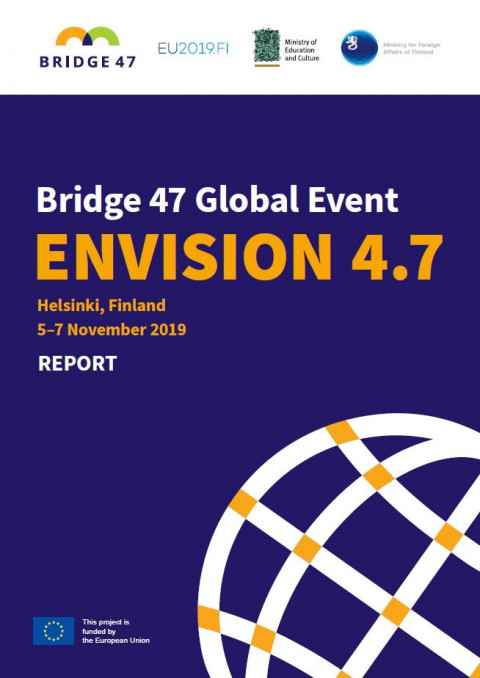 Envision 4.7: Bridge 47 Global Event; Helsinki, Finland 5–7 November 2019: Report Year of publication: 2019 Corporate author: Bridge 47 | Frinland. Ministry of Education and Culture | Finland. Ministry for Foreign Affairs Global event Envision 4.7 was held in Helsinki in November 2019. The event brought around 200 people together to discuss ways to take the SDG Target 4.7 forward. In this report you can find summaries of all the speeches, panel discussions, workshops and working groups that were held at the event, together with a summary of discussions around all the different topics. You can also find pictures and drawings from the event at the report.
  Guide on Human Rights Education Curriculum Development Year of publication: 2021 Author: Cecilia Decara | Carol Rask | Felisa Tibbitts Corporate author: Danish Institute for Human Rights This document aims to bring conceptual clarity on human rights education and curriculum development and provide concrete suggestions on how to build human rights curricula ft for 21st century human rights challenges, while contributing to the realisation of the SDG goals and targets set by the international community.
 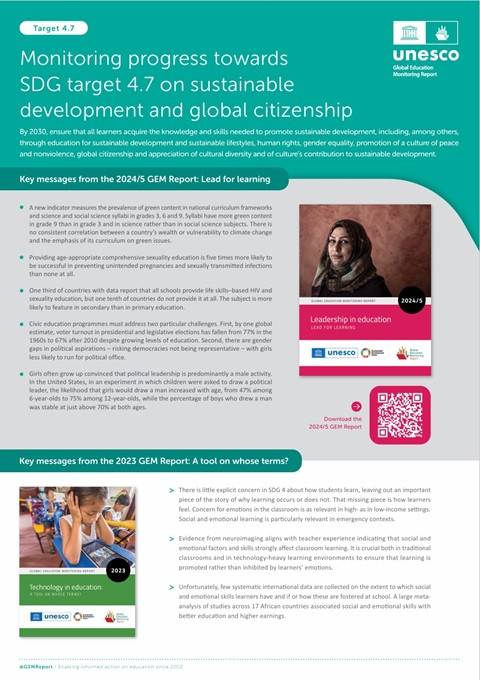 Monitoring Progress towards SDG Target 4.7 on Sustainable Development and Global Citizenship Year of publication: 2024 Corporate author: UNESCO | Global Education Monitoring Report Team This document introduces key messages from the GEM Reports and other related publications and online resources regarding the progress towards SDG Target 4.7.
  Envision 4.7 Event and Roadmap Year of publication: 2021 Corporate author: Bridge 47 Envision 4.7 took place in Helsinki in 2019, bringing together 200 education practitioners, civil society representatives and decision makes to create the Envision 4.7 Roadmap, a policy guideline to the future implementation of SDG Target 4.7 in Europe.
  Guidelines for Implementing SEL in Schools Year of publication: 2022 Corporate author: Mahatma Gandhi Institute of Education for Peace and Sustainable Development (MGIEP) Schools that promote SEL help in their students’ academic and global learning. It enables learners to live peacefully with others in heterogeneous societies and build ‘tolerance’ and ethics in behaviour in terms of universal human traits that go beyond social, cultural and gender differences. SEL cultivates children’s wellbeing, and because schools are mirrors or microcosms of our larger and dynamic societies, it is vital that personal and social learning be mainstreamed in schools. The purpose of these guidelines is to share the latest research with policymakers, school leaders, and teachers looking to integrate SEL into school practices and present scientific evidence on creating school environments and recommending practices that are key to building peaceful and sustainable societies.
 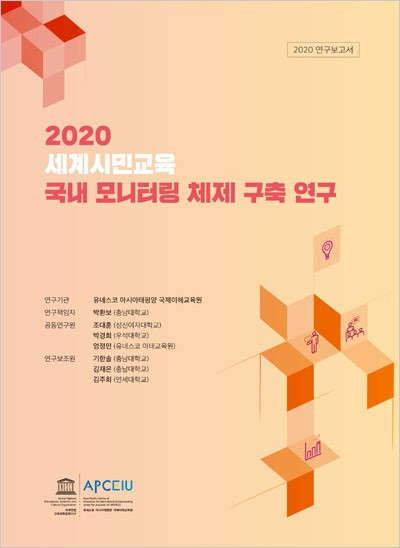 A Study on the Monitoring Framework of GCED in South Korea Year of publication: 2020 Author: Hwanbo Park | Daehoon Jho | Kyunghee Park | Jeongmin Eom Corporate author: APCEIU The purpose of this study is to establish a feasible monitoring system for the implementation of Global Citizenship Education (GCED) in South Korea that can both align itself with the global indicator (SDG 4.7.1) and reflect the domestic context and feasibility. The study further builds upon previous studies carried out by the Asia-Pacific Centre of Education for International Understanding (APCEIU). Particularly, it aims to refine and validate the GCED indicator system for domestic monitoring as proposed in the previous studies, which are also in line with SDG 4.7.1, the global indicator to monitor the mainstreaming of GCED/ESD.To this end, the study involved a Delphi survey and expert consultation to build the refined list and classification of GCED related thematic areas and keywords contextualized in Korea, and aligned these with global indicators so that it could establish a set of sub-indicators for the South Korean context. Then, it pilot-tested the sub-indicators by codifying and statistically analyzing key policy documents and the curricula of Teacher Education Institutes (TEIs) to validate the sub-indicators and to examine the extent to which GCED is mainstreamed in the given domains of the Korean context. Case analyses with focused interviews for some TEI curricula were also added to enrich the study. Lastly, the study draws key implications and proposes some recommendations for the establishment of a feasible and sustainable GCED monitoring system in South Korea. Considering the importance of national input in initiating the SDG agenda, the research concluded with a proposal on how to manage the global citizenship indicators in South Korea. 2020 세계시민교육 국내 모니터링 체제 구축 연구 Year of publication: 2020 Author: 박환보 | 조대훈 | 박경희 | 엄정민 Corporate author: 유네스코 아시아태평양 국제이해교육원 유네스코 아태교육원은 세계시민교육의 국내 모니터링을 체계화하기 위한 노력의 일환으로 “2020 세계시민교육 국내 모니터링 체제 구축 연구”를 실시, 결과물을 보고서로 발간하였다. 본 연구는 지속가능발전목표 글로벌 지표(4.7.1)에 부합하면서 국내 맥락과 실효성이 반영된 세계시민교육 이행 모니터링 체제 구축 방안을 모색하는데 목적이 있다.이를 위하여 첫째, 아태교육원의 선행 연구에서 제안한 세계시민교육 지표체계를 델파이 조사 및 전문가 협의를 통해 정교화하고 타당도를 높였으며, 둘째, 고도화된 하위지표 체계를 적용하여 국내 교육정책 및 교사교육 분야에 있어 세계시민교육 주류화 정도를 문헌연구, 통계자료 분석 등을 통하여 시범적으로 분석하였고, 이와 함께, 정책 및 교원양성교육의 사례도 제시하고 있다. 마지막으로 이러한 연구 결과를 토대로 국내 세계시민교육 모니터링 체제 구축 방안에 대한 시사점을 도출하였으며, 특히 SDGs에서 강조하는 국가별 자율적 이행을 고려하여, 한국에서 어떻게 세계시민교육 지표를 관리할 것인지에 대해 제언하였다.
  Being and Becoming Global Citizens: Measuring Progress toward SDG 4.7 (Phase I: Monitoring teacher and school readiness to enact global citizenship in the Asia-Pacific region) Year of publication: 2023 Author: Rachel Parker | Jennie Chainey | Payal Goundar | Sarah Richardson | Anna Dabrowski | Amy Berry | Claire Scoular Corporate author: Australian Council for Educational Research (ACER) | APCEIU Since 2022, APCEIU and the Australian Council for Educational Research (ACER) have conducted a study to identify enhanced tools and resources for schools and systems in the Asia-Pacific region to monitor and evaluate GCED in line with SDG 4.7.The Report of the Research for Phase 1 is available in three forms: Full report; Summary; and Policy Brief.
 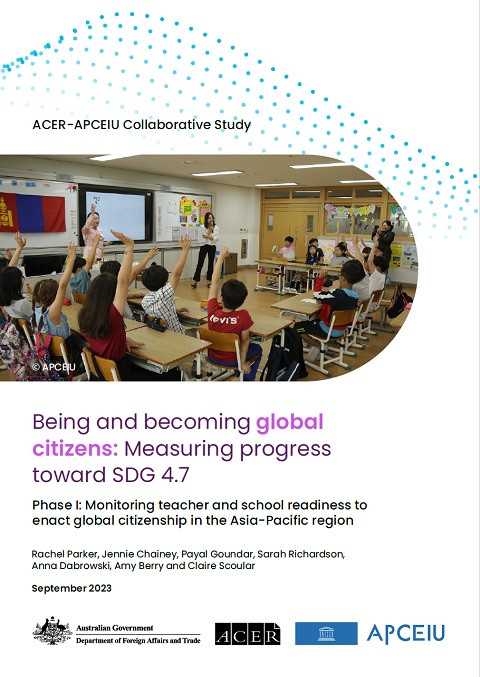 [Summary] Being and Becoming Global Citizens: Measuring Progress toward SDG 4.7 (Phase I: Monitoring teacher and school readiness to enact global citizenship in the Asia-Pacific region) Year of publication: 2023 Author: Rachel Parker | Jennie Chainey | Payal Goundar | Sarah Richardson | Anna Dabrowski | Amy Berry | Claire Scoular Corporate author: Australian Council for Educational Research (ACER) | APCEIU This is a summary report of the Being and Becoming Global Citizens: Measuring Progress toward SDG 4.7 (Phase I: Monitoring teacher and school readiness to enact global citizenship in the Asia-Pacific region), conducted by APCEIU and ACER in since 2022.
 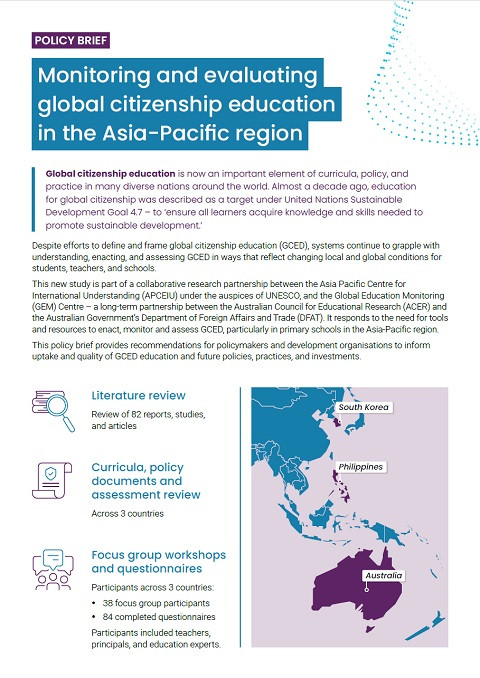 [Policy Brief] Monitoring and Evaluating Global Citizenship Education in the Asia-Pacific Region Year of publication: 2023 Author: Payal Goundar | Rachel Parker Corporate author: Australian Council for Educational Research (ACER) | APCEIU This is a policy brief version of the reserach report, Being and Becoming Global Citizens: Measuring Progress toward SDG 4.7 (Phase I: Monitoring teacher and school readiness to enact global citizenship in the Asia-Pacific region), conducted by APCEIU and ACER in since 2022.