
Resources
Explore a wide range of valuable resources on GCED to deepen your understanding and enhance your research, advocacy, teaching, and learning.
6 Results found
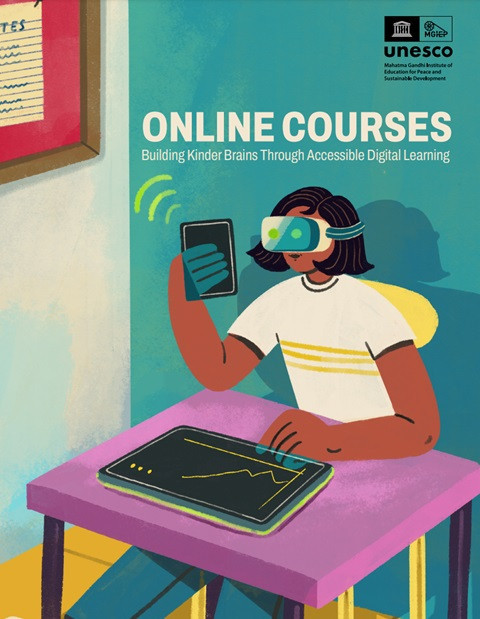 Online Courses: Building Kinder Brains Through Accessible Digital Learning Course Brochure Year of publication: 2023 Corporate author: Mahatma Gandhi Institute of Education for Peace and Sustainable Development (MGIEP) UNESCO MGIEP focuses on achieving the United Nations (UN) Sustainable Development Goal (SDG) 4, Target 7 towards education for building peaceful and sustainable societies across the world by developing programmes that promote social and emotional learning, innovate digital pedagogies and empower the youth. UNESCO MGIEP‘s Social Emotional Learning (SEL) courses are research and evidence based with built-in assessments. The courses are multi-modal, interactive and self-paced, and are designed to build intellectual and emotional intelligence among learners. Currently the courses are available in English and are being adapted to Hindi, Spanish and Russian.
  Ensuring Well-Being through Social-Emotional Learning in the Digital World Year of publication: 2023 Corporate author: Mahatma Gandhi Institute of Education for Peace and Sustainable Development (MGIEP) This document aims to identify the important elements addressed during the various TAGe discussions (social media discussion and live event) in addition to offering key recommendations for decision-makers. Concretely, this document has sought to highlight two social and emotional challenges faced today by youth, with a third issue present in each of them –(1) educational and employment disparities (economic exclusion),(2) poor civic engagement, and(3) the impact of the digital divide and misuse of social media platforms– in addition to showing how SEL competencies can be a tool to address the social and emotional challenges that may be encountered, supported by technological tools.
  Mainstreaming Social and Emotional Learning in Education Systems: Policy Guide; Highlights Year of publication: 2024 Corporate author: UNESCO UNESCO’s policy guide unpacks social and emotional learning (SEL) as a broadening of the educational process, from a focus on cognitive aspects to a balance between cognitive, social and emotional, and behavioural dimensions of learning, putting forward initial action ideas to guide its systematic mainstreaming in education. It builds on and extends previous work undertaken by UNESCO on SEL from the perspective of Global Citizenship Education (GCED) and Education for Sustainable Development (ESD), Building Strong Foundations for Health and Well-being Education, the Happy Schools Framework, and in multiple UNESCO Offices and Institutes.
  Strengthening Social and Emotional Learning in Hybrid Modes of Education: Building Support for Students, Teachers, Schools and Families; A UNESCO-IBE Discussion Paper Year of publication: 2024 Corporate author: UNESCO International Bureau of Education (IBE) The COVID-19 pandemic intensified existing educational disparities globally, prompting a reevaluation of school curricula to include Social and Emotional Learning (SEL). This shift recognized the holistic needs of learners, teachers, and families, emphasizing competencies beyond traditional knowledge acquisition. Despite SEL's increasing global recognition, it is often absent from formal curricula, prompting the UNESCO-IBE to address this gap. This Discussion Paper explores the crucial role of SEL in the broader transformation of global education, particularly in the post-COVID-19 era. It highlights six key topics, presenting diverse experiences in integrating SEL into education. Experts from various fields contribute insights, focusing on socio-emotional and hybrid learning advancements worldwide. The report aims to inspire global change-makers, advocating for robust policies aligned with UNESCO's Futures of Education framework. This call to action aligns with the UNESCO-IBE's HELA initiative, promoting flexible hybrid learning models for crisis response and sustainable educational strategies in line with the UN Transforming Education Summit's vision.
  Guidelines for Implementing SEL in Schools Year of publication: 2022 Corporate author: Mahatma Gandhi Institute of Education for Peace and Sustainable Development (MGIEP) Schools that promote SEL help in their students’ academic and global learning. It enables learners to live peacefully with others in heterogeneous societies and build ‘tolerance’ and ethics in behaviour in terms of universal human traits that go beyond social, cultural and gender differences. SEL cultivates children’s wellbeing, and because schools are mirrors or microcosms of our larger and dynamic societies, it is vital that personal and social learning be mainstreamed in schools. The purpose of these guidelines is to share the latest research with policymakers, school leaders, and teachers looking to integrate SEL into school practices and present scientific evidence on creating school environments and recommending practices that are key to building peaceful and sustainable societies.
 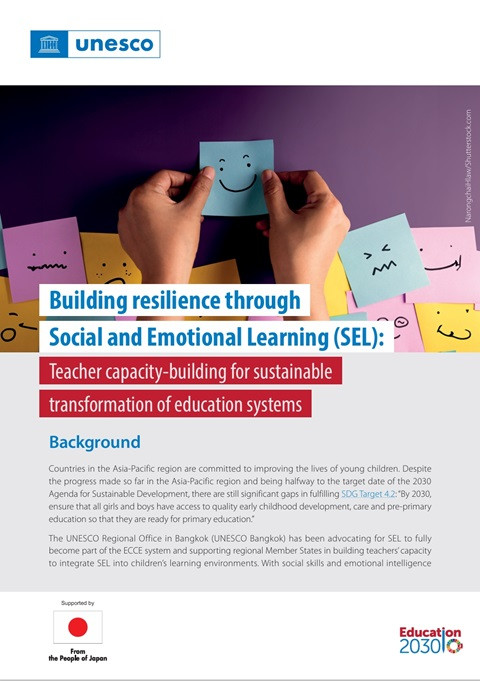 Building Resilience Through Social and Emotional Learning (SEL): Teacher Capacity-building for Sustainable Transformation of Education Systems Year of publication: 2024 Corporate author: UNESCO Bangkok Countries in the Asia-Pacific region are committed to improving the lives of young children. Despite the progress made so far in the Asia-Pacific region and being halfway to the target date of the 2030 Agenda for Sustainable Development, there are still significant gaps in fulfilling SDG Target 4.2: 'By 2030, ensure that all girls and boys have access to quality early childhood development, care and pre-primary education so that they are ready for primary education.' The UNESCO Regional Office in Bangkok (UNESCO Bangkok) has been advocating for SEL to fully become part of the ECCE system and supporting regional Member States in building teachers’ capacity to integrate SEL into children’s learning environments. With social skills and emotional intelligence taught in schools early, children will gain knowledge, skills, and attitudes to develop healthy identities, manage emotions, and achieve personal and collective goals. This can positively contribute to society and transformative resilience through enhancing civic engagement.