
Resources
Explore a wide range of valuable resources on GCED to deepen your understanding and enhance your research, advocacy, teaching, and learning.
12 Results found
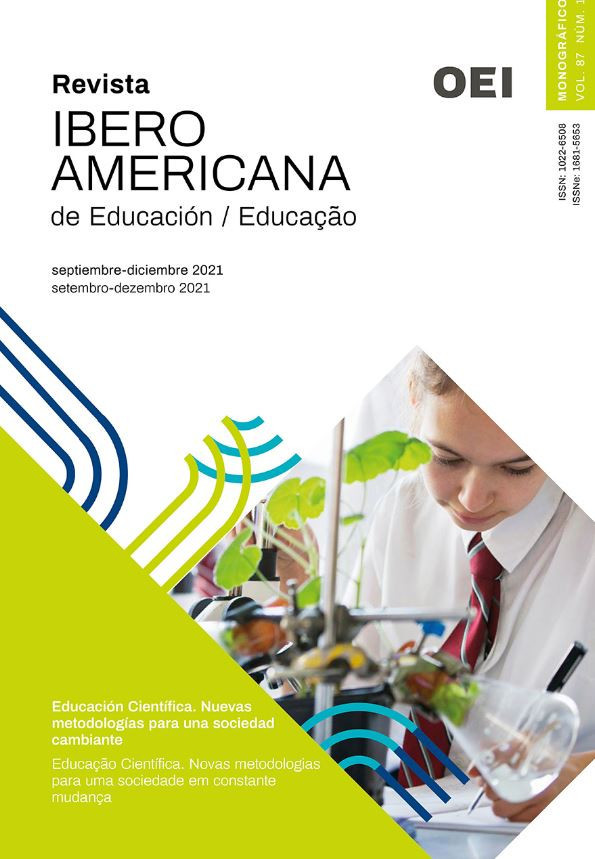 Scientific Education: New Methodologies for a Changing Society (Iberoamerican Journal of Education; vol. 87, no. 1) Year of publication: 2021 Author: F. Javier Perales | David Aguilera Corporate author: Organization of Ibero-American States for Education, Science and Culture (OEI) A society as changing as ours needs changes (innovations) and adaptations in the educational field that allow academics to be combined with social demands. We believe that this first monograph is representative of the richness and diversity of the proposals received which, in turn, constitute a sample of the strength of the community of teachers and researchers in their desire to make science education an attractive and efficient for new generations. Educación científica: Nuevas metodologías para una sociedad cambiante (Revista Ibero-americana de Educação; vol. 87, núm. 1) Year of publication: 2021 Author: F. Javier Perales | David Aguilera Corporate author: Organización de Estados Iberoamericanos para la Educación, la Ciencia y la Cultura (OEI) Una sociedad tan cambiante como la nuestra necesita de cambios (innovaciones) y adaptaciones en el ámbito educativo que permitan compaginar lo académico con las demandas sociales. Este primer monográfico estimamos que resulta representativo de la riqueza y diversidad de las propuestas recibidas que, a su vez, constituyen un muestrario de la pujanza de la comunidad de docentes e investigadores en su afán de hacer de la enseñanza de las ciencias una oferta atractiva y eficiente para las nuevas generaciones.
  Science Education in a Cultural Diversity Context: The Migrant Student in Chile (Revista Saberes Educativos; July-Decembe, No.11) Year of publication: 2023 Author: Carmen Luisa Alfaro Contreras | Iskra Pavez Soto The aim of this article is to analyze teachers' conceptions of science education in contexts of cultural diversity. In recent years, the presence of migrant students in Chilean education has increased, which has generated a meeting of diverse world views that stress the paradigms of scientific education itself. The article presents a study whose methodological design was of a qualitative nature. 13 interviews were conducted with a strategic sample made up of science teachers from the school system, pedagogy students, and university professors. The results reflect dissimilar ideas about the relationship between science and culture, generating, on the one hand, a kind of invisibility or denial of diversity and, on the other, a recognition of a multiplicity of ways of building knowledge, approaching an intercultural view of science. Stereotyped ideas about the student body and the lack of training to deal with cultural diversity are recognized. The main difficulties are associated with the characteristics of the school system and the hegemonic and monocultural nature of the curriculum. It concludes with recommendations on the need for a postcolonial scientific education and to democratize knowledge, with a focus on student learning that allows the development of critical individuals. Educación científica en contextos de diversidad cultural: El estudiantado migrante en chile Year of publication: 2023 Author: Carmen Luisa Alfaro Contreras | Iskra Pavez Soto El objetivo de este artículo es analizar las concepciones del profesorado en torno a la educación científica en contextos de diversidad cultural. Durante los últimos años ha aumentado la presencia de estudiantado migrante en la educación chilena, lo cual ha generado un encuentro de visiones de mundo diversas que tensionan los paradigmas de la propia educación científica.
  Effectiveness of Integrating Reciprocal Teaching and Science Stations Strategies in Teaching Science on Developing Some Science Hand Skills among Eighth Grade Female Pupils in Thamar City (Arts for Educational & Psychological Studies; Vol.5, No.3) Year of publication: 2023 Author: Nabeeha Saleh Abdulmoghni, Mohammed Ebrahim Al-San Corporate author: Dhamar University This study aimed to identify the impact of integrating reciprocal teaching and science stations strategies in teaching science on developing some science hand skills among Eighth-grade female pupils in Thamar City. To achieve the study objectives, the descriptive analytical method and the quasi-experimental design of the two groups, with pre and post measurements, were used. The data collection tools included: a checklist for analyzing Unit 7 (Nutrition in Living Organisms), and unit 8 (The Relationship of what you eat to your Health) in the respective textbook; a checklist of science hand skills to be developed; and an observation sheet of the skills, covering three main skills: (carrying out scientific experiments correctly- designing and drawing shapes and illustrations correctly- following safety rules in the laboratory). After testing the validity and reliability of the tools, and administering them to the study sample, a number of results were revealed. More specifically, there were statistically significant differences between the mean scores of the pupils of the experimental and control groups in the science hand skills, attributed to the experimental group due to the integrative approach. فاعلية التكامل بين إستراتيجيتي التدريس التبادلي والمحطات العلمية في تدريس مادة العلوم على تنمية بعض المهارات اليدوية العلمية لدى تلميذات الصف الثامن الأساسي في مدارس مدينة ذمار (مجلة الآداب للدراسات النفسية والتربوية; Vol.5, No.3) Year of publication: 2023 Author: Nabeeha Saleh Abdulmoghni, Mohammed Ebrahim Al-San Corporate author: Dhamar University هدف هذا البحث إلى التعرف على فاعلية التدريس باستخدام المدخل التكاملي البيني المدمج بين إستراتيجيتي التدريس التبادلي والمحطات العلمية في تدريس مادة العلوم لتنمية بعض المهارات اليدوية العلمية لدى تلميذات الصف الثامن الأساسي بمدينة ذمار، وتكونت عينة البحث من (60) تلميذة، ولتحقيق هدف البحث تم استخدام المنهج الوصفي التحليلي، والمنهج التجريبي القائم على التصميم شبه التجريبي للمجموعتين، ذي القياسين القبلي والبعدي، وتكونت أدوات البحث من قائمة تحليل محتوى الوحدة السابعة (التغذية في الكائنات الحية)، والثامنة (علاقة ما تتناوله بصحة جسمك)، من كتاب العلوم المقرر للصف الثامن الأساسي، وقائمة بالمهارات اليدوية العلمية اللازم تنميتها، وبطاقة ملاحظة المهارات اليدوية العلمية المكونة من ثلاثة مهارات رئيسة، هي: (مهارات إجراء التجارب العلمية بصورة صحيحة - تصميم ورسم الأشكال والرسوم التوضيحية بصورة صحيحة، ودقيقة -اتباع قواعد الأمان، والسلامة في المختبر)، وبعد التأكد من الصدق والثبات للأدوات المستخدمة، وتطبيقها على عينة البحث، توصل البحث إلى عدد من النتائج أبرزها أن هناك فروقاً دالة إحصائيًا بين متوسط درجات تلميذات المجموعتين التجريبية والضابطة في بطاقة ملاحظة المهارات اليدوية العلمية لصالح المجموعة التجريبية تُعزى للمدخل التكاملي البيني.
  Gender Inequality in Learning Achievement in Primary Education: What can TERCE Tell Us? Year of publication: 2016 Corporate author: UNESCO Santiago Existing research identifies several significant, subject-based gender inequalities in education. Male learners have significant advantages in mathematics and female learners have no less significant advantages in reading and writin. Such considerable differences in achievement may have important consequences for the future wellbeing of students. In order to shed light on this phenomenon in Latin America, this report analyzes the gender gaps in educational achievement in the Third Regional Comparative and Explanatory Study (TERCE) led by the Latin American Laboratory for Assessment of the Quality of Education (LLECE). Inequidad de género en los logros de aprendizaje en educación primaria ¿Qué nos puede decir TERCE? Year of publication: 2016 Corporate author: UNESCO Santiago Existing research identifies several significant, subject-based gender inequalities in education. Male learners have significant advantages in mathematics and female learners have no less significant advantages in reading and writin. Such considerable differences in achievement may have important consequences for the future wellbeing of students. In order to shed light on this phenomenon in Latin America, this report analyzes the gender gaps in educational achievement in the Third Regional Comparative and Explanatory Study (TERCE) led by the Latin American Laboratory for Assessment of the Quality of Education (LLECE).
 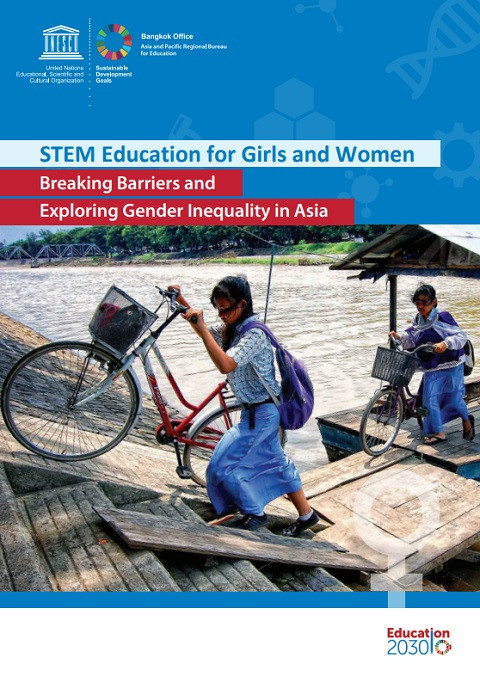 STEM Education for Girls and Women: Breaking Barriers and Exploring Gender Inequality in Asia Year of publication: 2020 Corporate author: UNESCO Bangkok | UNESCO Science, Technology, Engineering and Mathematics (STEM) fields are considered catalysts for the achievement of the 2030 Agenda for Sustainable Development. Yet, particularly for STEM fields, girls and women, for a multitude of social, cultural and psychological reasons, engage and participate at a lower rate than boys and men. This research collection aims to highlight the contextual barriers that girls and women face in STEM education and careers and offer concrete examples of interventions that successfully encourage participation of girls and women in STEM. These eight case studies from across Asia explore both the barriers and the achievements in SDG 4 and SDG 5, and give context-specific analysis of different aspects of gender disparities in the respective countries.
  Discours du Sous-Directeur général de l'UNESCO pour la culture M. Francesco Bandarin à l'occasion de la Journée internationale de la langue maternelle: Les langues locales pour la citoyenneté mondiale: zoom sur la science; UNESCO, le 21 février 2014 Year of publication: 2014 Corporate author: UNESCO This is an address by Mr. Francesco Bandarin, Assistant Director-General for culture of UNESCO, on the occasion of the International Mother Language Day: Local languages for global citizenship: focusing on science. Although little progress has been made to extend the benefits of multilingual education in the areas such as science, development of science will be considerably consolidated if people better understand and utilize local and international languages.