
Resources
Explore a wide range of valuable resources on GCED to deepen your understanding and enhance your research, advocacy, teaching, and learning.
20 Results found
 Educación para la ciudadanía y convivencia: protagonistas de la realidad, dirigimos la historia; ciclo tres (quinto, sexto y séptimo) Year of publication: 2014 Corporate author: Secretaría de Educación del Distrito (SED) | Fe y Alegría These twelve modules make reference to a series of activities that focus on how children from all the educative grades understand and live citizenship, strengthening and facilitating the learning processes based on autonomy. This educative materials, which are aimed at being implemented inside the classrooms, attempt to serve as input resources for educators and other agents that work on or are interested in working with citizenship education and coexistence. The overall objective is to provide quality education. Educación para la ciudadanía y la convivencia: hacemos sinergías para vivir y convivir en territorios de paz; ciclo cuatro (octavo y noveno) Year of publication: 2015 Corporate author: Secretaría de Educación del Distrito (SED) | Fe y Alegría These twelve modules make reference to a series of activities that focus on how children from all the educative grades understand and live citizenship, strengthening and facilitating the learning processes based on autonomy. This educative materials, which are aimed at being implemented inside the classrooms, attempt to serve as input resources for educators and other agents that work on or are interested in working with citizenship education and coexistence. The overall objective is to provide quality education. Educación para la ciudanía y la convivencia: parceras y parceros por la paz (en 140 caracteres); ciclo tres (quinto, sexto y séptimo) Year of publication: 2015 Corporate author: Secretaría de Educación del Distrito (SED) | Fe y Alegría These twelve modules make reference to a series of activities that focus on how children from all the educative grades understand and live citizenship, strengthening and facilitating the learning processes based on autonomy. This educative materials, which are aimed at being implemented inside the classrooms, attempt to serve as input resources for educators and other agents that work on or are interested in working with citizenship education and coexistence. The overall objective is to provide quality education. Global school partnerships programme impact evaluation report Year of publication: 2011 Author: Juliet Sizmur | Bernadetta Brzyska | Louise Cooper | Jo Morrison | Kathryn Wilkinson | David Kerr Corporate author: National Foundation for Educational Research The overarching aim of this evaluation is to assess the impact of DFID‟s Global School Partnerships (GSP) programme on levels of global awareness and attitudes to global issues in pupils attending GSP schools in the UK.This main aim can be broken down into four subsidiary aims, namely:1. to measure levels of global awareness and attitudes to global issues amongst pupils taking part in GSP programme activities2. to compare awareness levels and attitudes among pupils in GSP schools with those of pupils in non-GSP schools3. to evaluate whether the impact of GSP on global awareness and attitudes to global issues differs depending on pupils‟ ages and educational stages (e.g. at primary versus secondary level)4. to assess whether levels of awareness and attitudes amongst participating pupils change as the GSP programme becomes more embedded in schools (i.e. whether, over time, the programme has a positive, neutral or negative impact on pupil levels of development awareness). Programme mondial de partenariats scolaires et Rapport d'évaluation d'impact Year of publication: 2011 Author: Juliet Sizmur | Bernadetta Brzyska | Louise Cooper | Jo Morrison | Kathryn Wilkinson | David Kerr Corporate author: National Foundation for Educational Research L'objectif principal de cette évaluation est d'évaluer l'impact de partenariats scolaires internationaux(PSI) et le programme de DFID sur les niveaux de prise de conscience globale et attitudes aux enjeux mondiaux chez les élèves fréquentant les écoles PSI au Royaume-Uni. Cet objectif principal peut être décomposé en quatre objectifs subsidiaires, à savoir: 1. pour mesurer les niveaux de prise de conscience globale et attitudes à l'égard des enjeux mondiaux entre les élèves qui participent aux activités du programme PSI 2. pour comparer les niveaux de sensibilisation et les attitudes des élèves dans les écoles du PSI avec ceux des élèves des écoles non-PSI 3. afin d'évaluer si l'impact du PSI sur la sensibilisation et les attitudes envers les problèmes mondiaux global diffère selon les élèves «âges et niveaux d'enseignement (par exemple, au primaire ou au secondaire) 4. d'évaluer si les niveaux de sensibilisation et attitudes parmi les élèves participants changent à mesure que le programme PSI devient plus intégré dans les écoles (à savoir si, au fil du temps, le programme a un impact positif, neutre ou négatif sur le niveau des élèves de sensibilisation au développement). 2014 syllabus: character and citizenship education: secondary Year of publication: 2014 Corporate author: Singapore. Ministry of Education. Student Development Curriculum Division Character and Citizenship Education (CCE) has always been at the heart of Singapore's education system. In CCE, students learn to be responsible to family and community; and understand their roles in shaping the future of nation. The emerging trends and global developments that impact the society, such as social changes, globalisation and technological advancements are taken into consideration in the development of the CCE curriculum. The goal of CCE is to inculcate values and build competencies in students to develop them to be good individuals and useful citizens. Since 1959, various key programmes have been introduced to inculcate values, habits, competencies and skills in students. Some of these programmes include Civics and Moral Education (CME, 1992), National Education (NE, 1997), Social and Emotional Learning (SEL, 2005), and learning experiences such as Co-Curricular Activities (CCA).The new CCE curriculum shifts focus from programmes to a common purpose. The desired outcomes of CCE are aligned to the Key Stage Outcomes (KSOs) and Desired Outcomes of Education (DOE). CCE is central to the Framework for 21st Century Competencies and Student Outcomes. It emphasizes the interconnectedness of the core values, social and emotional competencies and civic literacy, global awareness and cross-cultural skills that are critical for character and citizenship development of students. 2014 syllabus: le caractère et l'éducation à la citoyenneté: secondaire Year of publication: 2014 Corporate author: Singapore. Ministry of Education. Student Development Curriculum Division Caractère et éducation à la citoyenneté (CEC) a toujours été au cœur du système éducatif de Singapour. En CEC, les élèves apprennent à être responsables de la famille et de la communauté; et de comprendre leurs rôles dans l'élaboration de l'avenir de la nation. Les nouvelles tendances et évolutions mondiales qui influent sur la société, tels que les changements sociaux, la mondialisation et les progrès technologiques sont pris en considération dans l'élaboration du programme de la CCE. L'objectif de la CCE est d'inculquer des valeurs et de construire des compétences chez les élèves de les développer pour être de bons individus et des citoyens utiles. Depuis 1959, divers programmes clés ont été mis en place pour inculquer des valeurs, des habitudes, des compétences et des compétences chez les élèves. Certains de ces programmes comprennent l'éducation civique et l'éducation morale (ECM, 1992), l'éducation nationale (NE, 1997), social et apprentissage émotionnel (SPE, 2005), et les expériences d'apprentissage tels que Co-curriculaires Activités (CCA). Les nouveaux changements de curriculum CEC concentrent des programmes à un but commun. Les résultats escomptés de la CEC sont alignés sur les résultats clés de scène (RCS) et résultats souhaités de l'Education (RSE). CEC est au centre du cadre pour les compétences du 21e siècle et résultats des élèves. Il met l'accent sur l'interdépendance des valeurs fondamentales, les compétences sociales et émotionnelles et alphabétisation civique, la sensibilisation mondiale et les compétences interculturelles qui sont critiques pour le caractère et la citoyenneté développement des élèves.
 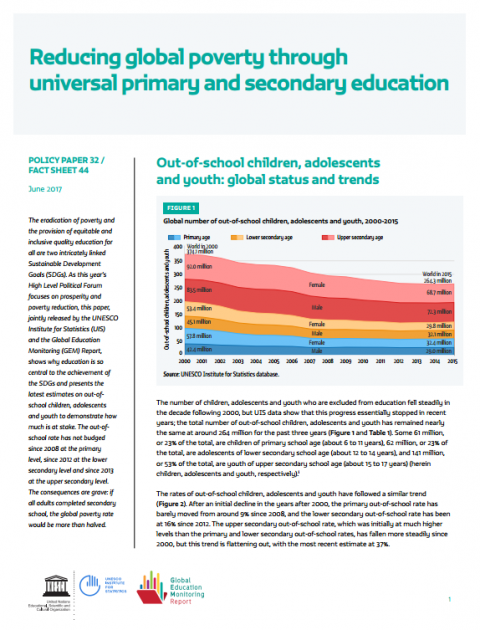 Reducing global poverty through universal primary and secondary education Year of publication: 2017 Corporate author: UNESCO The eradication of poverty and the provision of equitable and inclusive quality education for all are two intricately linked Sustainable Development Goals (SDGs). As this year’s High Level Political Forum focuses on prosperity and poverty reduction, this paper, jointly released by the UNESCO Institute for Statistics (UIS) and the Global Education Monitoring (GEM) Report, shows why education is so central to the achievement of the SDGs and presents the latest estimates on out-ofschool children, adolescents and youth to demonstrate how much is at stake. The out-ofschool rate has not budged since 2008 at the primary level, since 2012 at the lower secondary level and since 2013 at the upper secondary level. The consequences are grave: if all adults completed secondary school, the global poverty rate would be more than halved.
 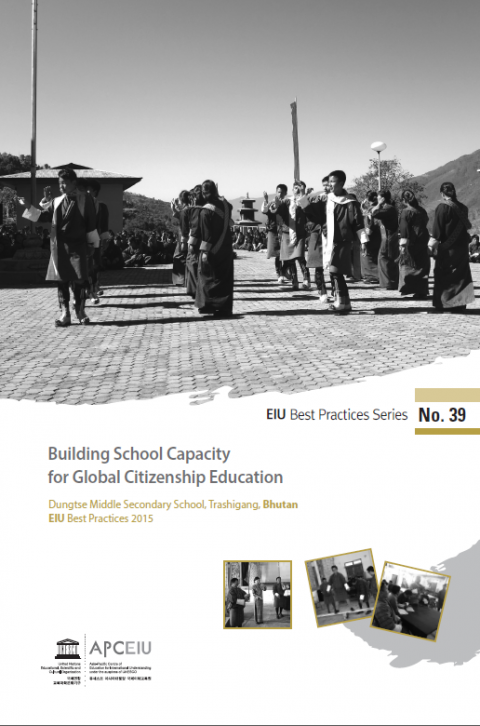 EIU Best Practices Series No.39: Building School Capacity for Global Citizenship Education: Dungtse Middle Secondary School, Trashigang, Bhutan Year of publication: 2015 Corporate author: APCEIU This monograph is one of APCEIU's EIU Best Practices Series, which aims to encourage educators, scholars, and activists to implement and share local initiatives on EIU. The Series No.39 introduces the Training of Trainers (TOT) program, a workshop for teachers to better incorporate GCED/EIU concepts into respective curriculum and school environment. Upon participating in the APCEIU training workshop, Mr. Yeshi Dorji from Dungtse Middle Secondary School in Bhutan sought to create a forum in which teachers and school officials can learn to incorporate GCED. Such exemplary initiative not only enhances capacity building of educators in the school, but also has potential to have larger impact in the local and regional communities.
  Countering Holocaust Denial and Distortion through Education: Lesson Activities for Secondary Education Year of publication: 2025 Corporate author: UNESCO Adaptable lessons to foster critical thinking, empathy and tolerance Holocaust denial rejects historical facts outright, while distortion manipulates the narrative. Both phenomena undermine historical truth, fuel antisemitism, and attack democratic values. By addressing these issues, this set of lesson activities for secondary education seeks to build students’ resilience against falsehoods through fostering critical thinking, empathy, and global citizenship. It was developed by UNESCO and funded by the European Commission to equip educators with tools to confront the dangerous spread of Holocaust denial and distortion. With 12 engaging lessons, students aged 14 to 18 will explore the historical facts of the Holocaust while learning to critically evaluate misinformation in today’s digital world. From analyzing survivor testimonies to deconstructing harmful memes and conspiracy theories, this resource features 12 adaptable lessons that focus on historical literacy, media analysis, and social-emotional competencies. Topics range from identifying denial and distortion, evaluating media and online sources, analyzing primary evidence like survivor testimonies, and understanding the misuse of Holocaust history in memes and conspiracy theories. Activities are scaffolded with questions, examples, and practical exercises to encourage analytical skills and promote meaningful classroom discussions. The lessons also include suggestions for incorporating primary sources, visiting memorial sites, and addressing broader issues of genocide and hate. In doing so, the guide aims to not only preserve Holocaust memory but also strengthen the values of truth, empathy, and tolerance in younger generations.