
Resources
Explore a wide range of valuable resources on GCED to deepen your understanding and enhance your research, advocacy, teaching, and learning.
17 Results found
 I Don’t Want… War! Year of publication: 2024 Corporate author: Amnesty International | Entreculturas | Mundo Cooperante | Save the Children On the occasion of the International Day of the Girl Child, which is commemorated on October 11, the organizations Amnesty International, Entreculturas, Mundo Cooperante and Save the Children, under the framework of the joint alliance NO QUIERO, denounce the serious consequences that armed conflicts have on girls and their integral development. Today, more than ever, it is urgent to address the effects of wars that prevent millions of girls from living a future free of violence, such as child and forced marriage or sexual violence. ¡No Quiero… la guerra! Year of publication: 2024 Corporate author: Amnesty International | Entreculturas | Mundo Cooperante | Save the Children Con motivo del Día Internacional de la Niña, que se conmemora el 11 de octubre, las organizaciones Amnistía Internacional, Entreculturas, Mundo Cooperante y Save the Children, bajo el marco de la alianza conjunta NO QUIERO, denunciamos las graves consecuencias que los conflictos armados tienen sobre las niñas y su desarrollo integral. Hoy, más que nunca, es urgente abordar los efectos de las guerras que impiden que millones de niñas puedan vivir un futuro libre de violencias, como el matrimonio infantil y forzoso o la violencia sexual.
 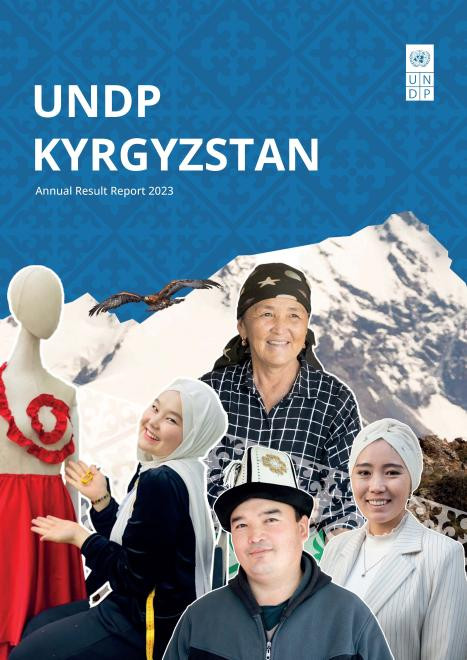 UNDP KYRGYZSTAN : Annual Result Report 2023 Year of publication: 2024 Corporate author: UNDP Kyrgyzstan In 2023, UNDP in Kyrgyzstan will use its global experience and strategic partnerships to achieve Sustainable Development Goals, focusing on digital transformation, development finance and innovation. Годовой отчет ПРООН в Кыргызстане за 2023г. Year of publication: 2024 Corporate author: UNDP Kyrgyzstan В 2023 году ПРООН в Кыргызстане использовала свой глобальный опыт и стратегические партнерства для реализации Целей устойчивого развития, уделяя особое внимание цифровой трансформации, финансированию развития и инновациях.
  Educación Integral de la Sexualidad: Conceptos, Enfoques y Competencias Year of publication: 2014 Corporate author: UNESCO Santiago El objetivo de este documento es comprender que la sexualidad es parte integral de la vida de las personas (en sus diferentes etapas o edades, y en toda su diversidad), y que contribuye al desarrollo de su identidad y por lo tanto, a su desarrollo social. Se trata de capacidades más que de contenidos, las que deben desarrollarse en forma interdisciplinaria y de manera progresiva para que las personas actúen de forma responsable respecto a ellas mismas y con los demás. El documento explica que la educación de la sexualidad está íntimamente relacionada con la comprensión, la reflexión y el discernimiento, y fortalece las bases para el aprendizaje a lo largo de la vida, preparando a los jóvenes para la vida adulta. Es así que el enfoque se centra en alcanzar un desarrollo y bienestar humano sostenible. Integral Education of Sexuality: Concepts, Approaches and Competencies Year of publication: 2014 Corporate author: UNESCO Santiago The objective of this document is to understand that sexuality is an integral part of people's lives (in their different stages or ages, and in all their diversity), and that it contributes to the development of their identity and, therefore, to their development Social. It is about capacities rather than content, which must be developed in an interdisciplinary way and progressively so that people act responsibly towards themselves and with others. The document explains that the education of sexuality is closely related to understanding, reflection and discernment, and strengthens the bases for lifelong learning, preparing young people for adult life. Thus, the focus is on achieving sustainable human development and well-being.
 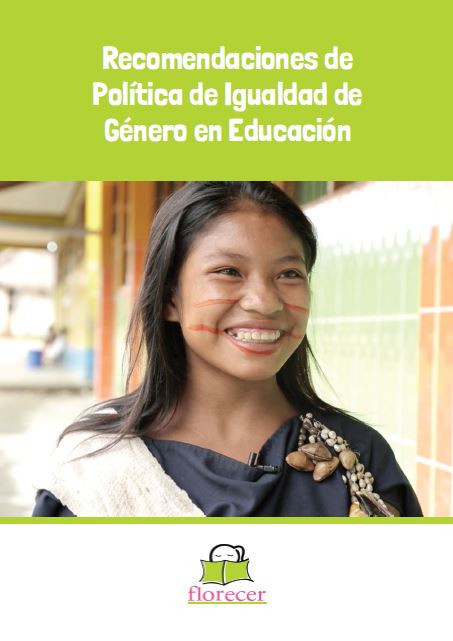 Policy Recommendations of Gender Equality in Education Year of publication: 2015 Author: Teresa Tovar Samanez Corporate author: United Nations Children's Fund (UNICEF) This document synthesizes the proposals of the Florecer Network to advance in gender equality, because we are convinced that the commitment to a more just and more human world necessarily implies the assumption of equality between men and women. Recomendaciones de Política de Igualdad de Género en Educación Year of publication: 2015 Author: Teresa Tovar Samanez Corporate author: United Nations Children's Fund (UNICEF) Este documento sintetiza las propuestas de la Red Florecer para avanzar en la igualdad de género, porque estamos convencidas y convencidos de que la apuesta por un mundo más justo y más humano implica necesariamente por la asunción de la igualdad entre hombres y mujeres.
 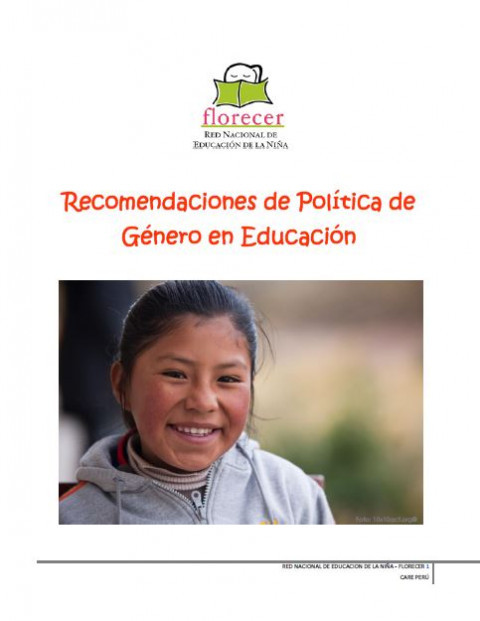 Gender Policy Recommendations in Education Year of publication: 2015 Corporate author: Red Nacional de Educación de la Niña This document synthesizes the proposals of the Florecer Network to advance in gender equality, convinced that the commitment to a more just and more human world necessarily involves the assumption of equality between men and women. The principle that the rights of women and girls are an integral, inalienable and indivisible part of universal human rights has been reaffirmed from the various international forums. Greater equity between men and women is also beneficial for the development of the country. A country with educated girls and women has a lower birth rate, improves their health and productivity conditions. This document synthesizes the main proposals of the Gender and Citizenship Forum: imperative for a quality education, organized by Red Florecer in May 2013 year. We want to put them in the hands of decision-makers and citizens in general to help concretize the mandates of equality between men and women in education. It is time not to give up dreams because they have become possible. Recomendaciones de Política de Género en Educación Year of publication: 2015 Corporate author: Red Nacional de Educación de la Niña Este documento sintetiza las propuestas de la Red Florecer para avanzar en la igualdad de género, convencidos de que la apuesta por un mundo más justo y más humano pasa necesariamente por la asunción de la igualdad entre hombres y mujeres. Desde los diversos foros internacionales se ha reafirmado el principio que los derechos de las mujeres y las niñas son parte integral, inalienable e indivisible de los derechos humanos universales. Una mayor equidad entre hombres y mujeres es además beneficiosa para el desarrollo del país. Un país con niñas y mujeres educadas tiene menor tasa de natalidad, mejora sus condiciones de salud y productividad.Este documento sintetiza las principales propuestas del Foro Género y Ciudadanía: imperativo para una educación de calidad, organizado por la Red Florecer en mayo del 2013 año. Queremos ponerlas en manos de los decisores y de la ciudadanía en general para contribuir a concretar los mandatos de igualdad entre hombres y mujeres en la educación. Es el momento de no desistir de los sueños porque estos se han tornado posibles.