
Resources
Explore a wide range of valuable resources on GCED to deepen your understanding and enhance your research, advocacy, teaching, and learning.
31 Results found
 Strategies to Counter Antisemitism: A Handbook for Educators Year of publication: 2025 Corporate author: UNESCO Education is the first line of defence against hate and prejudice. By targeting the root causes of hate ideologies, deconstructing the stereotypes that underlie them from an early age, and promoting inclusive models, education is the keystone of a holistic approach to combating discrimination. Tackling antisemitism through education requires tailored content that addresses its complex, shifting and multilayered forms, both past and present.Acknowledging the topic’s complexity and the paucity of resources available to education stakeholders, this concise guide developed by UNESCO and funded by the European Commission aims to provide a roadmap for policymakers, curriculum developers and educators on current approaches and initiatives. It presents ten educational practices, each grounded in academic literature and illustrated by a promising educational initiative that operationalizes core pedagogical principles. The handbook is built around the three core learning domains which inform UNESCO’s approach to Global Citizenship Education: cognitive, socio-emotional, and behavioural learning.Conceived as an accessible operational guide for practitioners, this resource sets out to start a larger conversation about the needs of educators for tackling contemporary forms of antisemitism. It aims to encourage investments in high-quality empirical research that can pave the way for a better approach to combat antisemitism.
  Online Courses: Building Kinder Brains Through Accessible Digital Learning Course Brochure Year of publication: 2023 Corporate author: Mahatma Gandhi Institute of Education for Peace and Sustainable Development (MGIEP) UNESCO MGIEP focuses on achieving the United Nations (UN) Sustainable Development Goal (SDG) 4, Target 7 towards education for building peaceful and sustainable societies across the world by developing programmes that promote social and emotional learning, innovate digital pedagogies and empower the youth. UNESCO MGIEP‘s Social Emotional Learning (SEL) courses are research and evidence based with built-in assessments. The courses are multi-modal, interactive and self-paced, and are designed to build intellectual and emotional intelligence among learners. Currently the courses are available in English and are being adapted to Hindi, Spanish and Russian.
  School Convivencia : Reviewing the Concept (Psicoperspectivas; No. 18, Vol. 1) Year of publication: 2019 Author: Cecilia Fierro-Evans | Patricia Carbajal-Padilla Corporate author: Catholic University of Valparaíso. School of Psychology This article reports an effort to review the concept of school convivencia (peaceful coexistence, living together) in the Spanish context with the purpose of advancing into its clarification, and thus contributing to developing a common language in the Latin American region. The authors conduct a basic literature review oriented to identify the main theoretical approaches in the convivencia field. Subsequently, they analyze four studies focused in systematizing the prevailing approaches in the study of school convivencia. As a result, they propose a concept of convivencia from a social justice perspective adapted to education, and they operationalize it in three areas of school life: pedagogical-curricular, organizationaladministrative, and the socio-communitarian. This comprehensive notion of school convivencia may guide future research, educational initiatives, and school assessments in the convivencia field that may respond to the violence and pervasive social exclusion that exist in the Latin American region. Convivencia escolar: Una revisión del concepto (Psicoperspectivas; No. 18, Vol. 1) Year of publication: 2019 Author: Cecilia Fierro-Evans | Patricia Carbajal-Padilla Corporate author: Catholic University of Valparaíso. School of Psychology El presente trabajo reporta un ejercicio de revisión del concepto de convivencia escolar con vistas a apoyar su clarificación y, por tanto, contribuir al desarrollo de un lenguaje común en la región latinoamericana. Para ello las autoras conducen un trabajo documental orientado a identificar los principales enfoques teóricos en la literatura de convivencia. Posteriormente analizan cuatro estudios enfocados a sistematizar los enfoques prevalecientes en el estudio de la convivencia escolar. Como resultado, proponen un concepto de convivencia desde la perspectiva de la justicia social adaptada a la educación y lo operacionalizan en tres ámbitos de la vida escolar: pedagógico-curricular, organizativo-administrativo y socio-comunitario. Esta noción comprehensiva de la convivencia escolar podría apoyar la realización de investigaciones futuras, propuestas educativas y evaluaciones de convivencia escolar que ofrezcan una respuesta a la violencia y a la persistente exclusión social que existe en la región latinoamericana.
  Mainstreaming Social and Emotional Learning in Education Systems: Policy Guide; Highlights Year of publication: 2024 Corporate author: UNESCO UNESCO’s policy guide unpacks social and emotional learning (SEL) as a broadening of the educational process, from a focus on cognitive aspects to a balance between cognitive, social and emotional, and behavioural dimensions of learning, putting forward initial action ideas to guide its systematic mainstreaming in education. It builds on and extends previous work undertaken by UNESCO on SEL from the perspective of Global Citizenship Education (GCED) and Education for Sustainable Development (ESD), Building Strong Foundations for Health and Well-being Education, the Happy Schools Framework, and in multiple UNESCO Offices and Institutes.
 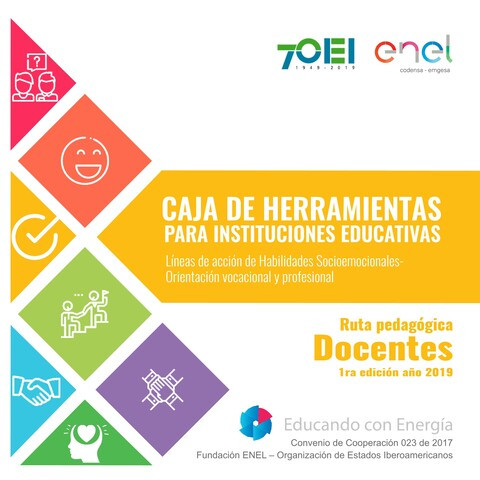 Toolbox for Educational Institutions: Lines of Action of Socio-Emotional Skills Vocational and Professional Orientation Year of publication: 2017 Corporate author: ENEL Foundation | Organization of Ibero-American States for Education, Science and Culture (OEI) This toolbox is aimed at educational agents who are motivated to articulate in their pedagogical work actions aimed at facilitating the decision-making of young people during their life path, by strengthening socio-emotional skills and vocational and professional guidance, in order to enable transformations, whether personal, family or social, and with a view to sustainable development. Caja de herramientas para instituciones educativas: Líneas de acción de Habilidades socioemocionales orientación vocacional y profesional Year of publication: 2017 Corporate author: ENEL Foundation | Organización de Estados Iberoamericanos para la Educación, la Ciencia y la Cultura (OEI) Esta caja de herramientas está dirigida a agentes educativos que se encuentren motivados en articular a su quehacer pedagógico acciones encaminadas a facilitar la toma de decisiones de los jóvenes durante su trayectoria de vida, mediante el fortalecimiento de las habilidades socioemocionales y la orientación vocacional y profesional, con el fin de posibilitar transformaciones ya sea de tipo personal, familiar o social y en miras al desarrollo sostenible.
  Mainstreaming Social and Emotional Learning in Education Systems: Policy Guide Year of publication: 2024 Corporate author: UNESCO Why social and emotional learning is key to transform education Since 2015, there has been significant progress towards reimagining education for wider societal transformation in support of peace, justice, inclusion, equality and sustainability. Yet, the existing challenges have intensified, and new ones have emerged. The world is witnessing a resurgence of multiple forms of conflict and violence, from racism and discrimination, to hate speech and armed conflict. Our efforts to build sustainable peace through education are falling short. Some 250 million children are still out of school, and those in school are not acquiring the necessary knowledge and skills they need. This guide makes the case for integrating Social and Emotional Learning (SEL) in collective efforts to transform education. It highlights the impact of SEL in improving academic achievement, reducing drop- out rates, and improving overall mental health and well-being, and importantly, in strengthening emotional and relational dynamics of classrooms, schools, communities, and societies. The guide synthesizes the latest research and practice from the world, including case studies of concrete SEL implementation. It provides policy-makers with preliminary guidance to facilitate their conceptualization and integration of SEL in all facets of their education systems to build long-lasting peace and sustainable development.
  Singapore’s educational reforms toward holistic outcomes: (Un)intended consequences of policy layering Year of publication: 2023 Author: Dennis Kwek | Jeanne Ho | Hwei Ming Wong Corporate author: Center for Universal Education at Brookings In the transition from economic imperatives to holistic drivers, there has been a gradual move over five policy phases (from 1965 to 2022 and beyond) toward curriculum and school diversification to cater to different students, with more autonomy given to schools to innovate their pedagogy and improve instructional quality to meet their students’ unique needs. Importantly, there has been a shift in policy rhetoric from focusing on educational structures to focusing on pedagogy and instructional quality. To shift pedagogy from being mainly didactic in nature—with emphasis on preparing students for national examination—the Singapore government recognized the need to focus on school leaders’ and teachers’ capacity building to enable new curricula and teaching practices. The school cluster structure was initiated in 1997 to enable collaboration and learning among school leaders, key personnel, and teachers. Opportunities for collaborative teacher learning are provided at different ecological levels: professional learning communities (PLCs) within schools and networked learning communities (NLCs) across schools. Beyond the education system, the Singapore government works with other ministries and community organizations, such as ethnic self-help organizations, to tackle educational equity issues. Ultimately, even though the official policy narrative post-1997 has been a de-emphasis on examination results and educational infrastructure to help improve the instructional quality in schools toward holistic outcomes and improved student well-being have been developed, education systems building co-exists with an alternative underlying shadow education system valued by parents who continue to chase narrow academic outcomes. Tuition and enrichment centers in Singapore constitute the shadow education system.
  The Comprehensive Learning Diagnosis: Chile’s approach to assess socio-emotional learning in schools Year of publication: 2023 Author: José Weinstein | Juan Bravo Corporate author: Center for Universal Education at Brookings Education in Chile has important challenges of quality, equity, and social integration. For decades, policies tried to respond to these concerns with a high-stakes accountability institutional framework, which has not had success. The underlying vision of educational quality was limited. The assessment system in place privileged cognitive and academic dimensions of educational results. Socio-emotional learning had been neglected or considered secondary, without an infrastructure of assessment tools that allowed teachers and principals to diagnosis students’ situations and monitor their progress. The COVID-19 crisis was an opportunity for change: Students’ socioemotional needs were a main concern for schools and society, and the regular accountability system based on standardized tests was interrupted. Subsequently, the Comprehensive Learning Diagnosis (DIA) was launched by the Education Quality Agency. The DIA is a voluntary assessment tool made available to all Chilean schools. The DIA promotes the comprehensive development of students, providing timely information and guidance to internally monitor students’ learning in the academic and socio-emotional domains at several points during the school year. Specifically, with respect to socio-emotional learning, three areas were considered: personal, community, and citizenship. In each of these areas, a set of socioemotional skills were defined, operationalized, and became possible to monitor by school communities. The DIA also collects students’ opinions of school management practices regarding socio-emotional skills. The DIA has received a wide acceptance in school communities. Despite being voluntary, an ample majority of schools decided to participate. The information collected from the DIA allows for practical use by principals and teachers. Moreover, the DIA provides the opportunity for students to inform school management. The new Chilean government has decided to strengthen DIA as an important component in a four-year national plan for reactivating academic and socio-emotional learning in schools. The previous high-stakes accountability system, which involved external assessments, has been suspended and is under discussion. The DIA experience has shown that critical social and educational situations can provide fertile ground to motivate deep and rapid transformation, if an educational actor (in this case the Education Quality Agency) is capable of enacting a pertinent, timely, and practical response to school needs. The DIA is not only an example of productive uses of students´ assessment by schools, but also a demonstration that it is possible to build an institutional arrangement among local, intermediate, and national levels of school systems, where a vertical hierarchy is changed by a collaborative relationship based on local agency, mutual trust, and differentiated technical contributions.