
Resources
Explore a wide range of valuable resources on GCED to deepen your understanding and enhance your research, advocacy, teaching, and learning.
75 Results found
 Curriculum in the Education 2030 Agenda: Latin America and the Caribbean Year of publication: 2017 Author: Renato Opertti Corporate author: UNESCO International Bureau of Education (IBE) “Curriculum in the Education 2030 Agenda: Latin America and the Caribbean”1 discusses the importance of rethinking the curriculum in light of a transformational, humanistic and holistic vision of education. The Education 2030 Agenda, which emerged from the World Education Forum (WEF) 2015 held in Incheon, Republic of Korea, positions curriculum as a powerful education policy tool leading the way to effective, relevant and sustainable learning opportunities, processes and outcomes. Curricula have a positive effect as levers for the sustainable, inclusive, fair and cohesive development of a country. They reflect and help to construct the type of society envisioned. The article provides recommendations to strengthen the positioning of curriculum toward an inclusive and equitable quality education in Latin America and the Caribbean. It therefore addresses the following questions: 1) How is curriculum currently conceived?; 2) What role does it play in the reforms aimed at improving equity and quality of the learning processes?; 3) What are the main regional challenges in relation to curriculum development?; and 4) How could countries align their curricula with their development needs?
  Global Citizenship Education in Canada and the U.S.: From Nation-Centric Multiculturalism to Youth Engagement Year of publication: 2020 Author: Sarah Ranco | Alexis Gilmer | Colleen Loomis Corporate author: Cham Springer This chapter examines the historical and current uses of global citizenship education (GCE) in Canada and the U.S. in public schools from primary through secondary levels, with attention to Canada as well as similarities and differences within and across the two countries. The authors assess how social and political contexts have influenced the definition and operationalization of multiculturalism, civic studies, and global studies in curricula, noting that the neo-liberal perspective has focused on making people an economic powerhouse rather than socially concerned global citizens. In their examination of educational approaches that relate to GCE, the authors present decolonizing pedagogies, the multiculturalism approach in Canada, as well as culturally responsive and anti-racist pedagogies. To illustrate these issues, the authors offer an example in the Canadian context and raise the need to prevent GCE from becoming yet another tool for hegemony by the Global North on the Global South, as dominant groups have long defined citizenship. They conclude by proposing that to realize GCE in these two countries, teacher/practitioner and local, national, and international actors must engage youth, and in doing so, power imbalances that prohibit becoming global citizens will be addressed.
  The Role of Education in Preventing Violent Radicalisation: A Review for Europe (The Journal of Education; No.397, 2022) Year of publication: 2022 Author: Arantxa Azqueta | Adoración Merino-Arribas Corporate author: Spain. Ministry of Education This research analyses government documents addressing the prevention of radicalisation in 16 European countries, differentiated according to the presence or absence of fatalities in attacks. The aim to identify the presence of the attitudes which PISA 2018 identifies as key to define a democratic and interculturally competent citizenry and guide integration-friendly policies: openness, respect, civic awareness, responsibility, self-efficacy and tolerance. A comparative methodology is employed, using a lexicographical content analysis through Iramuteq software together with a critical-interpretative analysis of the texts.
  Construction / Emerging Invention of Unequal Populations in Latin American Education Year of publication: 2017 Author: Jesús Aguilar Nery Corporate author: Universidad de San Andrés | Arizona State University This text explores the emergent construction of “unequal” populations in Latin-America, focusing on three national traditions: Argentina, Brazil and Mexico. It compares who has been named as unequal in educational research and under what categories, and treats this comparison as an indicator for understanding the phenomenon of educational inequalities in the region between 1960 and 1970. It is concluded that the rules used to enforce inclusion, equality and equity are, at the same time, standards and divisions that involve the construction of systems of reasoning that also simultaneously include and exclude.
  Education and Social Cohesion in Latin America: A Micro-political Perspective Year of publication: 2014 Author: Silvina Gvirtz | Jason Beech Corporate author: Universidad de San Andrés | Arizona State University This article analyses the relation between education and social cohesion in Latin America from a micropolitical perspective. Even though we acknowledge the relevance of the macro and mezzo levels, we argue that the political decisions that are made at the school level are crucial to understand the contribution of educational systems to social cohesion. We suggest that the relation between social cohesion and school micropolitics can be analysed in two dimensions: the first is related to the access and permanence of children in school, while the second is related to the curriculum. The article concentrates on the second level by analysing the relation between the curriculum and social cohesion from a local, a national, and a global perspective.
  Equipping To Deal With Intolerant Speech: Racism, Antisemitism, Sexism, Discriminations Year of publication: 2023 Corporate author: Citoyenneté Possible In this report, NGO Citoyenneté Possible shares 18 years' experience in the field of anti-discrimination and dialogue. It provides both hands-on experience, with testimonials and tools, and in-depth reflection, analysis and sharing of experiences, practices and visions. It's possible to dare to engage in constructive dialogue on divisive issues, provided you have the intention to do so, and above all, the skills to do so. This report offers very concrete and detailed recommendations for professionals working with young people (teachers, educators, associations, etc.).
  Verbal Communication Difficulties and Ability to Read Mind (Theory of Mind): A Comparative Study Between Autistic Children, Children with Down Syndrome, Children with Speech Disorders and Normal Children (Novels Magazine; Vol.6, No.1) Year of publication: 2022 Author: Zaghish Warda Corporate author: Batna 1 University This study aimed to determine the nature of the relation between verbal communicative ability with its formal and functional aspects and the ability to read mind, and to search for a correlation between mind reading and the mental level in both its verbal and performance aspects, as well as searching for the existence of statistically significant differences between the five samples of the study.The study sample included 30 children of both sexes distributed into five groups, each includes six children between the ages of 5-10 years: (Autistic children, children with Down syndrome, children with formal difficulties, children with functional difficulties,normal children), and to achieve these Objectives the researcher used a test to assess mental reading and an analysis grid for verbal communication, , in addition to the verbal and visual intelligence test of Ejlal Muhammad Serri to assess the mental level .This study reached several results: a correlation between mental reading and verbal communicative ability in its formal and functional aspects, and between mind reading and the mental level in both its verbal and performance aspects, while it was found that there were no statistically significant differences between the samples of normal children, children with formal difficulties, children with functional difficulties, autistic children, and children with Down syndrome, while the differences were significant between samples of normal children, children with formal difficulties, children with functional difficulties and the two samples of autistic children, and children with Down syndrome.
  A Theory of Justice (Arabic Edition) Year of publication: 2011 Author: John Rawls Corporate author: Syria. Ministry of Culture This is a book translated by Laila Al Taweel for the American author John Rawls, in which he reviewed justice by examining the institutions and laws that govern it. John asserts that justice is a major component of this universe and cannot be ignored in any way, or even surpassed even in the interests of society's well-being. This translated book is a reference in the Arab world for understanding justice.
 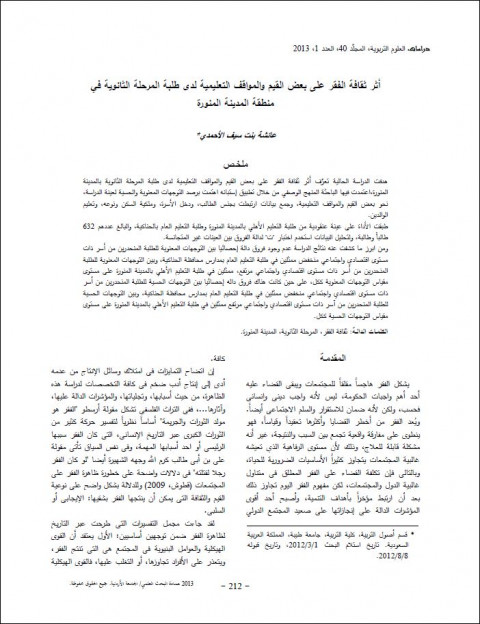 Poverty Culture Impact on Some Educational Values and Attitudes of Secondary Stage Students in Al-Madinah Al-Munawarah Province Year of publication: 2013 Author: Aysha Al-Ahmadi Corporate author: University of Jordan The study aimed at identifying the impact of the culture of poverty on some educational values and attitudes of high school students in Madinah. The researcher adopted the descriptive approach through the application of a questionnaire concerned with monitoring the moral and sensory trends of the study sample. The questionnaire was developed towards measuring some educational values and attitudes, and collecting data related to the student’s gender and family income Ownership and type of housing, and parenting education.
 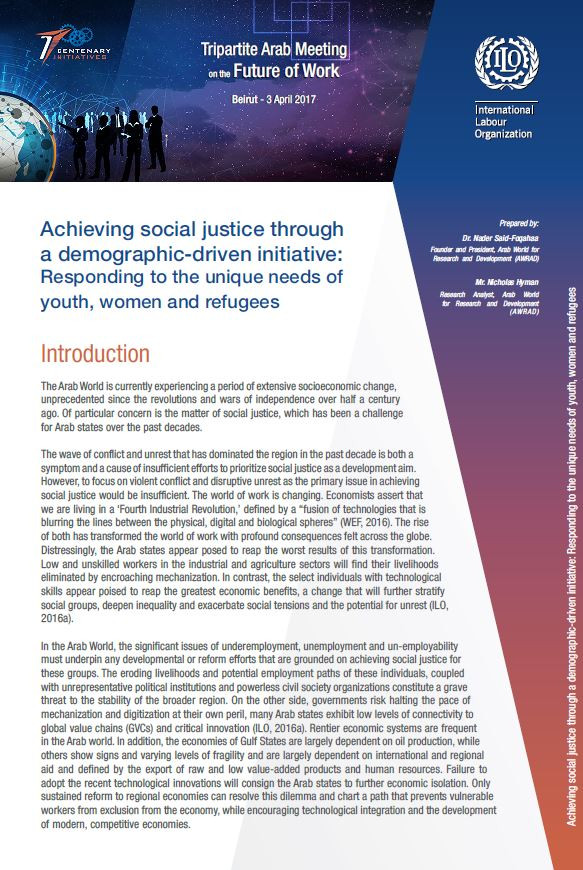 Achieving Social Justice Through a Demographic-driven Initiative: Responding to the Unique Needs of Youth, Women and Refugees Year of publication: 2017 Author: Nader Said-Foqahaa | Nicholas Hyman Corporate author: International Labour Organization (ILO) The Arab world is currently going through a period of great socio-economic change, unprecedented since the revolutions and wars of independence more than half a century ago. The issue of social justice, which has been a challenge to Arab states over the past decades, is a matter of particular concern. The authors attempt to establish a conceptual background of social justice, and to discuss its linkage with youth, children, women, and refugees. The paper concludes with recommendations on social justice in the Arab world.