
Resources
Explore a wide range of valuable resources on GCED to deepen your understanding and enhance your research, advocacy, teaching, and learning.
75 Results found
 Values Education through Sport Year of publication: 2016 Corporate author: UNESCO Innovative education for developmentEducation in the 21st century increasingly recognizes the role of values and social skills in tackling global challenges, such as inactivity, obesity, unemployment, and conflict. This approach is at the core of the Sustainable Development Goal 4 on quality education, which advocates for inclusive lifelong learning opportunities and innovative content delivery. Dynamic forms of values-based education using sport can be introduced in schools to support teachers deliver curricula actively and cooperatively.What are sport values?Sport can teach values such as fairness, teambuilding, equality, discipline, inclusion, perseverance and respect. Sport has the power to provide a universal framework for learning values, thus contributing to the development of soft skills needed for responsible citizenship.What can Values Education through Sport offer?Values Education through Sport (VETS) programmes support active learning, complement cognitive skills and give students increasing amounts of responsibility, and enhance their level of concentration and participation. VETS programmes are flexible and have a strong cross-curricular potential: they can reinforce existing curricula and can be streamed across different subjects, including physical education, civic and moral education, nutrition, biology, arts. Ultimately, these programmes help students to transfer and put values into action outside the school environment, by getting engaged in their communities, making informed decisions, being sensitive and respecting the others and the environment. VETS contributes to the development of self-confidence, active and healthy lifestyle choices, and an understanding of rights, supporting the delicate transition to the independence of adulthood. Eleventh meeting of the working group on Education for All, 2-3 February 2011, Paris, France: summary report Year of publication: 2011 Corporate author: UNESCO The eleventh meeting of the Working Group (WG) on Education for All (EFA) took place on 2 and 3 February 2011 at UNESCO headquarters in Paris. The meeting brought together people representing governments, bilateral and multilateral organizations, regional organizations, civil society organizations (CSOs), research institutes, foundations and the private sector. Consisting of seven sessions, the meeting aimed to review the world’s progress towards EFA and identify policy actions that can accelerate EFA progress, in particular as regards quality education, effective advocacy for education, violent conflicts and education and financing for education. The recommendations of the meeting were to be taken to the tenth meeting of the High Level Group (HLG) on EFA (Jomtien, Thailand, 22–24 March 2011).
 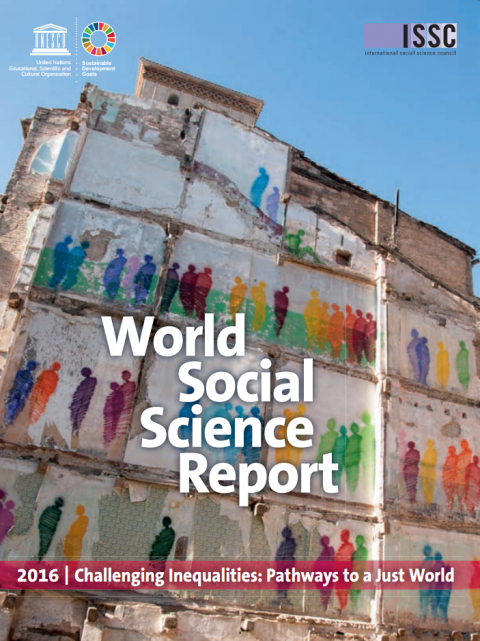 World social science report, 2016: Challenging inequalities; pathways to a just world Year of publication: 2016 Corporate author: UNESCO Never before has inequality been so high on the agenda of policy-makers worldwide, or such a hot topic for social science research. More journal articles are being published on the topic of inequality and social justice today than ever before. This Report draws on the insights of over 100 social scientists and other thought leaders from all over the world, across various disciplines, to emphasize transformative responses to inequality at all levels, from the grass roots to global governance. Too many countries are investing too little in researching the long-term impact of inequality on the sustainability of their economies, societies and communities. Unless we address this urgently, inequalities will make the cross-cutting ambition of the Sustainable Development Goals (SDGs) to ‘leave no one behind’ by 2030 an empty slogan.
 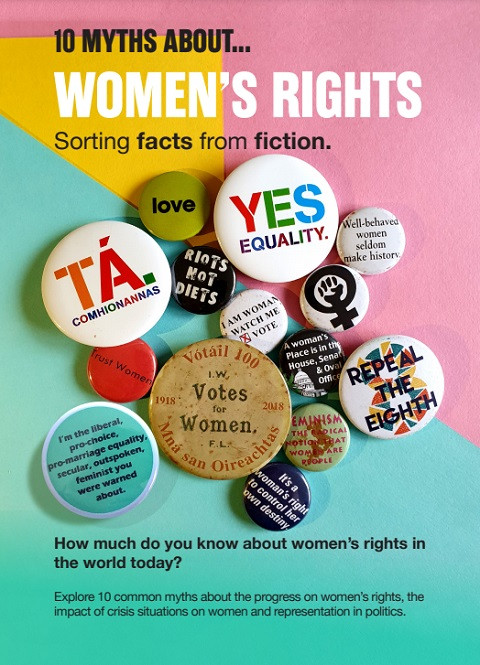 10 Myths About Women’s Rights: Sorting Facts From Fiction Year of publication: 2020 Author: Toni Pyke | Colm Regan Corporate author: DevelopmentEducation.ie Gender-based inequality is one of the most enduring and deep-seated discriminations. It affects all regions, classes and sectors. In most countries, it is maintained and defended in most of the same ways. One key component of that maintenance is a set of myths that are repeated time and time again.This pocket-size booklet includes:Why thinking about women’s rights matters10 short myths about progress on equality, who benefits from feminism, the realities of women’s health and the impact of COVID-19.Links to the Sustainable Development GoalsReferences per each myth following a fact or fiction approach and an explainerThe 10 Myths About…. series looks to sort facts from fiction on key global development, human rights and justice issues.Download 10 Myths About Women’s Rights PDFTest your knowledge and take the 10 Myths About Women’s Rights quiz or share with your group / class / friends For the latest fact checks and factsheets more on the fact checking project and development ideas, issues and debates, visit our What The Fact? project.
 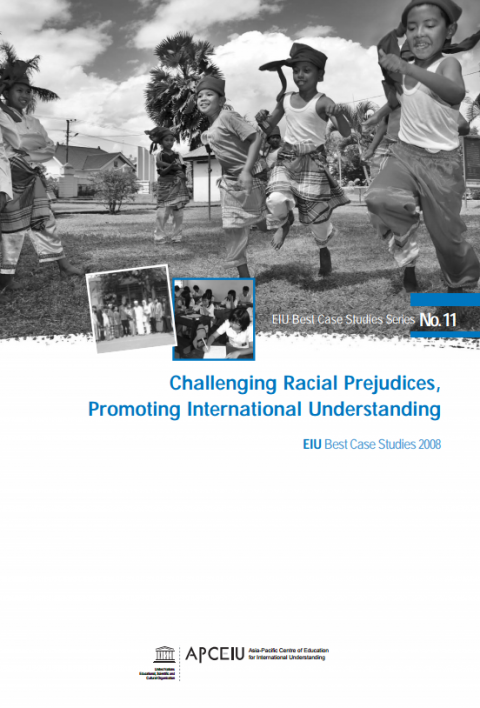 EIU Best Practices Series No. 11: Challenging Racial Prejudices, Promoting International Understanding Year of publication: 2008 Corporate author: APCEIU This monograph is one of APCEIU's EIU Best Practices Series, which aims to encourage educators, scholars, and activists to implement and share local initiatives on EIU. The Series No.11 introduces a case study of the SMA Taman Harapan High School in Indonesia, conducted to explore prevalent issues of racial prejudices and devise methods to reduce racism. Research revealed that students held a degree of racist perception against people of certain heritage. Activities were conducted thenceforth, allowing participants to have direct and extended interactions with people of different cultures. Despite the short timeframe of the activity, perception on stereotypes did not change altogether, yet progress was evident in students’ understanding of the severity of the issue. As educators also learned ways to help alleviate the problem of racism, the case is an exemplary example of increasing cultural awareness and international understanding.
  EIU Best Practices Series No. 19: Culture-Based Education Programme for Indigenous Children & Youth in the Philippines Year of publication: 2010 Author: Benjamin David Abadiano Corporate author: APCEIU This monograph is one of APCEIU's EIU Best Practices Series, which aims to encourage educators, scholars, and activists to implement and share local initiatives on EIU. The Series No.19 introduces the Pumulaan program, a successful culture-based education programme for indigenous children and youth in the Philippines. The program is similar to that of Tugdaan, a widely recognized education program that promote learning for the Indigenous people. The Pumulaan program focuses on providing culturally sensitive, appropriate, and relevant education to students in Mangyan Tribe in Mindoro and the Matigsalog Tribe in Mindanao, incorporating values of peace, harmony, and diversity within the education programs.
  EIU Best Practices Series No. 21: EIU School-based Initiatives in Bhutan Year of publication: 2010 Author: Rinzin Wangmo Corporate author: APCEIU This monograph is one of APCEIU's EIU Best Practices Series, which aims to encourage educators, scholars, and activists to implement and share local initiatives on EIU. The Series No.21 introduces the case of Yonphula Lower Secondary School in Trashigang, Bhutan, which successfully incorporated EIU principles into the existing curriculum. With the Gross National Happiness (GNH) principle as Bhutan’s educational framework, EIU can fit easily to the academic settings and system. The case highlights activities, such as providing non-formal education for illiterate parents, and counseling services, health programs, and meditation programs to students, in exemplifying how innovative school activities can optimize the GNH framework for the promotion of EIU.
 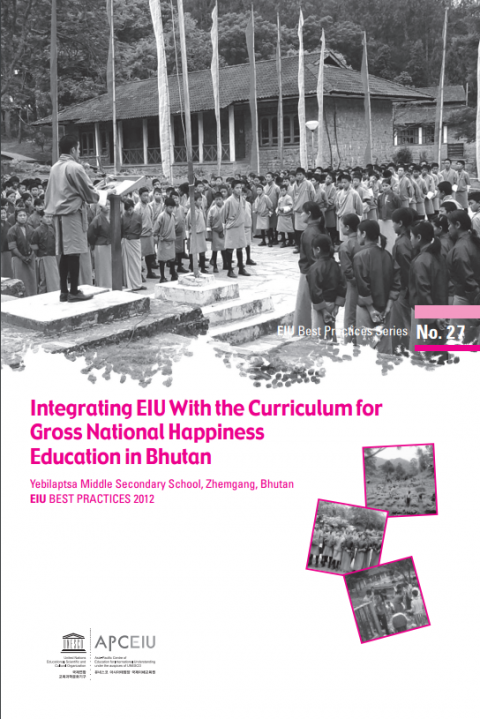 EIU Best Practices Series No. 27: Integrating EIU with the Curriculum for Gross National Happiness Education in Bhutan Year of publication: 2012 Author: Udhim Subba Corporate author: APCEIU This monograph is one of APCEIU's EIU Best Practices Series, which aims to encourage educators, scholars, and activists to implement and share local initiatives on EIU. The Series No.27 introduces Bhutan’s Yebilaptsa Middle Secondary School, in its effort to promote values of EIU as a complementary component of the Gross National Happiness Education efforts. Activities such as UNESCO club community activities, environmental learning, EIU cultural night, international exchange altogether exemplify effective ways to integrate EIU practices in the curriculum and extracurricular programs of schools.
 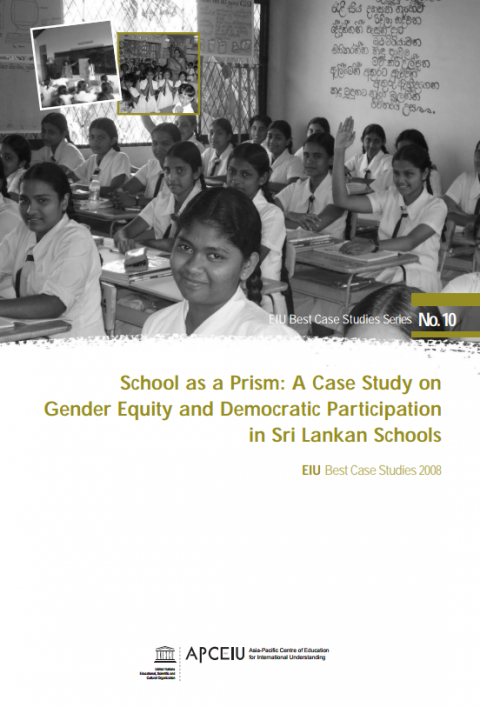 EIU Best Practices Series No. 10: School as a Prism: A Case Study on Gender Equity and Democratic Participation in Sri Lanka Schools Year of publication: 2008 Corporate author: APCEIU This report is one of the APCEIU's EIU Best Practices Series, which aims to encourage educators, scholars, and activists to implement and share local initiatives on EIU. The Series No.10 introduces a study of nine schools in Sri Lanka, which has been conducted to analyze current practices of gender education and provide suggestions for improvement. Upon careful assessment of documentary surveys, interviews, self-reports, and historical data analysis, the result indicates that gender equality and democratic participation are substantially provided and prioritized in Sri Lankan schools, in lieu of EIU theme of social justice. As common challenges still exist, the research notes the need to further examine learning patterns of boys and girls, classroom-specific gender issues, and good practices that promote role of women in democratic participation.
  School, Identity and Discrimination Year of publication: 2011 Author: Néstor López Corporate author: UNESCO IIEP Office for Latin America and the Caribbean Education, identity and school is just one more link, within the many wills that work for full equality of opportunities. As in other publications of the Institute, the wealth of perspectives is added, which give shape to sometimes pressing realities with a demand for urgent action. The publication is a new opportunity for the voices of different interlocutors to give an account, in their countries and contexts, both of the construction of identity processes, and of their recognition and respect. This also implies raising the obstacles, the contributions and the advances, to face the challenges still pending. In each work presented here, the authors-whose participation and effort we deeply appreciate-offer sharp insights on various tasks and contexts. We wish, to conclude, that this text also contributes to the reflection on the possible courses that have been adopted or that require a deepening of the educational policies, specifically in the agendas related to the themes of this publication.