
Resources
Explore a wide range of valuable resources on GCED to deepen your understanding and enhance your research, advocacy, teaching, and learning.
56 Results found
 Bank of Digital Task Sheets Corporate author: Council of Europe Around forty sheets of tasks anchored in real life and reflective tasks are available. The proposed tasks implement the didactic framework that promotes a socio-interactional approach and extends the usual typology of tasks with tasks anchored in real life.These tasks, carried out on online participatory sites, allow the people who carry them out to experience both authentic (inter)actions and digital citizenship.Alongside these tasks, reflective tasks invite learners to reflect on online practices and in particular on their own uses of digital technology. They are to be adapted according to the contexts of use and provide examples of the implementation of the approach defined in the Didactic Framework. Banque de fiches de tâches numériques Corporate author: Conseil de l'Europe Une quarantaine de fiches de tâches ancrées dans la vie réelle et de tâches réflexives sont disponibles. Les tâches proposées mettent en œuvre le cadre didactique qui promeut une approche socio-interactionnelle et étend la typologie habituelle des tâches avec des tâches ancrées dans la vie réelle.Ces tâches, réalisées sur des sites participatifs en ligne, permettent aux personnes qui les réalisent de faire l'expérience, à la fois, d'(inter)actions authentiques et de la citoyenneté numérique.A côté de ces tâches, des tâches réflexives invitent les apprenant·es à réfléchir sur les pratiques en ligne et notamment sur leurs propres usages du numérique. Elles sont à adapter en fonction des contextes d'utilisation et permettent de donner des exemples de mise en œuvre de l'approche définie dans le Cadre didactique.
  Citizens as Users of Languages and Digital Technology Year of publication: 2021 Corporate author: European Centre for Modern Languages (ECML) | Council of Europe A recent meta-analysis of the literature portrays male and female citizens who are users of languages and digital technologies. This helps to understand the goals of an education aimed at developing male and female citizens capable of using digital technology in a competent, informed, safe, responsible, ethical, and critical manner. Citoyens et citoyennes usagers et usagères des langues Year of publication: 2021 Corporate author: European Centre for Modern Languages (ECML) | Conseil de l'Europe Une méta-analyse de la littérature récente dresse le portrait des citoyens et citoyennes usagers et usagères de langues et du numérique. Cela permet de connaitre les objectifs d’une éducation qui vise le développement de citoyens et citoyennes capables d’utiliser le numérique d’une façon compétente, informée, sûre, responsable, éthique et critique.
  UNESCO MIL CLICKS Social Media Innovation Year of publication: 2016 Corporate author: UNESCO MIL CLICKS is a way for people to acquire media and information literacy (MIL) competencies in their normal day-to-day use of the Internet and social media and to engage peer education in an atmosphere of browsing, playing, connecting, sharing, and socializing.The acronym MIL CLICKS stands for Media and Information Literacy: Critical-thinking, Creativity, Literacy, Intercultural, Citizenship, Knowledge & Sustainability.The objectives of this social media strategy are to use social media to:1) Expose people to become more media and information literate and to2) Raise awareness about the importance of media and information literacy.
  UNESCO MIL CLICKS: Innover avec les médias sociaux Year of publication: 2016 Corporate author: UNESCO MIL CLICKS permet non seulement aux gens d'acquérir des compétences en matière d'éducation aux médias et à l'information (MIL en anglais) dans leur utilisation quotidienne d'Internet et des médias sociaux mais également d'engager l'éducation par les pairs dans une atmosphère de navigation, de jeu, de connexion, de partage et de socialisation.
 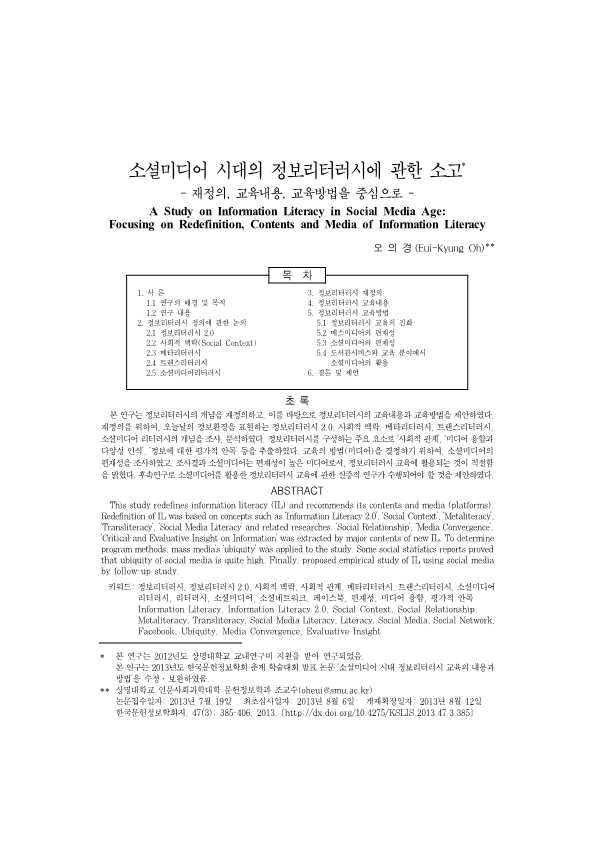 A Study on Information Literacy in Social Media Age: Focusing on Redefinition, Contents and Media of Information Literacy Year of publication: 2013 Author: Euikyung Oh Corporate author: Korean Society for Library and Information Science This study redefines information literacy (IL) and recommends its contents and media (platforms). Redefinition of IL was based on concepts such as ‘Information Literacy 2.0’, ‘Social Context’, ‘Metaliteracy’, ‘Transliteracy’, ‘Social Media Literacy’ and related researches. ‘Social Relationship’, ‘Media Convergence’, ‘Critical and Evaluative Insight on Information’ was extracted by major contents of new IL. To determine program methods, mass media’s ‘ubiquity’ was applied to the study. Some social statistics reports proved that ubiquity of social media is quite high. Finally, proposed empirical study of IL using social media by follow-up study.)
  소셜미디어 시대의 정보리터러시에 관한 소고: 재정의, 교육내용, 교육방법을 중심으로 Year of publication: 2013 Author: Euikyung Oh Corporate author: Korean Society for Library and Information Science 본 연구는 정보리터러시의 개념을 재정의하고, 이를 바탕으로 정보리터러시의 교육내용과 교육방법을 제안하였다. 재정의를 위하여, 오늘날의 정보환경을 표현하는 정보리터러시 2.0, 사회적 맥락, 메타리터러시, 트랜스리터러시, 소셜미디어 리터러시의 개념을 조사, 분석하였다. 정보리터러시를 구성하는 주요 요소로 ‘사회적 관계’, ‘미디어 융합과 다양성 인식’, ‘정보에 대한 평가적 안목’ 등을 추출하였다. 교육의 방법(미디어)을 결정하기 위하여, 소셜미디어의 편재성을 조사하였고, 조사결과 소셜미디어는 편재성이 높은 미디어로서, 정보리터러시 교육에 활용되는 것이 적절함을 밝혔다. 후속연구로 소셜미디어를 활용한 정보리터러시 교육에 관한 실증적 연구가 수행되어야 할 것을 제안하였다.
 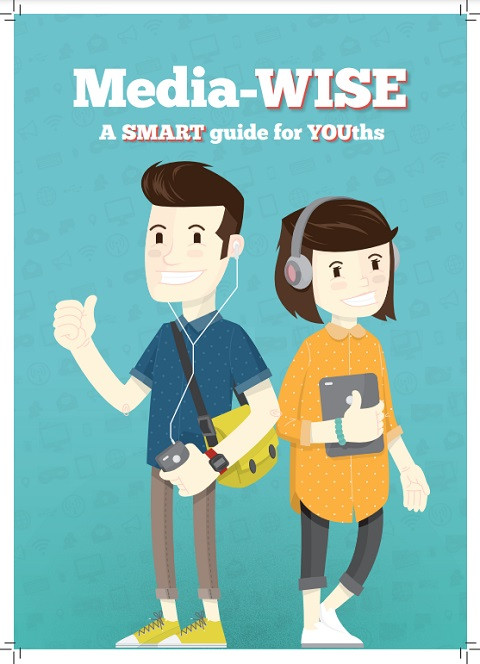 Media-Wise: A Smart Guide for Youths Year of publication: 2015 Corporate author: Media Literacy Council (MLC) Even as a digital native, you might need some help figuring out the safest and kindest route through the digital world - this guide will give you the tips and advice you need to make that journey.
 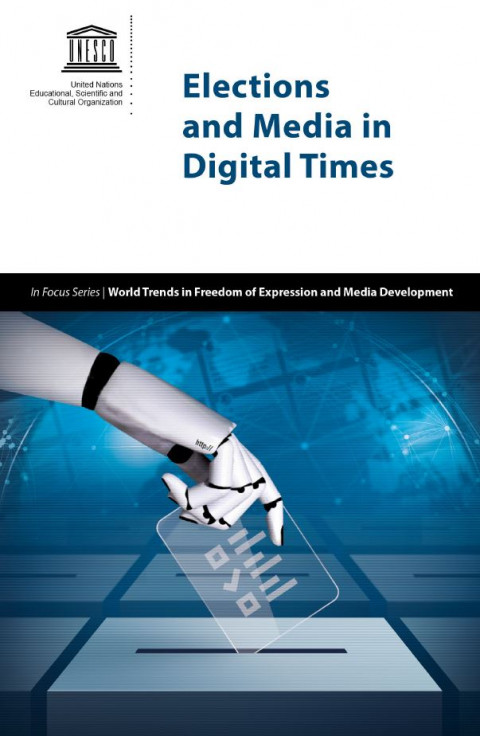 Elections and Media in Digital Times (In Focus Series: Global Trends in Freedom of Expression and Media Development) Year of publication: 2019 Author: Tarlach McGonagle | Maciek Bednarski | Mariana Francese Coutinho | Arthur Zimin Corporate author: UNESCO Digital companies are enabling politicians, political parties and voters to communicate in unprecedented ways, and expanding opportunities for seeking, receiving and imparting political information and ideas. Alongside positive developments, there also growing concerns about emerging and increasing threats to the integrity and credibility of elections, as well as the media's contribution to free, fair, transparent and peaceful electoral processes.This report highlights three converging trends in media and elections in digital times: the rise of disinformation, intensifying attacks on journalists, and disruptions linked to the use of information and communication technology in electoral arrangements. Offering possible responses to the challenges at hand, this study is a tool for governments, election practitioners, media organizations, journalists, civil society, the private sector, academia and individuals.