
Resources
Explore a wide range of valuable resources on GCED to deepen your understanding and enhance your research, advocacy, teaching, and learning.
9 Results found
 How to Develop Solidarity Service-Learning Projects: Manual for Various Educational Levels and Non-formal Education Year of publication: 2024 Author: María Nieves Tapia Corporate author: Latin American Center for Service-Learning (CLAYSS) The publication presents the concept and practice of solidarity-based service-learning (SLL) focusing on its implementation in Uruguay from a Latin American perspective. With this approach, throughout its 88 pages it explores local applications and compares experiences from other regions, providing a broad and enriching view of this methodology. Solidarity-based service-learning is a recommended pedagogical strategy to face the educational challenges of the 21st century. According to the Delors report (1996), this methodology is aligned with the four pillars of education: learning to be, learning to learn, learning to do and learning to live together. The manual details how SLL projects can be a powerful tool for social change. Cómo desarrollar proyectos de aprendizaje-servicio solidario: Manual para los diversos niveles educativos y la educación no formal Year of publication: 2024 Author: María Nieves Tapia Corporate author: Latin American Center for Service-Learning (CLAYSS) La publicación presenta el concepto y la práctica del aprendizaje y servicio solidario (AySS) centrándose en su implementación en Uruguay con una perspectiva latinoamericana. Con este enfoque, a lo largo de sus 88 páginas explora las aplicaciones locales y compara experiencias de otras regiones, proporcionando una visión amplia y enriquecedora de esta metodología. El aprendizaje-servicio solidario es una estrategia pedagógica recomendada para enfrentar los desafíos educativos del siglo XXI. Según el informe Delors (1996), esta metodología está alineada con los cuatro pilares de la educación: aprender a ser, aprender a aprender, aprender a hacer y aprender a vivir juntos. El manual detalla cómo los proyectos de AySS pueden ser una herramienta poderosa para el cambio social.
  Shared Responsibility, Global Solidarity: Responding to the Socio-Economic Impacts of COVID-19 Year of publication: 2020 Corporate author: United Nations (UN) We are facing a global health crisis unlike any in the 75-year history of the United Nations — one that is killing people, spreading human suffering, and upending people’s lives. But this is much more than a health crisis. It is a human crisis. The coronavirus disease (COVID-19) is attacking societies at their core. The IMF has just reassessed the prospect for growth for 2020 and 2021, declaring that we have entered a recession – as bad as or worse than in 2009. The IMF projects recovery in 2021 only if the world succeeds in containing the virus and take the necessary economic measures.In the face of such an unprecedented situation in recent history, the creativity of the response must match the unique nature of the crisis – and the magnitude of the response must match its scale. No country will be able to exit this crisis alone.This report is a call to action, for the immediate health response required to suppress transmission of the virus to end the pandemic; and to tackle the many social and economic dimensions of this crisis. It is, above all, a call to focus on people – women, youth, low-wage workers, small and medium enterprises, the informal sector and on vulnerable groups who are already at risk.
 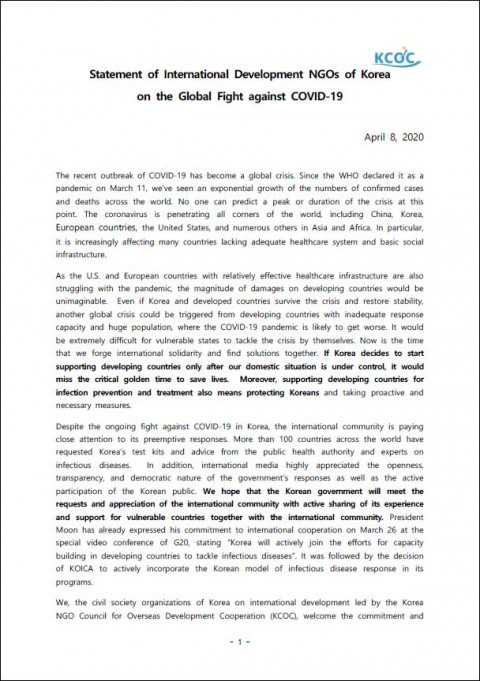 Statement of International Development NGOs of Korea on the Global Fight against COVID-19 Year of publication: 2020 Corporate author: Korea NGO Council for Overseas Development Cooperation (KCOC) The recent outbreak of COVID-19 has become a global crisis. Since the WHO declared it as a pandemic on March 11, we’ve seen an exponential growth of the numbers of confirmed cases and deaths across the world. No one can predict a peak or duration of the crisis at this point.As the U.S. and European countries with relatively effective healthcare infrastructure are also struggling with the pandemic, the magnitude of damages on developing countries would be unimaginable. It would be extremely difficult for vulnerable states to tackle the crisis by themselves. Now is the time that we forge international solidarity and find solutions together.
 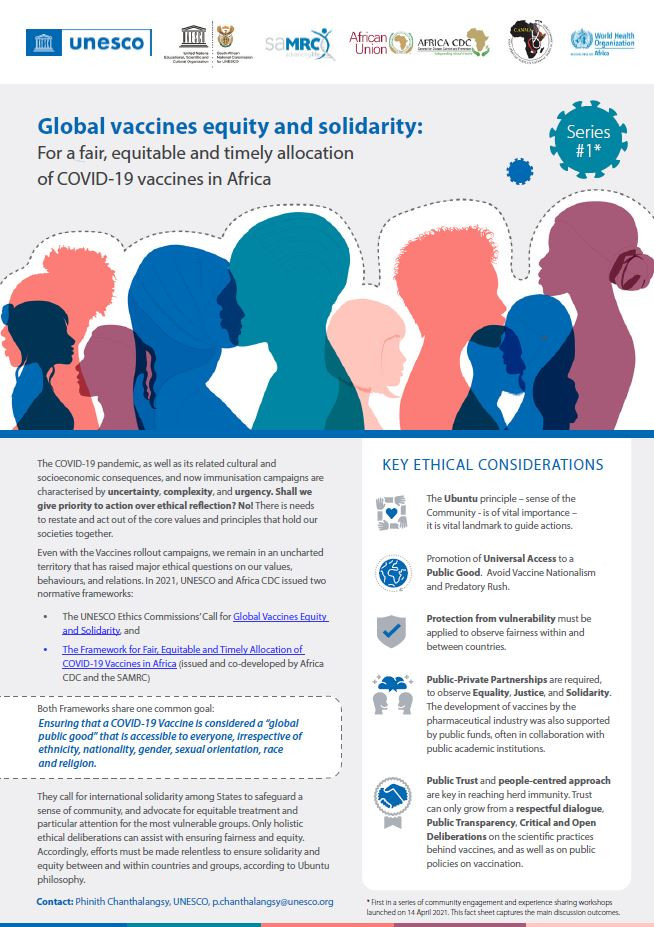 Global Vaccines Equity and Solidarity: For a Fair, Equitable and Timely Allocation of COVID-19 Vaccines in Africa; Series #1 Year of publication: 2021 Corporate author: UNESCO Harare African populations have been side-lined through the COVID-19 Vaccination roll-out process. A vaccination timeline taking Africa into 2023 would be unethical. African countries need to invest in their own structures and stop relying on colonial structures. There is a moral obligation to safeguard the population through equal distribution. This not only makes moral and ethical sense but also scientific and economic sense as a slow roll out in Africa will impact the rest of the world. First in a series of community engagement and experience sharing workshops launched on 14 April 2021. This fact sheet captures the main discussion outcomes.
 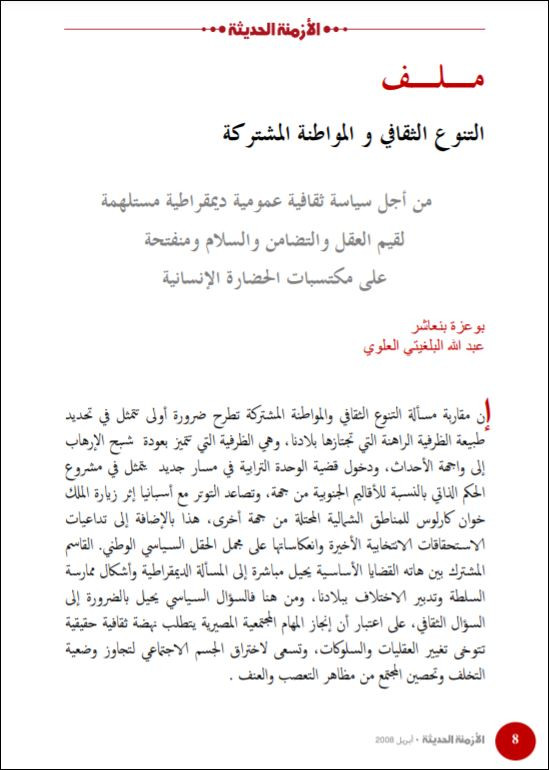 Cultural Diversity and Shared Citizenship Year of publication: 2008 Author: BoAzza Binasher | Abdullah Alalawai Corporate author: Modern Times Magazine This integrated file from the Journal of Modern Times reviews the issue of citizenship and cultural diversity. The file reviews many reflective questions on the subject of shared citizenship. The file contributes in general to setting a democratic cultural policy that guarantees the values of solidarity and peace in order to preserve human civilization. ملف التنوع الثقافي و المواطنة المشتركة Year of publication: 2008 Author: BoAzza Binasher | Abdullah Alalawai Corporate author: Modern Times Magazine يستعرض هذا الملف المتكامل من مجلة الأزمنة الحديثة قضية المواطنة والتنوع الثقافي. حيث يستعرض الملف تساؤلات كثيرة حول موضوع المواطنة المشتركة. ويسهم الملف عموما في وضع سياسة ثقافية ديموقراطية تضمن قيم التضامن والسلام من أجل الحفاظ على المكتسبات الإنسانية.
  Solidarity as the Future of Education: Perspectives From the Ibero-American Experience of Service-Learning Year of publication: 2024 Author: Elena Massat Corporate author: UNESCO | Latin American Center for Service-Learning (CLAYSS) With this work we have proposed to put into dialogue the recent UNESCO document “Reimagining our futures together. A new social contract for education. Report of the international commission on the futures of education” with the theory and practice of service-learning in Ibero-America. We would like to show how UNESCO's proposal for education for the future can already be verified as a practice in many educational institutions in the region, which develop solidarity service-learning projects even in the most vulnerable contexts. In these experiences, solidarity ceases to be just learning content, to become an educational process, a pedagogy to learn to solve complex problems of reality, and to use the SDGs as a “curriculum” for the education of the future (UNESCO, 2022:54). These practices are deeply innovative, as the experts who comment on them point out, and we hope that they can be inspiring for many other educational institutions. La solidaridad como futuro de la educación: Perspectivas desde la experiencia iberoamericana del aprendizaje-servicio Year of publication: 2024 Author: Elena Massat Corporate author: Organización de las Naciones Unidas para la Educación, la Ciencia y la Cultura (UNESCO) | Latin American Center for Service-Learning (CLAYSS) Con esta obra nos hemos propuesto poner en diálogo el reciente documento de la UNESCO “Reimaginar juntos nuestros futuros. Un nuevo contrato social para la educación. Informe de la comisión internacional sobre los futuros de la educación.” con la teoría y práctica del aprendizaje-servicio en Iberoamérica. Quisiéramos evidenciar de qué manera la propuesta de educación para el futuro de UNESCO se puede ya verificar como práctica en muchas instituciones educativas de la región, que desarrollan proyectos de aprendizaje-servicio solidario aún en los contextos de mayor vulnerabilidad. En estas experiencias, la solidaridad deja de ser sólo contenido de aprendizaje, para transformarse en proceso educativo, en pedagogía para aprender a solucionar problemas complejos de la realidad, y usar a los ODS como “currículo” de la educación del futuro (UNESCO, 2022:54). Estas prácticas son profundamente innovadoras, como lo señalan los expertos que las comentan, y esperamos que puedan ser inspiradoras para muchas otras instituciones educativas.