
Resources
Explore a wide range of valuable resources on GCED to deepen your understanding and enhance your research, advocacy, teaching, and learning.
340 Results found
 可持续发展教育校长培训手册 Year of publication: 2012 Corporate author: UNESCO | Beijing Sustainable Development Education Association | China National Council for Sustainable Development Education Secretariat 文章旨在解释可持续发展在中国的应用
 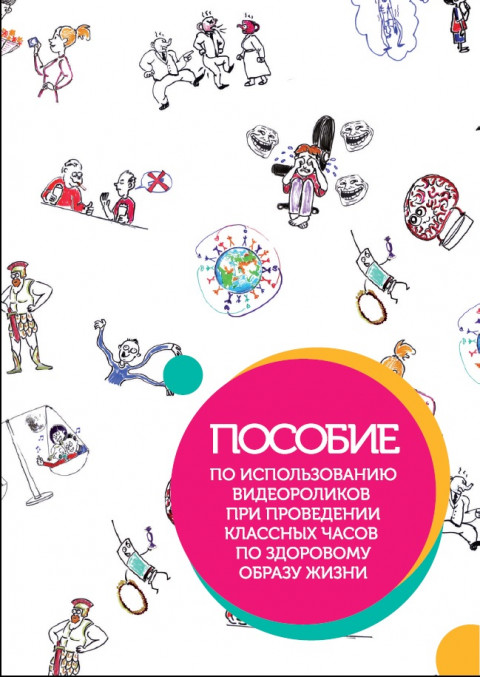 Development of classroom hour for a healthy lifestyle for students of 6-11 grades: Methodical guide for teachers Year of publication: 2014 Corporate author: UNESCO Institute for Information Technologies in Education (IITE) | Joint United Nations Programme on HIV/AIDS (UNAIDS) This manual has been developed to help pedagogical workers of educational institutions (class teachers, subject teachers) to conduct class hours in a healthy lifestyle using educational videos on the following basic topics: (1) the characteristics of adolescence, (2) the concept of "gender ", “Gender” and “gender equality”, (3) prevention of the consumption of psychoactive substances, (4) decision making and resistance to peer pressure, (5) love and sexual relations, (6) reproductive health and contraception, (7) HIV prevention, (8) interpersonal relationships and conflict resolution, (9) trolling and cyberbulling. Пособие по использованию видеороликов при проведении классных часов по здоровому образу жизни для учащихся 6-11 классов. Методическое руководство для учителей Year of publication: 2014 Corporate author: Институт ЮНЕСКО по информационным технологиям в образовании (ИИТО) | Объединенная программа ООН по ВИЧ/СПИДу (ЮНЭЙДС) Данное пособие разработано в помощь педагогическим работникам общеобразовательных организаций (классным руководителям, учителям-предметникам) для проведения классных часов по здоровому образу жизни с использованием образовательных видеороликов по следующим базовым темам: (1) особенности подросткового возраста, (2) понятия «пол», «гендер» и «гендерное равенство», (3) профилактика потребления психоактивных веществ, (4) принятие решения и противостояние давлению со стороны сверстников, (5) любовь и сексуальные отношения, (6) репродуктивное здоровье и контрацепция, (7) профилактика ВИЧинфекции, (8) межличностные отношения и разрешение конфликтов, (9) троллинг икибербуллинг.
 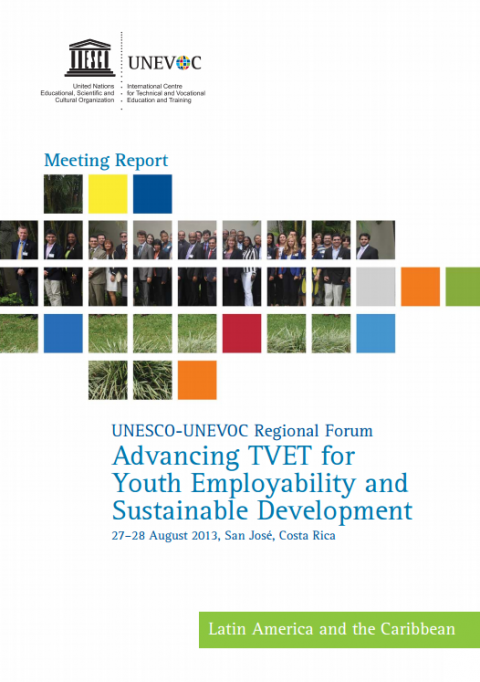 UNESCO-UNEVOC regional forum: advancing TVET for youth employability and sustainable development, Latin America and the Caribbean, 27-28 August 2013, San José, Costa Rica; meeting report Year of publication: 2013 Corporate author: UNESCO International Centre for Technical and Vocational Education and Training (UNEVOC) The Regional Forum of UNEVOC centres in Latin America and the Caribbean (LAC) presented in this report was one of a series of activities aiming to strengthen global and regional harmonization for the advancement of TVET transformation through the capacities of UNEVOC’s unique global network of specialized TVET institutions and affiliated partners, following the UNESCO Third International Congress on Technical and Vocational Education and Training (TVET) that took place in China in May 2012. The Forum also provided the opportunity to present evidence on the two priority thematic areas for UNESCO-UNEVOC for 2013, Youth and Skills and Greening TVET. This was achieved through the presentation and discussion of several promising practices in these two areas.
  Concept note for the 2020 Global education monitoring report on inclusion Year of publication: 2018 In line with its mandate, the 2020 GEM Report will assess progress towards Sustainable Development Goal 4 (SDG 4) on education and its ten targets, as well as other related education targets in the SDG agenda.Echoing the overall orientation in the SDGs to “leave no one behind”, this year's Report will also take an in-depth look at inclusion and education. Inclusion is central in the formulation of SDG 4 but is also taken up in other targets in the goal, notably targets 4.5 on gender equality and 4.a on learning environments. Responding to this emphasis, the 2020 GEM Report will analyse policies the world over and present evidence on the different elements of education systems that can support inclusion, such as laws and policies, governance and finance, curricular and learning materials, teachers, school infrastructure, school selection and parental and community views.The Report will focus on the barriers faced by all learners, especially those with overlapping characteristics that make them particularly vulnerable to exclusion. It will also take an in-depth look at people with disabilities, a group whose particular challenges gave rise to the inclusion debate. The Report will look at a range of indicators measuring inclusion in education using both quantitative and qualitative data. The analysis will be based on geographically balanced evidence, and will pay special attention to contexts where disadvantaged children might be particularly at risk of exclusion from education, such as in situations of conflict.
 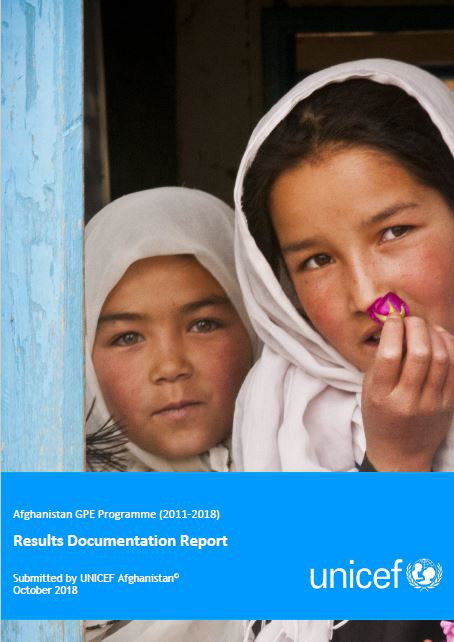 2018 grant completion report. Afghanistan Year of publication: 2019 Corporate author: UNICEF Afghanistan This is the completion report of GPE’s program in Afghanistan, which ran from 2012 to 2018. Overall, it appears education access and equity has been improved in target districts, and some of these effects promise to persist beyond the program period.Community engagement in schooling has also improved, as well as school performance. Target schools have safer and more conducive learning environments for children, and monitoring of education pathways has also improved.Schools have been reopened, and numbers of female teachers in target areas have grown. Finally, the Ministry of Education and national education sectors have seen advances in institutional capacity, and national aid coordination mechanisms also seem to have improved.
 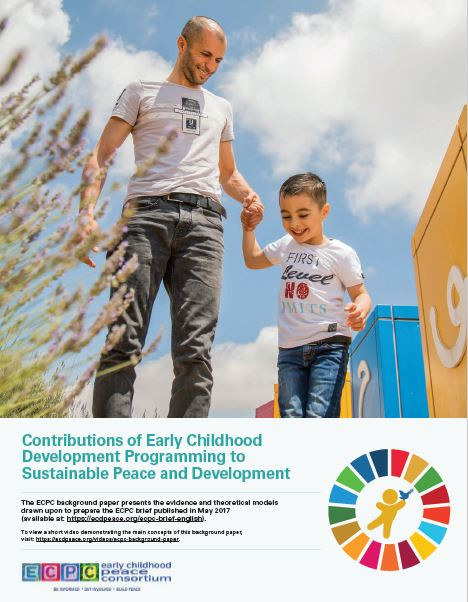 Contributions of Early Childhood Development Programming to Sustainable Peace and Development Year of publication: 2018 Author: Chelsea K. Donaldson | Friedrich W. Affolter | Liliana Angelica Ponguta | Rima Salah | Pia R. Britto | James Leckman | Paul Connolly | Siobhan Fitzpatrick | Pauline Walmsley By intervening early and engaging with children’s families, ECD services offer a unique opportunity to make a cost-effective and sustainable impact on interrupting cycles of poverty and violence. Given that efforts towards sustainable peace must encompass all sectors and address all societal levels, there is a crucial need for implementing “multi-level ECD services” that center on the whole child and engage his or her surrounding ecological context. These comprehensive ECD services can not only improve child development outcomes, but also strengthen competencies in caregivers, address stressors and conflict drivers in the community and build institutional capacities to reduce structural violence. The purpose of this background paper is to merge insights from both micro and macro-level perspectives to demonstrate how ECD services can be leveraged to sustainable peace and development. While peacebuilding experts have traditionally focused on macro-level strategies such as government reform or economic rehabilitation interventions, ECD practitioners have focused primarily on micro-level interventions of individual children and families without much exploration of how ECD services can be leveraged to mitigate risks of conflict and transform relationships across communities and regions.
  Artificial intelligence in education: challenges and opportunities for sustainable development Year of publication: 2019 Author: Pedró, Francesc | Subosa, Miguel | Rivas, Axel | Valverde, Paula Artificial Intelligence is a booming technological domain capable of altering every aspect of our social interactions. Ineducation, AI has begun producing new teaching and learning solutions that are now undergoing testing in differentcontexts. This working paper, written for education policymakers, anticipates the extent to which AI affects the education sector to allow for informed and appropriate policy responses. This paper gathers examples of the introduction of AI in education worldwide, particularly in developing countries, discussions in the context of the 2019 Mobile Learning Week and beyond, as part of the multiple ways to accomplish Sustainable Development Goal 4, which strives for equitable, quality education for all. First, this paper analyses how AI can be used to improve learning outcomes, presenting examples of how AI technology can help education systems use data to improve educational equity and quality in the developing world. Next, thepaper explores the different means by which governments and educational institutions are rethinking and reworking educational programmes to prepare learners for the increasing presence of AI in all aspects of human activity. Thepaper then addresses the challenges and policy implications that should be part of the global and local conversations regarding the possibilities and risks of introducing AI in education and preparing students for an AI-powered context. Finally, this paper reflects on future directions for AI in education, ending with an open invitation to create new discussions around the uses, possibilities and risks of AI in education for sustainable development.
  Annual Report 2018 : UNESCO INSTITUTE FOR LIFELONG LEARNING Year of publication: 2019 Corporate author: UNESCO Institute for Lifelong Learning (UIL) UIL’s 2018 Annual Report shows how, last year, our work contributed to fulfilling our mission to support better policy-making and strengthen the capacities of UNESCO Member States in the field of lifelong learning. UIL’s vision is for all children, youth and adults to benefit from quality lifelong learning, within the framework of sustainable development and peace, and we pursue it in the context of the United Nations 2030 Agenda for Sustainable Development, particularly Sustainable Development Goal (SDG) 4 on quality education and lifelong learning. Its publications are a valuable resource for education researchers, planners, policy-makers and practitioners.
  Bridge Zambia Project Report Year of publication: 2019 Corporate author: Korean National Commission for UNESCO | Zambia National Commission for UNESCO The Bridge Zambia Project (the Project) has been implemented jointly between the Korean National Commission for UNESCO (KNCU) and its partners in Zambia since October 2010. In March 2019, KNCU’s involvement in the Project will come to an end and Zambia will take over full responsibility for the Project as it goes forward. The Project has supported grassroots activities through the establishment of a Community Learning Centre (CLC), which acts as a hub of community-led development activities in non-formal education. The Project has mobilized and empowered communities and local leadership to take charge of non-formal education programmes with the aim of assisting Zambia to attain UNESCO’s Education for All goals and UN Sustainable Development Goal 4 (SDG 4), concerning education quality.