
Resources
Explore a wide range of valuable resources on GCED to deepen your understanding and enhance your research, advocacy, teaching, and learning.
191 Results found
 UNESCO-UNEVOC regional forum: advancing TVET for youth employability and sustainable development, Latin America and the Caribbean, 27-28 August 2013, San José, Costa Rica; meeting report Year of publication: 2013 Corporate author: UNESCO International Centre for Technical and Vocational Education and Training (UNEVOC) The Regional Forum of UNEVOC centres in Latin America and the Caribbean (LAC) presented in this report was one of a series of activities aiming to strengthen global and regional harmonization for the advancement of TVET transformation through the capacities of UNEVOC’s unique global network of specialized TVET institutions and affiliated partners, following the UNESCO Third International Congress on Technical and Vocational Education and Training (TVET) that took place in China in May 2012. The Forum also provided the opportunity to present evidence on the two priority thematic areas for UNESCO-UNEVOC for 2013, Youth and Skills and Greening TVET. This was achieved through the presentation and discussion of several promising practices in these two areas.
  Green Pack Year of publication: 2013 Corporate author: Regional Environmental Center for Central and Eastern Europe Inspired by the political process “Environment for Europe”, in 2000 the Regional Environmental Center for Central and Eastern Europe (REC) launched a programme on education for sustainable development (ESD), sponsored by Toyota. This included the development and introduction of an innovative multimedia educational kit, the Green Pack, for school teachers and their students in Central and EasternEurope. Other ESD tools similar to the Green Pack have been developed and introduced in recent years to address different target groups. Currently, the main group of REC ESD tools includes:Green Pack, aimed at children aged between 11 and 15 and their teachersGreen Pack Junior, aimed at children aged between 7 and 10 and their teachersGreen Steps, aimed at citizens and families After 14 years of project implementation, REC ESD materials have been introduced in 19 countries in Europe and Asia. Since the Green Pack launch in 2001, around 40,000 teachers and over 4.5 million students have been educated, fundamentally changing the way in which the teaching of sustainability is approached. Each project has been developed in cooperation with businesses, governments, professional organisations and NGOs in order to foster community support across a broad spectrum of society. Many donors from the international, governmental, business and private communities have supported this process. URL:http://www.greenpackonline.org/english/menu.html
  Development of classroom hour for a healthy lifestyle for students of 6-11 grades: Methodical guide for teachers Year of publication: 2014 Corporate author: UNESCO Institute for Information Technologies in Education (IITE) | Joint United Nations Programme on HIV/AIDS (UNAIDS) This manual has been developed to help pedagogical workers of educational institutions (class teachers, subject teachers) to conduct class hours in a healthy lifestyle using educational videos on the following basic topics: (1) the characteristics of adolescence, (2) the concept of "gender ", “Gender” and “gender equality”, (3) prevention of the consumption of psychoactive substances, (4) decision making and resistance to peer pressure, (5) love and sexual relations, (6) reproductive health and contraception, (7) HIV prevention, (8) interpersonal relationships and conflict resolution, (9) trolling and cyberbulling.
  The United Nations World Water Development Report 2021: Valuing Water Year of publication: 2021 Corporate author: UNESCO World Water Assessment Programme (WWAP) The 2021 edition of the United Nations World Water Development Report focuses on valuing water. There is enough water for all provided we use and manage it efficiently. But we don’t. We invest too little, and ineffectively. We use too much water, creating scarcities. Quality is suffering and so is the environment.The value we place on water varies, depending upon who is using it, and why. Value can be a guide to what our goals should be, what actions are needed, and where we should invest. Many of our problems arise because we don’t value water highly enough; all too often water is not valued at all.This report explains various approaches to valuing water for environmental considerations, water-related infrastructure, drinking water, sanitation and hygiene. It looks at valuation issues in food and agriculture, business, industry, energy and financing. And it highlights the perspectives of different value systems and cultures, and associated social and gender-based considerations.
  A New Era of Social Justice: International Labour Conference, 100th Session, 2011 Year of publication: 2011 Corporate author: International Labour Organization (ILO) This report specifically presents to the conference what the Director believes are the fundamental problems the ILO faces as it oversees a century of its inception in 2019. These problems are the remnants of an ineffective growth pattern that has increased inequality around the world over the past 30 years. The mission of the organization is to continue to work together to develop effective responses to these challenges - within the ILO itself, with national bodies such as governments, employers and workers, and through ILO cooperation with others.
  Inclusion of the Domains of Sustainable Development in Al Hadith Text Books in the Intermediate Stage Year of publication: 2019 Author: Zubaida S. Al Shamary | Talal M. Al Maaajal Corporate author: Sultan Qaboos University This study aims to identify the areas of sustainable development that should be included in the textbooks of Prophetic Sayings (Hadeeth) in the Kingdom of Saudi Arabia, to determine the degree of availability, and to find out if there are statistically significant differences at (α≤0.05) in the degree of availability. The descriptive analytical method was used to analyze the whole study population. Cooper coefficient of stability, frequencies, and percentages were used to analyze the results and measure the degree of availability of these fields. Chi Square equation was also used to measure the differences between the availability of fields among grades. The social field was firstly ranked with a percentage of 78.16%, and a total of 433 frequencies, while the environmental field followed it with a percentage of 6.98% and a total of 37 frequencies. The paper showed that there were statistically significant differences in the inclusion in Chi equation.
  Convention on Biological Diversity: Framework for a Communications Strategy Year of publication: 2016 Corporate author: United Nations Environment Programme (UNEP) | United Nations (UN) The document contains the Convention on Biological Diversity.It is a decision adopted by the Conference of the Parties to the Convention on Biological Diversity.
 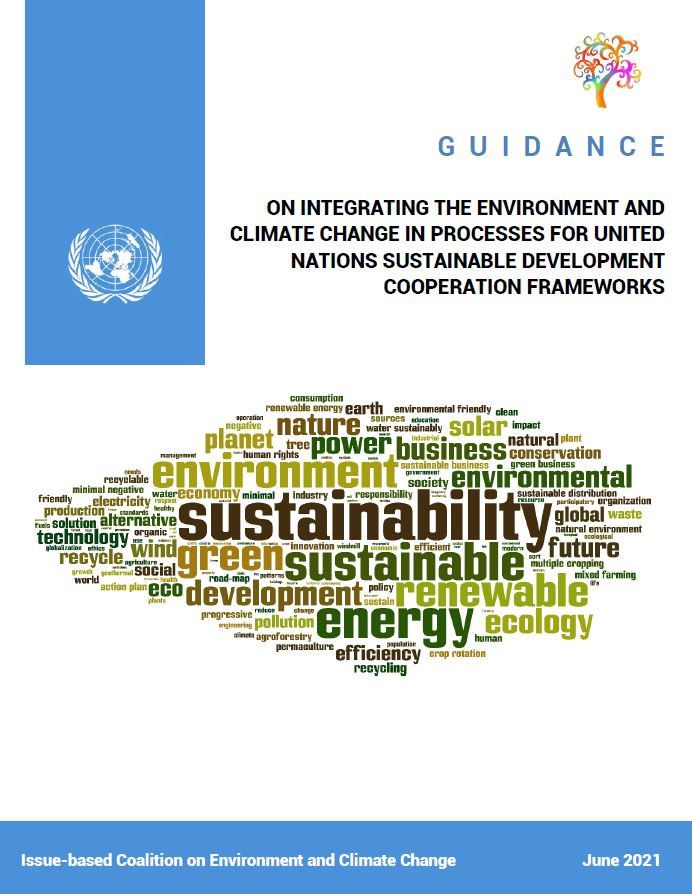 Guidance on Integrating the Environment and Climate Change in Processes for United Nations Sustainable Development Cooperation Frameworks Year of publication: 2021 Author: Henrieta Martonakova Corporate author: Issue-based Coalition on Environment and Climate Change The guidance, which benefits from the diverse expertise of the 18 member organizations of the Coalition, looks at mainstreaming environmental and climate change considerations into the different stages of preparing the UNSDCF: The roadmap for a new cooperation frameworkThe common country analysisThe cooperation framework designThe cooperation framework implementationCooperation framework monitoring and evaluation The guidance looks deeper into mainstreaming the environment and climate change into a series of development priorities: human rights, including children’s rights and the rights of women; economic and trade development, including innovations, SMEs and decent work; food security and agriculture; infrastructure and sustainable use of resources, including energy, water and waste management; quality education; good health; good governance; and disaster reduction and conflict prevention.
 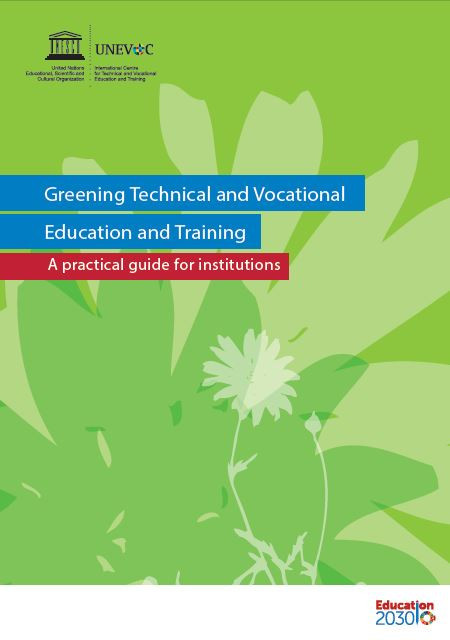 Greening Technical and Vocational Education and Training: A Practical Guide for Institutions Year of publication: 2017 Corporate author: UNESCO International Centre for Technical and Vocational Education and Training (UNEVOC) This Guide describes the macro need for TVET reform in conformity with the Sustainable Development Goals, the Global Action Programme (GAP) on Education for Sustainable Development (ESD), and other United Nations, UNESCO and national initiatives. The Guide also provides specific practical help for institutional greening transition teams to plan and carry out the changes that are deemed necessary. It is essential that all such greening undertakings have a clear vision, are known to all those concerned, follow a strategic plan, set targets and milestones, and include a monitoring/assessment tool. The concept of shared vision and team reformation combined with the support of senior leaders is evident throughout this Guide. A major goal is that greening will grow into an ongoing process which is eventually infused into the culture of each institution.
 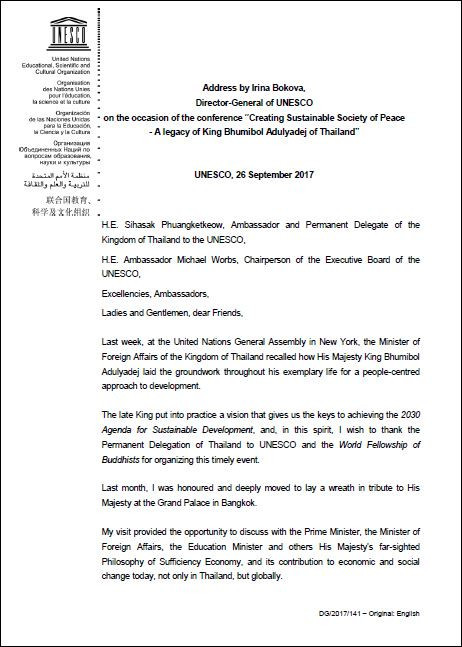 Address by Irina Bokova, Director-General of UNESCO, on the occasion of the conference: Creating Sustainable Society of Peace: A Legacy of King Bhumibol Adulyadej of Thailand Year of publication: 2017 Corporate author: UNESCO. Director-General, 2009-2017 (Bokova, I.G.) This address was delivered by Irina Bokova, Director-General of UNESCO, on the occasion of the conference: Creating Sustainable Society of Peace: A Legacy of King Bhumibol Adulyadej of Thailand; UNESCO, 26 September 2017.