
Resources
Explore a wide range of valuable resources on GCED to deepen your understanding and enhance your research, advocacy, teaching, and learning.
109 Results found
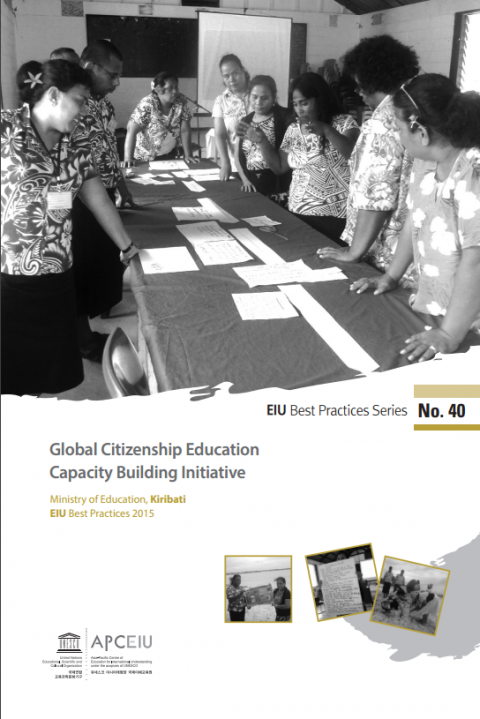 EIU Best Practices Series No. 40: Global Citizenship Education Capacity Building Initiative Year of publication: 2015 Author: Eretia Monite Corporate author: APCEIU This monograph is one of APCEIU's EIU Best Practices Series, which aims to encourage educators, scholars, and activists to implement and share local initiatives on EIU. The Series No. 40 introduces a successful hosting of workshop on GCED in Kiribati. Considered the first of its kind in Kiribati, the workshop brought together education officers and teachers to learn about emerging concept of GCED and EIU and means for implementation. The exemplary workshop involving fieldtrips and seminars has created a wave of learning opportunities for key stakeholders at all levels, paving way to put GCED into practice.
  EIU Best Practices Series No. 4: Implementation of Civic Approach for Development of Positive School Environment and a Culture of Peace Year of publication: 2006 Corporate author: APCEIU This monograph is one of APCEIU's EIU Best Practices Series, which aims to encourage educators, scholars, and activists to implement and share local initiatives on EIU. The Series No.4 is an experimental research conducted by the Information and Research Center to promote culture of peace and teaching and learning outcomes that support positive development of school environment. Three pilot schools in Kazakhstan were analyzed upon implementation of teacher training workshops, instructional materials, and programs in civic and human rights education.
  Getting Every School Climate-ready: How Countries are Integrating Climate Change Issues in Education Year of publication: 2021 Corporate author: UNESCO This document summarizes the findings of selected studies by UNESCO and its partners on how climate change issues are integrated in education.These findings shed light on four key questions: where do we stand on climate change education; what do teachers say; what are the examples of country good practices on climate change education; and what does inter-ministerial collaboration on education for sustainable development look like?
  AI Competency Framework for Teachers Year of publication: 2024 Author: Fengchun Miao | Mutlu Cukurova Corporate author: UNESCO AI processes vast information, generates new content, and helps decision-making through predictive analyses. In education, AI has transformed the traditional teacher–student relationship into a teacher–AI–student dynamic.This shift requires a re-examination of teachers’ roles and the competencies they need in the AI era. Yet, few countries have defined these competencies or developed national programmes to train teachers in AI, leaving many educators without proper guidance.The AI competency framework for teachers addresses this gap by defining the knowledge, skills, and values teachers must master in the age of AI. Developed with principles of protecting teachers’ rights, enhancing human agency, and promoting sustainability, the publication outlines 15 competencies across five dimensions: Human-centred mindset, Ethics of AI, AI foundations and applications, AI pedagogy, and AI for professional learning. These competencies are categorized into three progression levels: Acquire, Deepen, and Create.As a global reference, this tool guides the development of national AI competency frameworks, informs teacher training programmes, and helps in designing assessment parameters. It also provides strategies for teachers to build AI knowledge, apply ethical principles, and support their professional growth.
  Teachers Have Their Say: Motivation, Skills and Opportunities to Teach Education for Sustainable Development and Global Citizenship Year of publication: 2021 Corporate author: منظمة الأمم المتحدة للتربية والعلم والثقافة (UNESCO) | Education International (EI) This report examines how ready teachers are to meet the promise of Sustainable Development Goal 4 on Education and Target 4.7, which calls on countries ‘to ensure that all learners acquire the knowledge and skills needed to promote sustainable development’.
  Global Education Monitoring Report 2024, Pacific: Technology in Education; A Tool on Whose Terms? Year of publication: 2024 Corporate author: UNESCO | Global Education Monitoring Report Team | Commonwealth of Learning Information transmission and connectivity is crucial in the Pacific, a region characterized by high geographic dispersion. While the application of ICT in education has significant potentials, it is hindered by the region's limited and costly infrastructure. This edition accompanies the 2023 Global Education Monitoring Report, which acknowledges technology as a useful tool but invites the education community to question on whose terms it is deployed. The report considered four key policy areas of the Pacific Regional Education Framework (PacREF) (2018–2030): In terms of quality and relevance, mobile technology has offered an affordable and flexible approach to learning, and social media have improved communication between institutions, parents and learners. Moodle is the most widely used digital platform in the region. Textbooks are being digitalised and digital resources made available. Yet content is not always developed or adapted to local languages and cultural contexts. Open and distance learning has historically expanded learning pathways in the Pacific, specially in higher education and as a response to natural hazards. The University of South Pacific is a leading example of open and distance learning connecting campus across 12 countries. With the aim to enhance student outcomes and well-being, efforts have been made to incorporate digital skills into curricula and initiatives have increased outside formal education. Yet regulations do not adequately address threats from the use of technology to privacy, safety and well-being. With a focus on the teaching profession, countries leverage technology to provide training opportunities and transform the teaching profession. However, ICT training varies greatly across the region and limited digital infrastructure hinders technology integration into classrooms and teacher training. Three conditions need to be met for technology's potential to be fulfilled: equitable access to technology, appropriate governance and regulation, and sufficient teacher capacity. Supporting this publication is seven background thematic studies that provide a comprehensive overview of education technology issues; Commonwealth of Learning’s short case studies on some of its projects; a survey administered to key informed respondents from the region; and a series of country profiles on PEER, a policy dialogue resource describing policies and regulations related to technology in the region’s education systems.
  Mainstreaming Social and Emotional Learning in Education Systems: Policy Guide Year of publication: 2024 Corporate author: UNESCO Why social and emotional learning is key to transform education Since 2015, there has been significant progress towards reimagining education for wider societal transformation in support of peace, justice, inclusion, equality and sustainability. Yet, the existing challenges have intensified, and new ones have emerged. The world is witnessing a resurgence of multiple forms of conflict and violence, from racism and discrimination, to hate speech and armed conflict. Our efforts to build sustainable peace through education are falling short. Some 250 million children are still out of school, and those in school are not acquiring the necessary knowledge and skills they need. This guide makes the case for integrating Social and Emotional Learning (SEL) in collective efforts to transform education. It highlights the impact of SEL in improving academic achievement, reducing drop- out rates, and improving overall mental health and well-being, and importantly, in strengthening emotional and relational dynamics of classrooms, schools, communities, and societies. The guide synthesizes the latest research and practice from the world, including case studies of concrete SEL implementation. It provides policy-makers with preliminary guidance to facilitate their conceptualization and integration of SEL in all facets of their education systems to build long-lasting peace and sustainable development.
  Teacher Policy Development Guide Year of publication: 2019 Corporate author: UNESCO | International Task Force on Teachers for Education 2030 Countries will need to have a broad perspective on teacher issues in order to meet Sustainable Development Goal 4 and address the provisions on Teachers in the Incheon Declaration with the Framework for Action of Education 2030. A system to orient the elaboration and/or review of national teacher policies will be a useful tool. The International Teacher Task Force builds on its comparative advantage as a global multiple-stakeholder alliance joining hands to address the global teacher challenges, to offer the present Teacher Policy Development Guide.Users will find relevant definitions of concepts, description of the different dimensions of teacher issues and how they correlate, and suggestions of phases in the process of developing a national teacher policy. Of utmost importance is the involvement of all stakeholders, especially the teachers, in the process.
 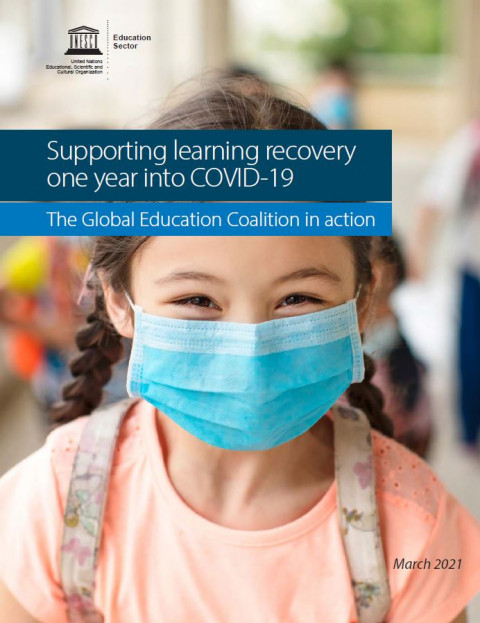 Supporting Learning Recovery One Year into COVID-19: The Global Education Coalition in Action Year of publication: 2021 Corporate author: UNESCO | Global Education Coalition The Global Education Coalition, launched by UNESCO, is a platform for collaboration and exchange to protect the right to education during this unprecedented disruption and beyond.This is the annual report of the Coalition, which builds on the inaugural report published in September 2020, and covers the activity between March 2020 and March 2021.