
Resources
Explore a wide range of valuable resources on GCED to deepen your understanding and enhance your research, advocacy, teaching, and learning.
109 Results found
 Integrating education for sustainable development & education for international understanding: conceptual issues and pedagogical principles for teacher education to address sustainability Year of publication: 2006 Author: Swee-Hin Toh Corporate author: UNESCO Bangkok It is in this spirit that this essay seeks to “integrate” two active and expanding fields of 2 educational innovation and transformation worldwide, namely ESD (education for sustainable development or sustainability) and EIU (education for international understanding). The key conceptual issues and themes of both of these movements will be clarified and shared values and understandings highlighted. It will also be argued that both ESD and EIU , in order to effectively fulfill their goals of building a peaceful, just and sustainable world order, rests on some key common pedagogical principles and processes. Another introductory caveat is also essential here, namely the question of paradigm. Among policy-makers, theorists and practitioners, there may well be and often are distinct differences in conceptualization according to their paradigmatic interpretations, with consequently alternative implications for policies and practices. Integrating education for sustainable development & education for international understanding: conceptual issues and pedagogical principles for teacher education to address sustainability Year of publication: 2006 Author: Swee-Hin Toh Corporate author: UNESCO Bangkok Il est dans cet esprit que cet essai vise à «intégrer» deux champs actifs et en expansion de 2 innovations pédagogiques et de transformation dans le monde entier, à savoir l'EDD (éducation pour le développement durable ou la durabilité) et ECI (éducation pour la compréhension internationale). Les principaux problèmes conceptuels et les thèmes de ces deux mouvements seront clarifiés et des valeurs et une compréhension partagées mis en évidence. Il sera fait également valoir que les deux EDD et ECI, en vue de remplir efficacement leurs objectifs de construction, un ordre pacifique juste et durable monde, repose sur quelques principes pédagogiques communs clés et des processus. Une autre mise en garde d'introduction est également essentiel ici, à savoir la question de paradigme. Parmi les décideurs, les théoriciens et les praticiens, il pourrait bien être souvent des différences distinctes dans la conceptualisation en fonction de leurs interprétations paradigmatiques, ayant des implications en conséquence alternatives pour les politiques et les pratiques. 지속가능발전교육과 국제이해교육의 통합: 지속가능성 문제 해결에 대한 교사 교육의 개념적 문제와 교육학적 원칙 Year of publication: 2006 Author: Swee-Hin Toh Corporate author: UNESCO Bangkok 이것은 ESD(지속가능한발전 혹은 지속가능성을 위한 교육)와 EIU(국제이해교육)이라는 교육 혁신과 전 세계의 변화, 이 두 가지 확장 개념과 활동을 ‘통합’하고자 한다. 아울러 이 두 운동의 주요 개념적 문제와 주제는 명확히 되고, 공유된 가치와 이해가 강조될 것이다. 또한 평화롭고 지속가능한 세계 질서 구축이라는 목표를 효과적으로 수행하기 위해서, ESD와 EIU는 몇 가지 주요 공통 교수법과 과정에 그 성패가 달려있다고 보인다. 여기에 또 다른 입문주의 사항(introductory caveat), 즉 패러다임의 문제가 필수적이다. 정책 입안자, 이론가 및 실무자 사이에선 결과적으로 정책과 관행에 대한 대안적 함의와 함께 그들의 패러다임 해석에 따른 개념화의 뚜렷한 차이점이 종종 나타날 수 있다.
 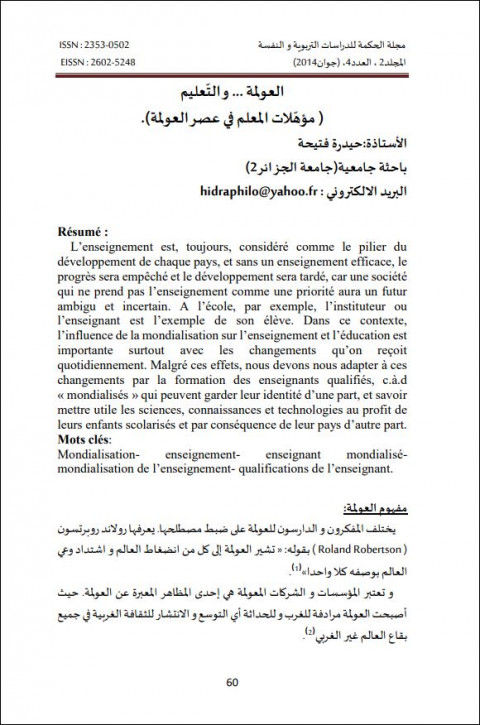 Globalization and Education (Teacher Qualifications in the Era of Globalization) Year of publication: 2014 Author: Haidara Fatiha Education is, always, considered as the pillar of the development of every country, and without effective education, progress will be impeded and development will be delayed. This is because a society that does not take education as a priority will have an ambiguous future. In school, for example, the teacher is the model for his students. In this context, the influence of globalization on teaching and education is important especially with the changes that we receive daily. Despite these effects, we must adapt to these changes by training qualified teachers, ie "globalized" teachers who can keep their identity on the one hand, and know how to use science, knowledge and technology for the benefit of their teachers. children in school and consequently from their country on the other hand. العولمة ... و التّعليم ( مؤهّلات المعلم في عصر العولمة) Year of publication: 2014 Author: Haidara Fatiha يعتبر التعليم دائمًا ركيزة التنمية في كل بلد ، وبدون تعليم فعال ، سيتم إعاقة التقدم وستتأخر التنمية. هذا لأن المجتمع الذي لا يأخذ التعليم كأولوية سيكون له مستقبل غامض. في المدرسة ، على سبيل المثال ، المعلم هو نموذج لطلابه. في هذا السياق ، فإن تأثير العولمة على التدريس والتعليم مهم خاصة مع التغييرات التي نتلقاها يوميًا. على الرغم من هذه التأثيرات ، يجب أن نتكيف مع هذه التغييرات من خلال تدريب المعلمين المؤهلين ، أي المعلمين "المعولمين" الذين يمكنهم الحفاظ على هويتهم من ناحية ، ومعرفة كيفية استخدام العلم والمعرفة والتكنولوجيا لصالح معلميهم. الأطفال في المدرسة وبالتالي من بلدهم من ناحية أخرى.
 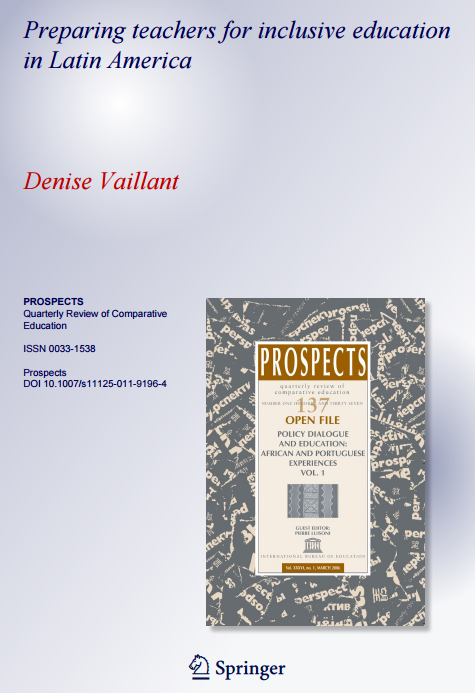 Preparing teachers for inclusive education in Latin America (Prospect: quarterly review of comparative education) Year of publication: 2011 Author: Denise Vaillant Corporate author: UNESCO International Bureau of Education (IBE) This article analyzes the current challenges facing inclusive education in Latin America and explores some possible solutions. The author suggests that teachers play a key role in providing education that is inclusive for all. In Latin America, today, however, inclusive education often does not respond to the needs of children and young people, and teachers often finish their professional training without acquiring the skills they need to work with children and young people living in difficult circumstances. Teachers also need incentives to work in remote or difficult geographical areas, and they benefit from national efforts to improve their status, including awards for innovative work. Much remains to be done, but the training of teachers for a more inclusive education system is gradually being incorporated as part of the educational policy agenda in Latin America. Préparer les enseignants pour l'éducation inclusive en Amérique latine (Perspectives: la revue trimestrielle d'éducation comparée) Year of publication: 2011 Author: Denise Vaillant Corporate author: UNESCO International Bureau of Education (IBE) Cet article analyse les défis actuels éducation inclusive en Amérique latine et explore des solutions possibles. L'auteur suggère que les enseignants jouent un rôle clé dans l'éducation inclusive pour tous. En Amérique latine, aujourd'hui, cependant, l'éducation inclusive souvent ne répond pas aux besoins des enfants et des jeunes, et les enseignants finir souvent leur formation professionnelle sans acquérir les compétences dont ils ont besoin pour travailler avec les enfants et les jeunes vivant dans des circonstances difficiles. Les enseignants ont également besoin d'incitations à travailler dans des zones géographiques éloignées ou difficiles, et ils bénéficient des efforts nationaux pour améliorer leur statut, y compris des prix pour des travaux novateurs. Il reste encore beaucoup à faire, mais la formation des enseignants pour un système éducatif plus inclusif est progressivement intégré dans le cadre de l'ordre du jour de la politique éducative en Amérique latine.
  Homegrown terrorism and transformative learning: an interdisciplinary approach to understanding radicalization Year of publication: 2010 Author: Alex S. Wilner | Claire-Jehanne Dubouloz Since 2001, a preponderance of terrorist activity in Europe, North America and Australia has involved radicalized Westerners inspired by Al Qaeda. Described as ‘homegrown terrorism’, perpetrators are citizens and residents born, raised, and educated within the countries they attack. While most scholars and policy-makers agree that radicalization plays a central role in persuading Westerners to embrace terrorism, little research properly investigates the internal and cognitive processes inherent to radicalization. Transformative learning theory, developed from the sciences in education, health and rehabilitation, provides an unconventional and interdisciplinary way to understand the radicalization process. The theory suggests that sustained behavioural change can occur when critical reflection and the development of novel personal belief systems are provoked by specific triggering factors. Homegrown terrorism and transformative learning: an interdisciplinary approach to understanding radicalization Year of publication: 2010 Author: Alex S. Wilner | Claire-Jehanne Dubouloz Depuis 2001, une grande partie de l'activité terroriste en Europe, en Amérique du Nord et en Australie a impliqué des Occidentaux radicalisés inspirés par Al Qaïda. Décrite comme un « terrorisme venant de l’intérieur », leurs auteurs sont des citoyens et des résidents qui sont nés, ont grandi et ont été éduqués dans les pays qu'ils attaquent. Alors que la plupart des chercheurs et des décideurs conviennent que la radicalisation joue un rôle central pour convaincre les Occidentaux d'embrasser le terrorisme, peu de recherche étudie d’une manière adéquate les processus internes et cognitifs inhérents à la radicalisation. La théorie de la pédagogie transformative, développée à partir des sciences de l'éducation, de la santé et de la réadaptation, fournit une manière peu commune et interdisciplinaire de comprendre le processus de radicalisation. Cette théorie suggère que le changement de comportement de manière durable peut se produire lorsque la réflexion critique et le développement de nouveaux systèmes de croyance personnelle sont provoqués par des facteurs déclencheurs spécifiques.
 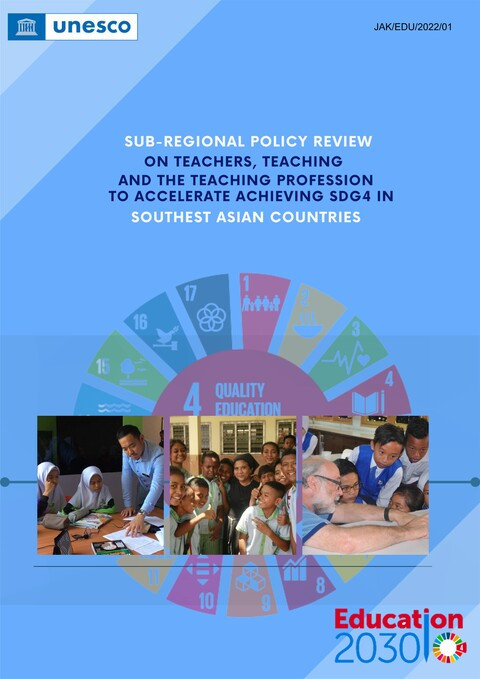 Sub-regional Policy Review on Teachers, Teaching and the Teaching Profession to Accelerate Achieving SDG4 in Southeast Asian Countries Year of publication: 2022 Author: Azlina Abdul Aziz | Kamisah Osman | Khairul Farhah Khairuddin | Meeyoung Choi Corporate author: UNESCO Jakarta The objectives of this report are to analyse existing national policies related to Teachers, Teaching and the Teaching Profession and examine their implementation in the five UNESCO cluster countries, namely Brunei, Indonesia, Malaysia, the Philippines and Timor-Leste. Eight themes have emerged from the systematic review of literature and they are i) Teacher Standard Competence, ii) Teacher professional Development, iii) Teacher Support, iv) Teaching Quality, v) Formative and Summative Assessment Framework on Teaching, vi) Showcasing and Rewarding Best Teaching Practices, vii) Teacher Professionalism and finally viii) Teacher Career Development.