
Resources
Explore a wide range of valuable resources on GCED to deepen your understanding and enhance your research, advocacy, teaching, and learning.
109 Results found
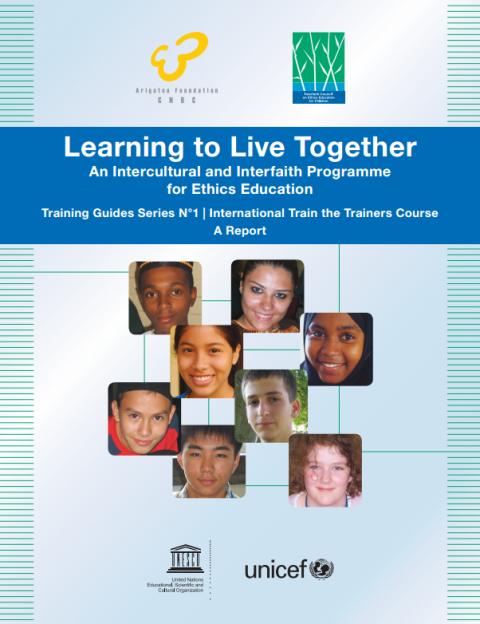 Learning to live together: an intercultural and interfaith programme for ethics education: Traning guides series 1; international train the trainers course; a report Year of publication: 2012 Corporate author: United Nations Children's Fund (UNICEF) | Interfaith Council on Ethics Education for Children | Arigatou Foundation In 2010, Arigatou International offered an International Train the Trainers course designed to help those providing training programmes on the use of the Learning to Live Together. The University of Edinburgh helped develop and evaluate the Train the Trainers as a pilot project.
 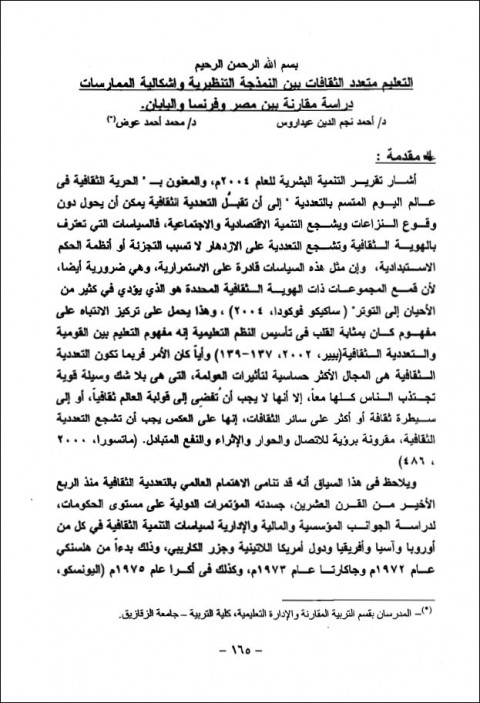 Multicultural Education between Theoretical Modeling and Problematic Practices: A Comparative Study between Egypt, France, and Japan Year of publication: 2006 Author: Ahmed Aidrous | Mohammed Awad Corporate author: Zagazig University This paper focuses on studying multiculturalism as a concept, theories, frameworks and associated applied models. The study reviews the experience of France, Japan and Egypt, and makes comparisons between them. The study ends with a proposed vision for multicultural education in light of the experiences presented.
  Regional workshop on enhancing teachers' competencies in education for sustainable development, Alexandria, Egypt, 7-9 May 2007: final report Year of publication: 2007 Corporate author: UNESCO Beirut | University of Alexandria In the framework of the UN decade of education for sustainable development, the UNESCO offices in the Arab region held their first workshop in September 2005 on the role of education and training for sustainable development. This second workshop was inaugurated in May 2007 on Enhancing Teachers’ Competencies in Education for sustainable Development. The choice of the teacher to be at the center of this workshop stresses the role teacher plays in development programs. Atelier régional sur le renforcement des compétences des enseignants en matière d'éducation pour le développement durable, Alexandrie, Égypte, 7-9 mai 2007: rapport final Year of publication: 2007 Corporate author: UNESCO Beirut | University of Alexandria Dans le cadre de la Décennie des Nations Unies pour l'éducation au développement durable, les bureaux de l'UNESCO dans la région arabe ont tenu leur premier atelier en septembre 2005 sur le rôle de l'éducation et de la formation pour le développement durable. Ce deuxième atelier a été inauguré en mai 2007 sur le renforcement des compétences des enseignants en éducation pour le développement durable. Le choix de l'enseignant à être au centre de cet atelier met l'accent sur le rôle que l'enseignant joue dans les programmes de développement.
 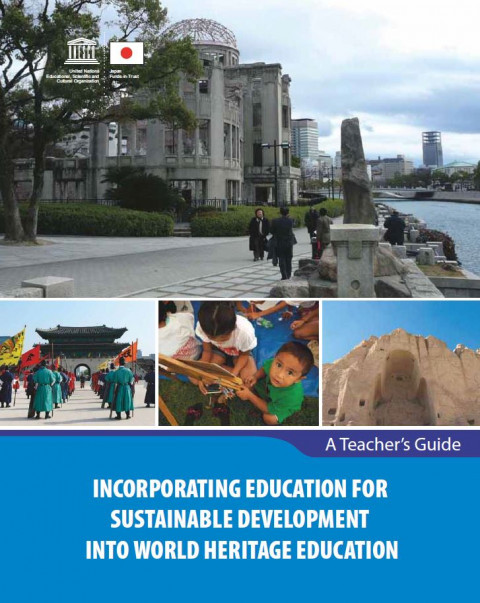 Incorporating education for sustainable development into world heritage education: a teacher's guide Year of publication: 2010 Corporate author: UNESCO Bangkok This publication, A Teacher’s Guide: Incorporating Education for Sustainable Development into World Heritage Education, represents the collective efforts of workshop participants to produce a practical tool for teachers to modify available curricula and incorporate ESD concepts and principles into WHE. It has taken a long time for the guide to be available in print. Nonetheless, the content of the guide remains practical and relevant in incorporating Education for Sustainable Development into World Heritage Education. Intégrer l'éducation au développement durable dans l'éducation au patrimoine mondial: un guide pour l'enseignant Year of publication: 2010 Corporate author: UNESCO Bangkok Cette publication, intitulée Un guide pour les enseignants: intégrer l'éducation au développement durable dans l'éducation au patrimoine mondial, représente les efforts collectifs des participants à l'atelier pour produire un outil pratique pour les enseignants afin de modifier les programmes disponibles. Le guide a mis du temps à être disponible en version imprimée. Néanmoins, le contenu du guide reste pratique et pertinent pour intégrer l'éducation au développement durable dans l'éducation au patrimoine mondial. Education for sustainable development country guidelines for changing the climate of teacher education to address sustainability: putting transformative education into practice Year of publication: 2011 Corporate author: UNESCO Jakarta This document on ESD Country Guidelines for TEIs is the result of the Regional Training Workshop Programme, titled “Developing Capacities of Teacher Education Institutions (TEIs) of Brunei Darussalam, Indonesia, Malaysia, Philippines and Timor-Leste in Reorienting Teacher Education to Address Sustainability” and has been developed by the five cluster countries of the UNESCO Office, Jakarta. The developed guidelines ultimately aim to reorient each country's curriculum, policies, standard practices and programmes to address sustainability and implement it in a tangible way. Although many idealistic descriptions of sustainability and sustainability education exist, faculties of education must decide which themes should receive particular focus and create their own guidelines and design criteria on this specific area. Therefore, these ESD Country Guidelines are significant initial steps to ensuring teacher education programmes fit the environmental, social, cultural and economic conditions and goals of each country's communities, regions and nations. Lignes directrices pour l'éducation au service du développement durable pour changer le climat de la formation des enseignants pour aborder la durabilité: mettre en pratique l'éducation transformatrice Year of publication: 2011 Corporate author: UNESCO Jakarta Le présent document sur EDD pour les Institutions de Formations des Enseignants (IFE) est le résultat du Programme régional d'ateliers de formation intitulé «Développer les capacités des établissements d'enseignement de Brunei Darussalam, de l'Indonésie, de la Malaisie, des Philippines et du Timor-Leste pour réorienter la formation des enseignants pour la durabilité» et a été développé par les cinq pays du Bureau de l'UNESCO à Jakarta. Les lignes directrices élaborées visent en fin de compte à réorienter les programmes, les politiques, les pratiques et les programmes standard de chaque pays en vue d'aborder la durabilité et de la mettre en œuvre de façon tangible. Bien que de nombreuses descriptions idéalistes de la durabilité et de l'éducation en matière de durabilité existent, les facultés d'éducation doivent décider quels thèmes devraient recevoir une attention particulière et créer leurs propres lignes directrices et critères de conception dans ce domaine spécifique. Par conséquent, ces EDD directrices sont des étapes importantes pour assurer que les programmes de formation des enseignants correspondent aux conditions et aux objectifs environnementaux, sociaux, culturels et économiques des communautés, des régions et des nations de chaque pays. 2nd European congress on global education: education, interdependence and solidarity in a changing world; final report Year of publication: 2012 Corporate author: North-South Centre of the Council of Europe | Global Education Network Europe (GENE) | CONCORD Europe | Portuguese Institute of Cooperation and Language | Portuguese NDGO Platform | University of Lisbon | European Commission The 2nd European Congress on Global Education: Education, Interdependence and Solidarity in a Changing World took place on 27 – 28 September 2012 in Lisbon. It was organised by the North-South Centre of the Council of Europe (NSC) in partnership with Global Education Network Europe (GENE) and CONCORD Europe, in cooperation with the Portuguese Institute of Cooperation and Language - Camões, the Portuguese NDGO Platform and the University of Lisbon and with the financial support of the European Commission. This Congress brought together approximately 200 stakeholders in global education, in particular international organisations, governments, parliamentarians, local and regional authorities, civil society organisations, as well as educators from Europe and beyond, using the principle of “quadrilogue” and a holistic approach to global education. This two-day event built on the efforts of the North-South Centre (NSC) and other stakeholders to promote global education since the Maastricht Congress Declaration (2002) which established a European strategy framework for improving and increasing global education in Europe to the year 2015. Thematic dialogue and exchange of ideas and practices together with a reflection on the political dimension of global education contributed to the formulation of a Lisbon Statement and the revision of the proposed Strategic Recommendations for Strengthening Global Education till 2015. The resume of the thematic dialogues, the Lisbon Statement on Global Education and the Strategic Recommendations represent an integral part of this report. This is also complemented with a short concluding section with follow-up proposals. 2nd European congress on global education: education, interdependence and solidarity in a changing world; final report Year of publication: 2012 Corporate author: North-South Centre of the Council of Europe | Global Education Network Europe (GENE) | CONCORD Europe | Portuguese Institute of Cooperation and Language | Portuguese NDGO Platform | University of Lisbon | European Commission Ce rapport national sur l'éducation globale en Autriche fait partie du processus d'évaluation intra-européenne Éducation Mondiale, qui a été lancé en 2002 dans le but d'augmenter et d'améliorer l'éducation mondiale dans les États membres du Conseil de l'Europe. Ce rapport est l'aboutissement d'un processus d'examen par les pairs mené par une équipe d'examen international par des pairs. Grâce à la recherche et des entrevues avec des intervenants clés, des informations ont été recueillies et des perspectives critiques développé sur l'état actuel et les perspectives d'avenir pour l'éducation mondiale en Autriche. Ce processus long de l'année, facilitée par le Centre Nord-Sud du Conseil de l'Europe, a été développé en partenariat avec le Groupe Stratégie autrichienne pour l'éducation mondiale comme la contrepartie nationale dans le processus. Il a impliqué le Ministère des Affaires étrangères, le Ministère de l'Education, l'Agence Autrichienne de Développement (AAD), KommEnt, et les ONG et les milieux universitaires. Ce rapport d'évaluation intra reconnaît la relativement forte tradition d'éducation mondiale en Autriche. le soutien autrichien de EM se reflète dans l'éventail des organisations engagées impliquées dans EM, et les nombreuses initiatives et projets dans les secteurs formels et non formels d'éducation, et dans la société civile. Le chapitre 1 ci-dessous fournit une introduction au rapport et le processus général. Le chapitre 2 décrit le contexte de l'éducation mondiale en Autriche. Le chapitre 3 examine l'éducation mondiale dans le secteur de l'éducation formelle. Le chapitre 4 met l'accent sur le travail important et varié qui se déroule dans l'éducation non formelle, les organisations de la société civile et d'autres secteurs dans ce domaine. Le chapitre 5 fournit, de façon sommaire, un aperçu des observations et recommandations de l'examen par les pairs clés.