
Resources
Explore a wide range of valuable resources on GCED to deepen your understanding and enhance your research, advocacy, teaching, and learning.
153 Results found
 Een stap in het verleden – een les voor de toekomst: Handboek voor leraren Year of publication: 2010 Corporate author: European Union Agency for Fundamental Rights What role do Holocaust-related sites play in today's societies? What do they offer young people? What should schools and teachers consider when planning a visit to such a site? And how can teachers make best use of such visits for teaching about the Holocaust and human rights? This Handbook provides a number of examples, hints and historical background information, which will help teachers and students to make visits to Holocaust-related sites and exhibitions a meaningful and enriching experience.
  Education Can Transform the World Corporate author: United Nations Children's Fund (UNICEF) World’s Largest Lesson is a collaborative education project to support the announcement of the United Nations Global Goals for Sustainable Development.Learning outcomes of the project is: • To understand the power of education for transforming lives • To know that not everyone has the same access to education • To interpret global education data by using online visualizations • To practice persuasive writing techniques • To advocate for equal access to education for everyone around the world
  Why are so many children not in school? Corporate author: United Nations Children's Fund (UNICEF) World’s Largest Lesson is a collaborative education project to support the announcement of the United Nations Global Goals for Sustainable Development. Learning outcomes of the project is: • To explore issues about the lives of children that cannot go to school. • To empathise with the circumstances of other children. • To learn about the barriers that some children face that stop them from being educated.
  Educating Against Hate Year of publication: 2016 Corporate author: United Kingdom. Department of Education, United Kingdom. Home Office As children grow and become more independent, it is not unusual for them to take risks, explore new things and push boundaries. This can mean that they are particularly vulnerable to extremist groups, who may claim to offer answers, as well as identity and a strong social network. And because they know young people are vulnerable, extremist groups often target them using the internet and social media to spread their ideology. The purpose of this website is to provide practical advice and support to help all individuals with an interest in keeping children safe from the dangers of extremism. Educating Against Hate Year of publication: 2016 Corporate author: United Kingdom. Department of Education, United Kingdom. Home Office Lorsque les enfants grandissent et deviennent plus indépendants, ils prennent des risques, explorent l’inconnu et repoussent les limites. Ils sont alors particulièrement vulnérables aux groupes extrémistes, qui prétendent détenir les réponses à leurs questions et pouvoir leur offrir une identité, ainsi qu’un important réseau social. Et parce qu’ils savent que les jeunes sont vulnérables, les groupes extrémistes utilisent internet et les réseaux sociaux pour répandre leur idéologie et atteindre les jeunes. L’objectif de ce site web est d’apporter des conseils pratiques et un soutien pour tous les individus, afin d’éloigner les enfants des dangers de l’extrémisme.
  A Multilingual Treasure Hunt Corporate author: United Nations Children's Fund (UNICEF) World’s Largest Lesson is a collaborative education project to support the announcement of the United Nations Global Goals for Sustainable Development. Learning outcomes of the project: • For students to have experienced a situation where they cannot find their way because they are unable to speak the language. • To empathise with those who are refugees in a new country.
 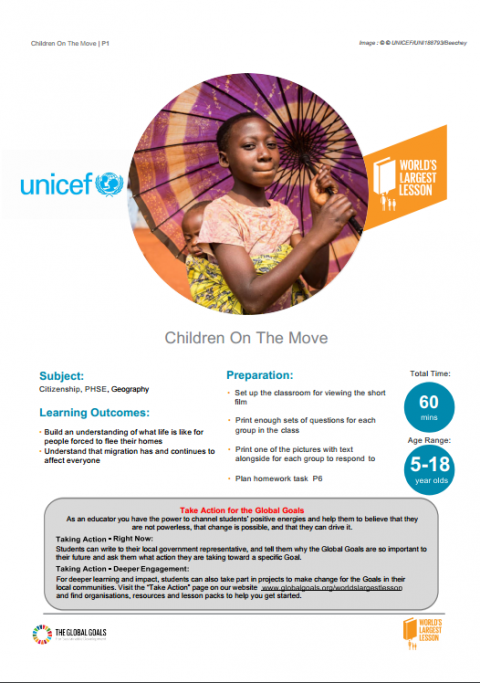 Children on the Move Corporate author: United Nations Children's Fund (UNICEF) World’s Largest Lesson is a collaborative education project to support the announcement of the United Nations Global Goals for Sustainable Development. Learning outcomes of the project: • Build an understanding of what life is like for people forced to flee their homes • Understand that migration has and continues to affect everyone
 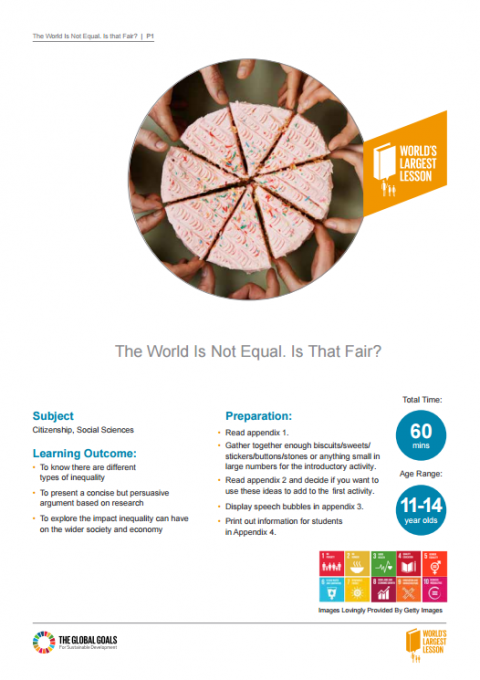 The World Is Not Equal. Is That Fair? Corporate author: United Nations Children's Fund (UNICEF) World’s Largest Lesson is a collaborative education project to support the announcement of the United Nations Global Goals for Sustainable Development. Learning outcomes of the project: • To know there are different types of inequality • To present a concise but persuasive argument based on research • To explore the impact inequality can have on the wider society and economy
 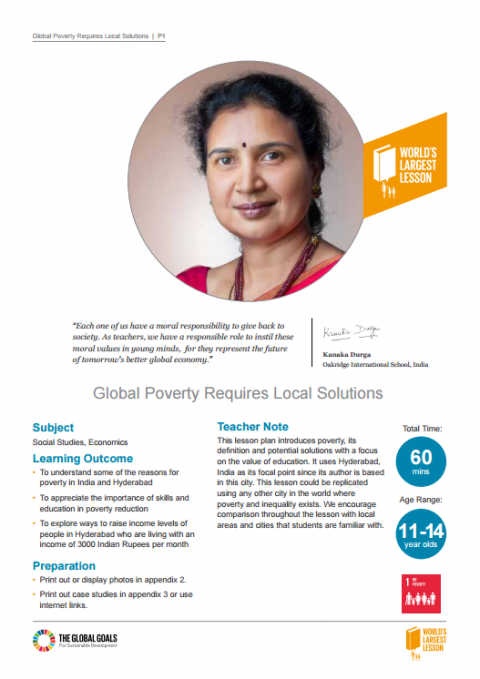 Global Poverty Requires Local Solutions Corporate author: United Nations Children's Fund (UNICEF) World’s Largest Lesson is a collaborative education project to support the announcement of the United Nations Global Goals for Sustainable Development. Learning outcomes of the project: • To understand some of the reasons for poverty in India and Hyderabad • To appreciate the importance of skills and education in poverty reduction • To explore ways to raise income levels of people in Hyderabad who are living with an income of 3000 Indian Rupees per month
  La Shoah à l'écran: Crimes contre l'humanité et représentation La mise en scène de l'Holocauste et des crimes contre l'humanité pose cinéastes questions éthiques et des documentaires ou des fictions ont déjà soulevé la controverse. Est-audio-visuel donc la meilleure façon de sensibiliser les jeunes populations? Faut-il pas plutôt le rôle d'autres matériaux tels que des archives ou des témoignages? Telles sont les questions soulevées par ce livre. Cinéma peut non seulement mettre en scène l'horreur des camps de concentration, mais doit aussi éduquer les jeunes publics. Dans la première partie, Anne-Marie Baron re-examine les définitions et les concepts importants concernant le traitement audio-visuel de l'Holocauste et dans la deuxième partie, elle fournit une liste de documentaires et de films ainsi que l'analyse pour aider les enseignants dans cet exercice.