
Resources
Explore a wide range of valuable resources on GCED to deepen your understanding and enhance your research, advocacy, teaching, and learning.
19 Results found
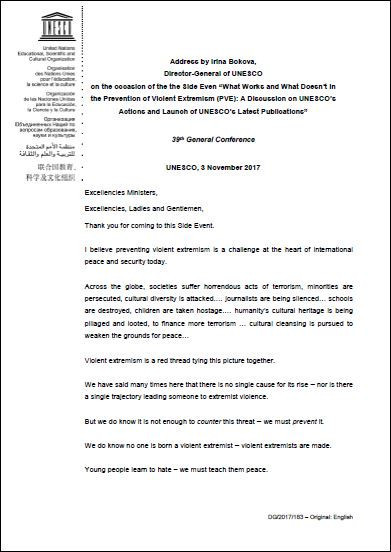 Address by Irina Bokova, Director-General of UNESCO on the occasion of the the Side Even “What Works and What Doesn’t in the Prevention of Violent Extremism (PVE)” Year of publication: 2017 Corporate author: UNESCO. Director-General, 2009-2017 (Bokova, I.G.) This Address was delivered by Irina Bokova, Director-General of UNESCO on the occasion of the the Side Even “What Works and What Doesn’t in the Prevention of Violent Extremism (PVE): A Discussion on UNESCO’s Actions and Launch of UNESCO’s Latest Publications”.
  PREVENT: creating “radicals” to strengthen anti-Muslim narratives Year of publication: 2015 Author: Asim Qureshi Corporate author: Critical Studies on Terrorism The use of de-radicalization narratives in schools, universities and hospitals has led to the criminalization of large sections of the various Muslim communities in the UK. Based on different experiences we hope to present a view of how an aggressive anti-Muslim narrative that is based on assumptions subverts the political expression/identity of individuals by turning them into potential threats. By understanding the everyday interactions with PREVENT, a picture can be formed of the way that a false presentation of narratives can lead to a person becoming an “extremist” or “terrorist”, while the truth may lie in a completely alternative place. PREVENT: creating “radicals” to strengthen anti-Muslim narratives Year of publication: 2015 Author: Asim Qureshi Corporate author: Critical Studies on Terrorism L'utilisation des récits de déradicalisation dans les écoles, les universités et les hôpitaux a conduit à la criminalisation d’une fraction importante des différentes communautés musulmanes au Royaume-Uni. En se basant sur des expériences différentes, nous espérons montrer comment un récit agressif antimusulman qui se fonde sur des hypothèses bouleverse les opinions /l’identité des individus et les transforment en des menaces potentielles. Chercher à comprendre comment se font les interactions quotidiennes avec PREVENT permet de saisir comment une présentation erronée des récits de vie peut conduire à présenter une personne comme un « extrémiste » ou un « terroriste », alors que la réalité est tout à fait différente.
  Youth Engagement to Counter Violent Extremism and Radicalization that Lead to Terrorism: Report on Findings and Recommendations from an OSCE Secretariat - OSCE ODIHR Expert Roundtable Year of publication: 2013 Corporate author: Организация по безопасности и сотрудничеству в Европе (ОБСЕ) This report is based on the results of a joint meeting of experts in a round-table format of the OSCE Secretariat and the OSCE Office for Democratic Institutions and Human Rights on October 23-24, 2012 in Vienna, Austria.This report should not be considered official OSCE recommendations on the basis of an agreed decision or the official position of the OSCE Secretariat, the OSCE Office for Democratic Institutions and Human Rights, or any OSCE participating State. It presents opinions individually expressed by the participants in the expert meeting in a round-table format. Вовлечение молодежи в усилия по противодействию насильственному экстремизму и радикализации, ведущим к терроризму: Отчет о выводах и рекомендациях Year of publication: 2013 Corporate author: Организация по безопасности и сотрудничеству в Европе (ОБСЕ) Данный отчет составлен по итогам совместного заседание экспертов в формате «круглого стола» Секретариата ОБСЕ и Бюро ОБСЕ по демократическим институтам и правам человека 23-24 октября 2012 года в Вене, Австрия.Настоящий отчет не следует считать официальными рекомендациями ОБСЕ на основании согласованного решения или официальной позицией Секретариата ОБСЕ, Бюро ОБСЕ по демократическим институтам и правам человека или какого-либо государства-участника ОБСЕ. В нем представлены мнения, индивидуально выраженные участниками заседания экспертов в формате «круглого стола».
  State Program on Countering Religious Extremism and Terrorism in the Republic of Kazakhstan for 2018 - 2022 Year of publication: 2018 Corporate author: Government of the Republic of Kazakhstan The document contains the main provisions of the State program on countering religious extremism and terrorism in the Republic of Kazakhstan for 2018 - 2022.The geopolitical changes taking place in the world initiate a new spectrum of challenges and risks in the field of national security, which is becoming more diverse and emanating from a greater number of sources of danger. This determines the complexity and relevance of the tasks within the framework of a systematic prevention of threats of religious extremism and terrorism.Under these conditions, the current national system of combating religious extremism and terrorism needs to be further improved in the context of creating a mechanism for reliable protection of individuals, society and the state from extremist manifestations of a violent nature and threats of terrorism. Государственная программа по противодействию религиозному экстремизму и терроризму в Республике Казахстан на 2018 – 2022 годы Year of publication: 2018 Corporate author: Government of the Republic of Kazakhstan Документ содержит основные положения Государственной программы по противодействию религиозному экстремизму и терроризму в Республике Казахстан на 2018 – 2022 годы.Происходящие в мире геополитические изменения инициируют новый спектр вызовов и рисков в сфере национальной безопасности, который становится все более разнообразным и исходящим от большего числа источников опасности. Этим обусловлены сложность и актуальность задач в рамках системного предупреждения угроз религиозного экстремизма и терроризма.В этих условиях действующая общегосударственная система противодействия религиозному экстремизму и терроризму нуждается в дальнейшем совершенствовании в контексте создания механизма надежной защиты личности, общества и государства от экстремистских проявлений насильственного характера и угроз терроризма.
 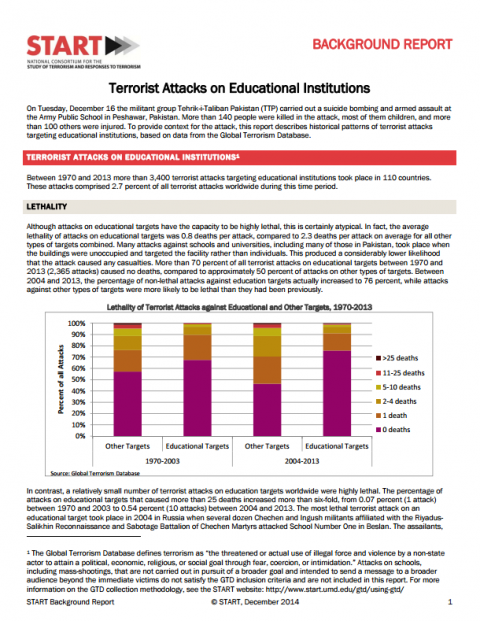 Terrorist Attacks on Educational Institutions Year of publication: 2014 Author: Erin Miller Corporate author: National Consortium for the Study of Terrorism and Responses to Terrorism (START) | Department of Homeland Security Science and Technology The report describes historical patterns of terrorist attacks targeting educations institutions dating back to 1970. Since that year, more than 3,400 terrorist attacks targeting educations institutions took place in 110 countries. These attacks comprised 2.7 percent of all terrorist attacks worldwide during this time period. Terrorist Attacks on Educational Institutions Year of publication: 2014 Author: Erin Miller Corporate author: National Consortium for the Study of Terrorism and Responses to Terrorism (START) | Department of Homeland Security Science and Technology Le rapport revient sur les attaques terroristes qui ont ciblé les institutions éducatives depuis 1970. A partir de cette année, on dénombre plus de 3.400 attaques terroristes qui avaient pour cible les institutions éducatives, dans 110 pays. Ces attaques représentent 2,7 % de l’ensemble des attaques terroristes perpétrées à travers le monde au cours de cette période.
 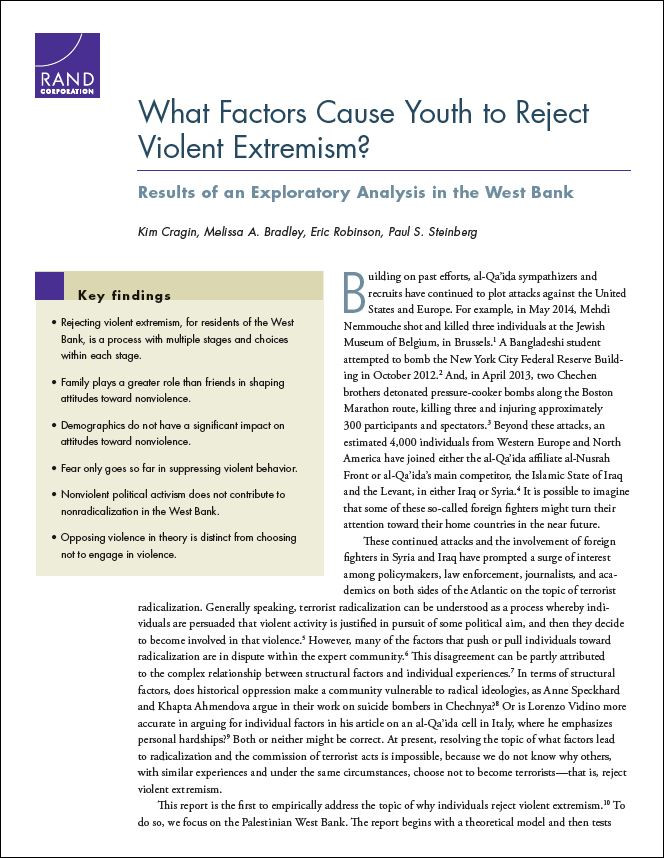 ما هي العوامل التي تدفع الشباب إلى رفض التطرف العنيف؟: نتائج تحليل استكشا في تم إجراؤه في الضفة الغربية Year of publication: 2015 Author: Kim Cragin | Melissa A. Bradley | Eric Robinson | Paul S. Steinberg Corporate author: RAND Corporation أدت الهجمات الإرهابية المستمرة وتورط مقاتلين أجانب في سوريا والعراق إلى زيادة الاهتمام بين صانعي السياسات وإنفاذ القانون والصحفيين والأكاديميين على جانبي المحيط الأطلسي بشأن موضوع التطرف الإرهابي. العديد من العوامل التي تدفع الأفراد أو تدفعهم نحو التطرف محل نزاع داخل مجتمع الخبراء. بدلاً من فحص العوامل التي تؤدي إلى التطرف وارتكاب أعمال إرهابية ، يتخذ هذا التقرير مقاربة جديدة. ما هي العوامل التي تدفع الشباب إلى رفض التطرف العنيف؟ نتائج التحليل الاستكشافي في الضفة الغربية تعالج بشكل تجريبي موضوع لماذا يرفض الشباب التطرف العنيف. للقيام بذلك ، يركز المؤلفون على الضفة الغربية الفلسطينية. يبدأ التقرير بنموذج نظري ثم يختبر هذا النموذج بالبيانات التي تم جمعها من خلال المقابلات والمسح المنظم. في هذه الدراسة ، تم إجراء عشر مقابلات شبه منظمة مع سياسيين من حماس وفتح في عام 2012. إلى جانب هذه المقابلات ، أجرى المؤلفون مسحًا على 600 شاب (تتراوح أعمارهم بين 18 و 30 عامًا) يعيشون في الخليل وجنين ورام الله.تظهر النتائج الشاملة لهذا الجهد أن (1) رفض التطرف العنيف ، بالنسبة لسكان الضفة الغربية ، هو عملية ذات مراحل وخيارات متعددة في كل مرحلة. (2) تلعب الأسرة دورًا أكبر من دور الأصدقاء في تشكيل المواقف تجاه اللاعنف ؛ (3) الديموغرافيات ليس لها تأثير كبير على المواقف تجاه اللاعنف. و (4) تختلف مناهضة العنف نظريًا عن اختيار عدم الانخراط في العنف.