
Resources
Explore a wide range of valuable resources on GCED to deepen your understanding and enhance your research, advocacy, teaching, and learning.
30 Results found
 Including Transformative Education in Pre-service Teacher Training: A Guide for Universities and Teacher Training Institutions in the Arab Region Year of publication: 2024 Author: Khalaf Al Abri | Marco Pasqualini Corporate author: UNESCO Beirut Transformative Education (TE), which includes concepts such as Global Citizenship Education (GCED) and Education for Sustainable Development (ESD), is an essential approach to provide learners with the tools to act for more just, peaceful and sustainable societies. Between 2021 and 2023, the experts of the UNESCO Arab Transformative Education Network identified the creation of a course on Transformative Education for teachers’ pre-service training as a key step to (i) provide teachers with the needed skills to promote Transformative Education as part of the national curriculum as well as though their daily teaching practices, and (ii) to support the reform of pedagogies more broadly, by making them more interactive and focused on critical thinking, and thus positively contributing to improving learners’ overall learning outcomes. This guidance document is addressed to all entities in charge of pre-service teacher training (e.g. departments of education within higher education institutions and teacher training institutions) in the Arab region interested in including Transformative Education as part of their programmes. The guidance document particularly supports faculty deans and academia in defining the scope and the key parameters to consider while developing a course on Transformative Education, including defining course objectives, format, content, and pedagogy, as well as choosing the right facilitator(s) to deliver the course. The document also provides useful references to other guides and tools which can further support the reflections around Transformative Education and how it can be concretely applied and promoted at the higher education level.
  Transformative Education for Global Citizenship in the Spanish Education System: Recommendations for Its Incorporation and Approach Year of publication: 2022 Author: Fabiola Fares Sade | Carolina Del Río Usábel | Yénifer López Ramos | Marta Martín Pastor | Elisabet Santpere Baro Corporate author: Movement for Transformative Education and Global Citizenship This document is the Report corresponding to the research commissioned by the Movement for Transformative Education and Global Citizenship to the University of Santiago de Compostela within the framework of the agreement "For a transformative education and for Global Citizenship committed to the fulfillment of the SDGs" led by the NGOs Alboan, Entreculturas, InteRed and Oxfam Intermón, which has been approved and financed by the Spanish Agency for International Development Cooperation, AECID. This publication aims to highlight the most significant elements of the analysis and conclusions obtained in the research, whose ultimate objective is to state recommendations for the inclusion of Transformative Education approaches for Global Citizenship in the formal education system. These recommendations seek to be a contribution to the intersectoral dialogue between the different agents with responsibilities in the educational field, both at the state and regional level. La educación transformadora para la ciudadanía global en el sistema educativo español: Recomendaciones para su incorporación y abordaje Year of publication: 2022 Author: Fabiola Fares Sade | Carolina Del Río Usábel | Yénifer López Ramos | Marta Martín Pastor | Elisabet Santpere Baro Corporate author: Movement for Transformative Education and Global Citizenship El presente documento es el Informe correspondiente a la investigación encargada por el Movimiento por la Educación Transformadora y la Ciudadanía Global a la Universidad de Santiago de Compostela en el marco del convenio “Por una educación transformadora y para la Ciudadanía Global comprometida con el cumplimiento de los ODS” liderado por las ONGD Alboan, Entreculturas, InteRed y Oxfam Intermón que ha sido aprobado y financiado por la Agencia Española de Cooperación Internacional para el Desarrollo, AECID. Esta publicación pretende destacar los elementos más significativos del análisis y de las conclusiones obtenidas en la investigación, cuyo objetivo último es enunciar recomendaciones para la inclusión de los enfoques de la Educación Transformadora para la Ciudadanía Global en el sistema educativo formal. Estas recomendaciones buscan ser un aporte para el diálogo intersectorial entre los diferentes agentes con responsabilidades en el ámbito educativo, ya sea a nivel estatal así como autonómico.
  Transformative Learning Journeys: Venturing Into the Wilds of Global Citizenship Education Year of publication: 2021 Corporate author: Bridge 47 With the intensive courses of the Transformative Learning Journey, Bridge 47 created experimental learning spaces for communities of practitioners, researchers and activists of transformative education from around the world.The courses endeavored to challenge common concepts of Global Citizenship Education, to explore questions like those below and to experiment with different, holistic and potentially more transformative, practices of learning and co-creating.What are the (cultural) root causes of the global multi-crisis?How to decolonize and transform a modern system that is broken beyond fixing?What do we have to learn, unlearn or let go of- individually and collectively - in order to allow, embrace and foster real change? What characterizes transformative learning, and how can education create holistic spaces to trigger, support and accompany such learning processes? How transformative is our own organizational and educational practice?Do we have to re-imagine education and activism and become more radical? Are we asking the right questions?Based on the positive resonance, Bridge 47 wants to share some of the learnings through this publication. The book gives insights into the design, content and methodology of the course. Featuring diverse contributions from participants, it is a mosaic of perspectives and experiences of transformation, decolonization and learning. It also comprises some tools and invitations for reflection. It is not a cohesive prescription of how to facilitate transformative learning – as there is none - but an invitation to relate to and play."This book is dedicated to all the curious people out there who are passionate about education in caring for our world and each other - the dreamers, the healers, the lovers, the teachers for a different future to emerge. It goes to the fighters who are desperate and overwhelmed in face of complex challenges and are worn out by their struggle for justice and change – to find inspiration, energy and courage to treat ourselves gently, to let go and to make space for new things to emerge."
 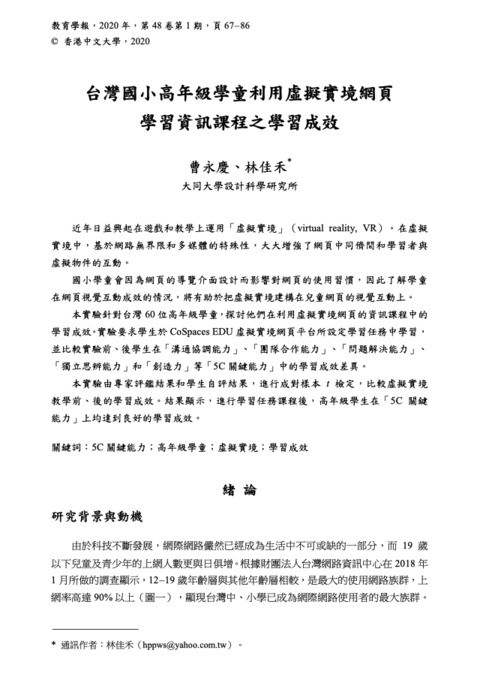 Learning Outcomes of Fifth and Sixth Graders in a Computer Course Using a Virtual Reality Website for Learning (Educational Journal ; Vol.48, No.1) Year of publication: 2020 Author: 曹永庆 | 林佳禾 In recent years, the use of virtual reality (VR) in games and teaching has become increasingly popular. The boundless nature of the Web and the uniqueness of multimedia in VR greatly enhance peer interaction as well as the interaction between learners and virtual objects on Webpages.Elementary schoolchildren’s habits of using Webpages depends upon the navigation interface design of the Webpages. Therefore, understanding the effectiveness of schoolchildren’s visual interaction with Webpages will help implement VR into Websites for schoolchildren.The purpose of this experiment was to explore the learning outcomes of 60 Taiwanese fifth and sixth graders in a computer course using VR Webpages. The experiment involved students learning through the tasks set on the VR Web platform “CoSpaces EDU.” The differences in their learning outcomes on the “5C key competencies” (i.e., communication and coordination skills, teamwork capabilities, problem-solving skills, independent thinking capabilities, and creativity) before and after the experiment were compared.Based on the results of expert assessment and students’ self-evaluation, paired-samples t test was conducted to compare the learning outcomes before and after implementing the VR teaching. Results show that the fifth and sixth graders were found to exhibit excellent 5C competencies after the experiment. 台湾国小高年级学童利用虚拟实境网页学习资讯课程之学习成效 (教育学报; Vol.48, No.1) Year of publication: 2020 Author: 曹永庆 | 林佳禾 近年日益兴起在游戏和教学上运用「虚拟实境」(virtual reality, vr)。在虚拟实境中,基于网路无界限和多媒体的特殊性,大大增强了网页中同侪间和学习者与虚拟物件的互动。 国小学童会因为网页的导览介面设计而影响对网页的使用习惯,因此了解学童在网页视觉互动成效的情况,将有助于把虚拟实境建构在儿童网页的视觉互动上。本实验针对台湾60位高年级学童,探讨他们在利用虚拟实境网页的资讯课程中的学习成效。实验要求学生于cospaces edu虚拟实境网页平台所设定学习任务中学习,并比较实验前、后学生在「沟通协调能力」、「团队合作能力」、「问题解决能力」、「独立思辨能力」和「创造力」等「5c关键能力」中的学习成效差异。本实验由专家评监结果和学生自评结果,进行成对样本t检定,比较虚拟实境教学前、后的学习成效。结果显示,进行学习任务课程后,高年级学生在「5c关键能力」上均达到良好的学习成效。
  미래교육시대의 인간교사와 인공지능(AI) 교사의 역할 및 기능 정립 방향 탐색 연구 Year of publication: 2021 Author: 전제상 Corporate author: 한국교육정책연구소 이 연구는 인공지능의 급격한 발전과 사회의 변화로 교육 현장에 점차 도입될 인공지능이 어떤 모습으로 존재해야 하는지 그리고 어떤 방식으로 학생들에게 도움을 줄 수 있는지 길을 찾고자 하였다. 이를 위하여 인공지능의 현재 상황과 선행연구를 분석하는 것으로 시작하여 인공지능(AI) 교사에 대한 현장 교사들의 인식을 양적, 질적으로 살펴보았다. 이를 토대로 미래교육시대의 교사와 인공지능(AI) 교사의 역할과 기능을 정립하고 상호보완적인 협업 방안을 모색한 후 인공지능(AI) 교사 도입에 따른 제도적, 법적, 윤리적 기준을 확인하였다.인공지능 기반의 미래 사회가 도래했다고 하여 인간교사의 역할이 크게 바뀌지는 않는다. 기존의 해오던 여러 수업과 업무 중에 우선순위의 변화가 생길 수 있고, 수업보다 행정에 할애했던 시간을 수업과 학생지도, 상담 등에 집중할 수 있게 될 것으로 기대한다. 다만 인공지능(AI) 교사 도입에 따라 야기될 윤리적 문제를 해결하기 위해서는 도입 단계부터 준비하여 지속적인 확인과 점검, 성찰을 통해 협업 과정이 목적에 알맞게 기능하도록 모든 요소에 대해 철저하게 대비하고 점검하여야 한다.
  The Role of Education in Addressing Future Challenges Year of publication: 2020 Corporate author: Bridge 47 In response to UNESCO’s Futures of Education consultation, Bridge 47 has released the following report on the power that transformative education has to address future challenges, including those linked to inequalities, climate change and health.Through the consultation process UNESCO raises questions about the importance and purpose of education by 2050. In a fast-evolving world, Bridge 47 supports the idea that education should foster the kind of education that helps learners of all ages to become active global citizens and thus contribute to building a more just and sustainable report world for all.The report, ‘The Role of Education in Addressing Future Challenges’, further emphasises the importance of measuring and monitoring the progress towards achieving the transformative vision of education as outlined in Sustainable Development Goal Target 4.7. It is hoped that the overall Future of Education report will encourage a measuring framework for SDG 4.7 that acknowledges the connection between non-formal and formal education as well as supporting dialogue between key actors that the reflect any conceptual shifts within the fields of Education for Sustainable Development and Global Citizenship Education.
  Being and Knowing: Teaching Profile for Sustainable Development and Global Citizenship Year of publication: 2023 Corporate author: InteRed Document of a pedagogical nature that describes the characteristics of the teaching profile necessary to educate in Sustainable Development and Global Citizenship. Identify what skills are necessary to carry out transformative education that responds to global challenges as proposed by social movements, NGOs and civil society. This publication is the result of collaborative work carried out during the years 2022 and 2023 by a Movement 4.7 team formed for this purpose. Ser y Saber: Perfil docente para el Desarrollo Sostenible y la Ciudadanía Global Year of publication: 2023 Corporate author: InteRed Documento de carácter pedagógico que describe qué características tiene el perfil docente necesario para educar en el Desarrollo Sostenible y la Ciudadanía Global. Identifica qué competencias necesarias para llevar a cabo una educación transformadora que dé respuesta a los retos globales conforme proponen movimientos sociales, ONG y sociedad civil. Esta publicación es el resultado de un trabajo colaborativo realizado durante los años 2022 y 2023 por un equipo del Movimiento 4.7 conformado con ese fin.