
Resources
Explore a wide range of valuable resources on GCED to deepen your understanding and enhance your research, advocacy, teaching, and learning.
141 Results found
 Réunion de consultation régionale sur l'ODD 4: Education 2030, Etats d'Europe et d'Amérique du Nord, Paris, 24-25 octobre 2016 Year of publication: 2016 Corporate author: UNESCO
 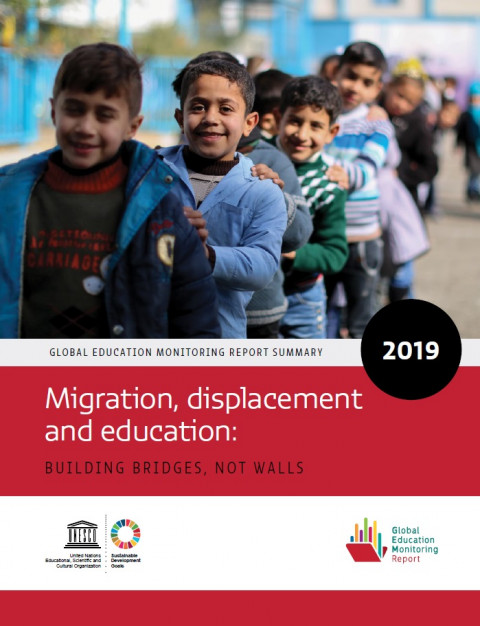 [Summary] Global Education Monitoring Report Summary 2019: Migration, Displacement and Education: Building Bridges, Not Walls Year of publication: 2018 Corporate author: UNESCO | Global Education Monitoring Report Team This Report points directly to a major challenge: How can teachers be supported to practise inclusion? It offers us fascinating insights into humanity and the age-old phenomenon of migration. I invite you to consider its recommendations and to act on them. This report is a vital toolkit for these compacts. It covers policy issues that address seasonal migrants, rural school consolidation, intercultural curricula, refugee inclusion in national education systems and elimination of segregation, qualifications recognition, targeting of school funding, more effective humanitarian education aid and teacher preparedness for diverse classrooms in emergency, protracted and “new normal” contexts. This summary of the 2019 GEM Report calls on countries to see education as a tool to manage migration and displacement and an opportunity for those needing one. [Резюме] РЕЗЮМЕ ВСЕМИРНОГО ДОК ЛАДА ПО МОНИТОРИНГ У ОБРАЗОВАНИЯ 2019 г .: Миграция, перемещенные лица и образование: наводить мосты, а не возводить препятствия Year of publication: 2018 Corporate author: UNESCO | Global Education Monitoring Report Team В докладе четко указан один из главных вызовов: как обеспечить поддержку учителей в их инклюзивной работе. В нем увлекательно рассказывается об истории человечества и о феномене миграции, существующем с незапамятных времен. Я приглашаю вас рассмотреть содержащиеся в нем рекомендации и действовать в соответствии с ними. Настоящий доклад является важнейшим информационным источником для этих договоров, охватывающим вопросы политики, которые, среди прочего, касаются сезонных мигрантов, объединения сельских школ, межкультурных учебных программ, включения беженцев в национальные системы образования и борьбы с сегрегацией, признания квалификаций, целенаправленного финансирования школ, более эффективной гуманитарной помощи образованию и подготовленности учителей к работе в классах с разнообразным составом учащихся в чрезвычайных ситуациях, в условиях затянувшегося кризиса и в новых обстоятельствах, характерных для сегодняшнего дня. Настоящий доклад также содержит обращенный к странам призыв рассматривать образование как средство для регулирования миграции и перемещений и как возможность для тех, кто в этой возможности нуждается. [요약문] 세계 교육 현황 보고서 요약본: 이주, 강제이주와 교육: 장벽이 아닌 가교 만들기 Year of publication: 2018 Corporate author: 유네스코 | 세계교육현황보고서팀 『2019 세계 교육 현황 보고서』는 국경 내 및 국경 간, 자발적이거나 강제적인, 고용이나 교육을 위한 모든 인구 이동에 따른 이주 및 강제이주에 교육이 미치는 영향을 검토한다. 이 보고서는 또한 2030 지속가능발전의제에서 교육의 진전 상황도 평가한다. 다양성이 증가하면서 이 보고서는 교육이 어떻게 포용적인 사회를 구축하고, 어떻게 사람들이 관용을 넘어서서 함께 사는 법을 배울 수 있는지를 분석한다. 교육을 평등하게 제공하면 다리를 건설하지만, 교육을 불평등하게 제공하면 이주민, 난민 및 수용국 지역사회 사이에 벽을 쌓는다.이주민과 난민에 대한 두 가지 새로운 글로벌 콤팩트는 교육의 역할을 인식하고 ‘어느 누구도 뒤처지지 않게 한다’는 전 세계적인 약속과 일치하는 목표를 설정한다. 이 보고서는 이 글로벌 콤팩트를 위한 중요한 툴킷(toolkit)으로 다양한 정책 이슈를 다루고 있다. 즉, 계절 이주자, 농촌 학교 통합, 문화간 교육과정, 국가 교육제도에 난민 포용 및 분리 폐지, 자격 인정, 학교 기금 목표 설정, 보다 효과적인 인도주의적 교육 원조, 그리고 위기 상황, 장기화된 상황, ‘뉴 노멀(new normal)’ 상황에서 다양한 교실을 위한 교사의 준비 등을 포함한다. 이 GEM 보고서 요약본은 국가들이 교육을 이주와 강제이주를 관리하는 도구로 보고, 이를 필요로 하는 사람들을 위한 기회로 간주할 것을 요구한다.
  Mainstreaming SDG4-Education 2030 in sector-wide policy and planning: technical guidelines for UNESCO field offices Year of publication: 2016 Corporate author: UNESCO Mainstreaming SDG4-Education 2030 in sector-wide policy and planning offers technical guidelines for UNESCO field offices to ensure adequate technical support to national authorities. The guidelines take into account the different profiles of countries’ need and capacities, thus avoiding a one-size-fits-all approach. The document contains resources and pointers that can be combined and tailored to fit the particular context of each country. In all cases, UNESCO is expected to ensure that all the relevant information about SDG4-Education 2030 is properly disseminated in these guidelines. Field staff will adapt the guidelines provided here to the country they are serving to ensure that UNESCO plays its role as the leading United Nations agency in the field.
  UNESCO education strategy 2014-2021 Year of publication: 2014 Corporate author: UNESCO This publication is a result of extensive collective work by my colleagues in UNESCO’s Education Sector over the past two years. It elaborates on UNESCO’s Medium-Term Strategy (2014–2021), which was drafted by the Organization’s Secretariat and approved by the 37th session of its General Conference in November 2013. This publication elaborates on the education component of the Medium-Term Strategy. While continuing to focus efforts on the ‘unfinished business’ of EFA, such as literacy, teachers and vocational skills development, UNESCO will lead and advocate for strengthened action towards empowering learners to be creative and responsible citizens. In a world of change, when individuals are increasingly called upon to make a positive contribution to their communities through the promotion of peace, solidarity, and respect for others and the environment, I am convinced that Education for Sustainable Development and Global Citizenship Education must also be considered crucial elements for well-rounded educational systems. UNESCO education strategy 2014-2021 Year of publication: 2014 Corporate author: Organisation des Nations Unies pour l'éducation, la science et la culture (UNESCO) Cette publication est le résultat d'une vaste travail collectif par mes collègues dans le secteur de l'éducation de l'UNESCO au cours des deux dernières années. Il élabore sur la stratégie à moyen terme de l'UNESCO (2014-2021), qui a été élaboré par le Secrétariat de l'Organisation et approuvé par la 37e session de la Conférence Générale en Novembre 2013. Cette publication développe sur le volet éducation de la Stratégie à Moyen Terme. Tout en continuant à concentrer les efforts sur le «travail inachevé» de l'EPT, tels que l'alphabétisation, les enseignements et le développement des compétences professionnelles, l'UNESCO dirigera et plaider pour une action renforcée vers l'autonomisation des apprenants à être des citoyens créatifs et responsables. Dans un monde de changement, lorsque les individus sont de plus en plus appelés à apporter une contribution positive à leurs communautés par la promotion de la paix, la solidarité et le respect des autres et de l'environnement, je suis convaincu que l'Éducation pour le Développement Durable et de l'Éducation à la Citoyenneté Mondiale doivent aussi être considérés comme des éléments cruciaux pour les systèmes éducatifs bien arrondis.
  Asia-Pacific Regional Education Conference, Bangkok, Thailand, 6-8 August 2014: Asia-Pacific Statement on Education Beyond 2015, Bangkok Statement Year of publication: 2014 Corporate author: UNESCO This document is an outcome of the Asia-Pacific Regional Education Conference (APREC) on August 6 -8, 2014, attended by Ministers of Education, high-level government officials and representatives of civil society organizations, teachers’ organizations, United Nations (UN) agencies, development partners, and members of academia and the private sector, gathered in Bangkok, Thailand. Having taken stock of the progress made in the region in achieving the six Education for All (EFA) goals, having examined the remaining challenges, and having reflected on future priorities and strategies for the Asia-Pacific region to achieve the emerging post-2015 education agenda, the deliberations were made based on the national EFA reviews, the Muscat Agreement adopted at the Global Education for All Meeting (Muscat, Oman, 12-14 May 2014), and the Outcome Document of the UN General Assembly Open Working Group for Sustainable Development Goals. The statement fully endorses the vision, principles and targets laid out in the Muscat Agreement, noting that the overarching goal to ‘ensure equitable and inclusive quality education and lifelong learning for all by 2030’ reflects the aspiration of the region for education and development. Conférence de l'Éducation Régionale Asie-Pacifique Bangkok, Thaïlande, 6-8 Août 2014: Déclaration de l'Asie-Pacifique sur l'Éducation Au-delà de 2015 Year of publication: 2014 Corporate author: Organisation des Nations Unies pour l'éducation, la science et la culture (UNESCO) Ce document est le résultat de la Conférence de l'Éducation Régionale Asie-Pacifique (en englais, APREC) le 6 Août -8 2014, en présence de ministres de l'éducation, des responsables gouvernementaux de haut niveau et des représentants des organisations de la société civile, les organisations d'enseignants, United Nations agences (ONU), les partenaires de développement, et des membres du milieu universitaire et du secteur privé, se sont réunis à Bangkok, Thaïlande. Après avoir fait le bilan des progrès réalisés dans la région dans la réalisation des six Éducation Pour Tous (EPT) buts pour, après avoir examiné les défis restant à relever, et après avoir réfléchi sur les priorités et les stratégies futures pour la région Asie-Pacifique pour atteindre le l'après 2015 émergente agenda de l'éducation, les délibérations ont été faites sur la base des examens nationaux de l'EPT, l'accord Muscat adopté à la éducation globalepour tous Réunion (Muscat, Oman, 12-14 mai 2014), et le document final du Groupe ouvert de travail de l'Assemblée générale des Nations Unies pour Objectifs de développement durable. La déclaration souscrit pleinement à la vision, les principes et les objectifs énoncés dans l'Accord de Mascate, en notant que l'objectif primordial de «garantir une éducation de qualité équitable et inclusive et l'apprentissage continu pour tous d'ici 2030» reflète l'aspiration de la région pour l'éducation et le développement. البيان الختامي للاجتماع العالمي لحركة التعليم للجميع – 2014 : اتفاق مسقط Year of publication: 2014 Corporate author: UNESCO This statement is agreed by Ministers, heads of delegations, leading officials of multilateral and bilateral organizations, and senior representatives of civil society and private sector organizations at the Global Education for All (EFA) Meeting in Muscat, Oman on May 12-14, 2014. Recalling the GEM 2012 Final Statement, the conference took note of the 2013/14 EFA Global Monitoring Report, the regional EFA reports, the Resolution of the 37th session of UNESCO's General Conference on Education Beyond 2015, the Decision of the Executive Board of UNESCO at its 194th session and the Joint Proposal of the EFA Steering Committee on Education Post-2015.