
Resources
Explore a wide range of valuable resources on GCED to deepen your understanding and enhance your research, advocacy, teaching, and learning.
141 Results found
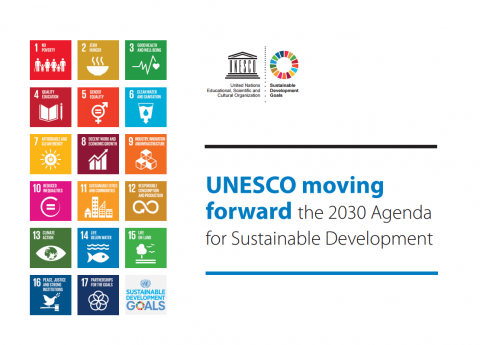 ЮНЕСКО: работа по осуществлению Повестки дня в области устойчивого развития на период до 2030 г. Year of publication: 2017 Corporate author: Организация Объединенных Наций по вопросам образования, науки и культуры (UNESCO) The United Nations 2030 Agenda for Sustainable Development, with its 17 Sustainable Development Goals, sets forth a bold new framework for development cooperation over the next 15 years. This agenda aspires to ensure prosperity and well-being for all women and men, while protecting our planet and strengthening the foundations for peace. 教科文组织助力 《2030年可持续发展议程》 Year of publication: 2017 Corporate author: 联合国教科文组织 (UNESCO) The United Nations 2030 Agenda for Sustainable Development, with its 17 Sustainable Development Goals, sets forth a bold new framework for development cooperation over the next 15 years. This agenda aspires to ensure prosperity and well-being for all women and men, while protecting our planet and strengthening the foundations for peace.
  Intégrer l'ODD 4-Education 2030 dans les politiques et la planification sectorielles: directives techniques à l'intention des bureaux hors Siège de l'UNESCO Year of publication: 2016 Corporate author: Organisation des Nations Unies pour l'éducation, la science et la culture (UNESCO) Mainstreaming SDG4-Education 2030 in sector-wide policy and planning offers technical guidelines for UNESCO field offices to ensure adequate technical support to national authorities. The guidelines take into account the different profiles of countries’ need and capacities, thus avoiding a one-size-fits-all approach. The document contains resources and pointers that can be combined and tailored to fit the particular context of each country. In all cases, UNESCO is expected to ensure that all the relevant information about SDG4-Education 2030 is properly disseminated in these guidelines. Field staff will adapt the guidelines provided here to the country they are serving to ensure that UNESCO plays its role as the leading United Nations agency in the field. Integración del ODS 4-Educación 2030 en la formulación de políticas y planeamiento para todo el sector: directrices técnicas para las oficinas de la UNESCO fuera de la Sede Year of publication: 2016 Corporate author: Organización de las Naciones Unidas para la Educación, la Ciencia y la Cultura (UNESCO) Mainstreaming SDG4-Education 2030 in sector-wide policy and planning offers technical guidelines for UNESCO field offices to ensure adequate technical support to national authorities. The guidelines take into account the different profiles of countries’ need and capacities, thus avoiding a one-size-fits-all approach. The document contains resources and pointers that can be combined and tailored to fit the particular context of each country. In all cases, UNESCO is expected to ensure that all the relevant information about SDG4-Education 2030 is properly disseminated in these guidelines. Field staff will adapt the guidelines provided here to the country they are serving to ensure that UNESCO plays its role as the leading United Nations agency in the field.
 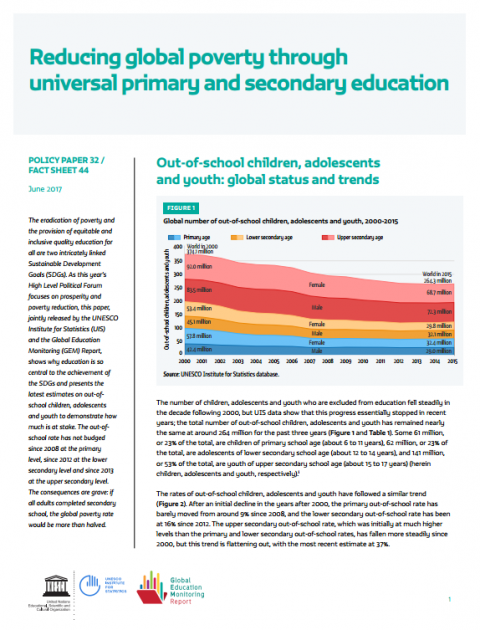 Reducing global poverty through universal primary and secondary education Year of publication: 2017 Corporate author: UNESCO The eradication of poverty and the provision of equitable and inclusive quality education for all are two intricately linked Sustainable Development Goals (SDGs). As this year’s High Level Political Forum focuses on prosperity and poverty reduction, this paper, jointly released by the UNESCO Institute for Statistics (UIS) and the Global Education Monitoring (GEM) Report, shows why education is so central to the achievement of the SDGs and presents the latest estimates on out-ofschool children, adolescents and youth to demonstrate how much is at stake. The out-ofschool rate has not budged since 2008 at the primary level, since 2012 at the lower secondary level and since 2013 at the upper secondary level. The consequences are grave: if all adults completed secondary school, the global poverty rate would be more than halved.
  Declaración Final de la Reunión Mundial sobre la EPT de 2014 El Acuerdo de Mascate Year of publication: 2014 Corporate author: Organización de las Naciones Unidas para la Educación, la Ciencia y la Cultura (UNESCO) This statement is agreed by Ministers, heads of delegations, leading officials of multilateral and bilateral organizations, and senior representatives of civil society and private sector organizations at the Global Education for All (EFA) Meeting in Muscat, Oman on May 12-14, 2014. Recalling the GEM 2012 Final Statement, the conference took note of the 2013/14 EFA Global Monitoring Report, the regional EFA reports, the Resolution of the 37th session of UNESCO's General Conference on Education Beyond 2015, the Decision of the Executive Board of UNESCO at its 194th session and the Joint Proposal of the EFA Steering Committee on Education Post-2015. 2014 GEM Final Statement: The Muscat Agreement Year of publication: 2014 Corporate author: UNESCO This statement is agreed by Ministers, heads of delegations, leading officials of multilateral and bilateral organizations, and senior representatives of civil society and private sector organizations at the Global Education for All (EFA) Meeting in Muscat, Oman on May 12-14, 2014. Recalling the GEM 2012 Final Statement, the conference took note of the 2013/14 EFA Global Monitoring Report, the regional EFA reports, the Resolution of the 37th session of UNESCO's General Conference on Education Beyond 2015, the Decision of the Executive Board of UNESCO at its 194th session and the Joint Proposal of the EFA Steering Committee on Education Post-2015. 2014 GEM Final Statement: The Muscat Agreement Year of publication: 2014 Corporate author: Organisation des Nations Unies pour l'éducation, la science et la culture (UNESCO) Cette déclaration est acceptée par les Ministres, les chefs de délégation, de hauts responsables d'organisations multilatérales et bilatérales, et les hauts représentants de la société civile et des organisations du secteur privé à l'Education pour tous (EPT) Réunion à Muscat, Oman du 12 au 14 mai 2014 . Rappelant la Déclaration finale SEM 2012, la conférence a pris note de l'EPT Rapport mondial de suivi 2013/14, rapporte l'EPT régional, la résolution de la 37e session de la Conférence générale de l'UNESCO sur l'éducation au-delà de 2015, la décision du Conseil exécutif de l'UNESCO à sa 194e session et la proposition conjointe du Comité directeur de l'EPT sur l'éducation post-2015. 2014 무스카트 협약, ‘모두를 위한 교육(EFA)’에 관한 세계 회의 최종 선언문 Year of publication: 2014 Corporate author: 유네스코 본 성명서는 2014년 5월 12일에서 14일까지 오만(Oman)의 무스카트(Muscat)에서 이루어진 유네스코 ‘모두를 위한 교육(이하 EFA)’을 위한 글로벌 교육 회의에서 장관, 대표단, 다자 및 양자간 조직의 주요 관계자, 시민 사회 및 민간 부분 조직의 수석 대표들이 모여 합의한 것이다. 본 회의에선 2012 글로벌 교육현황(이하 GEM) 보고서, 2013/14 ‘EFA 글로벌 모니터링 회의 보고서’, 지역 EFA 보고서, 2015년 이후 제 37차 세션 유네스코 총회의 결의안, post-2015 유네스코 운영 위원회의 공동 제안 및 194차 유네스코 집행위원회 결정 회의에 관한 결의안을 재작성 하였다. 九个人口大国关于2015年后教育的联合声明 : 伊斯兰堡声明 Year of publication: 2014 Corporate author: 联合国教科文组织 (UNESCO) This statement is adopted by the participants of the 10th E-9 Ministerial Review Meeting held in Islamabad, Pakistan, on November 27-28, 2014. They have taken stock of the progress made since 2000 and challenges remaining in the nine countries in achieving the six Education for All (EFA) goals, and reflected on the priorities and prospects for each country to sustain and further advance educational development beyond 2015. Their deliberations were based on a careful examination of the National EFA 2015 Reviews of the countries concerned, the Muscat Agreement adopted at the Global Education for All Meeting (Muscat, Oman, 12-14 May 2014), the Outcome Document of the United Nations General Assembly Open Working Group on Sustainable Development Goals, and took into account the Aichi-Nagoya Declaration on Education for Sustainable Development as well as the changing global environment that shapes the cooperation among the E-9 countries.