
Resources
Explore a wide range of valuable resources on GCED to deepen your understanding and enhance your research, advocacy, teaching, and learning.
145 Results found
 Gender-Based Violence in Education Year of publication: 2015 Author: Jenny Perkes This paper examines how policies and strategies to address school-related gender-based violence have evolved since 2000, when gender-based violence within education was largely invisible. It traces remarkable progress in research, policy and programmes, particularly since the mid-2000s when evidence around the globe exposed high levels of many forms of violence. However, there is still insufficient knowledge about what works to reduce violence, and weaknesses in processes of policy enactment which inhibit effective action. Through four country case studies, in South Africa, Brazil, India and Liberia, this paper explores how different forms of violence are being addressed in varying contexts. It concludes that more attention is needed to the space between national and local policy enactments, and to tackling at national, district, school and community levels the norms and inequalities at the heart of gender-based violence.
  Quality Physical Education (QPE): guidelines for policy makers Year of publication: 2015 Author: Nancy, McLennan | Jannine, Thompson Corporate author: UNESCO A key feature of the Post-2015 Development Agenda is sustainable development. Sustainable development starts with safe, healthy, well-educated children. Participation in quality physical education (QPE), as part of a rounded syllabus, enhances young peoples’ civic engagement, decreases violence and negative patterns of behaviour, and improves health awareness. The UNESCO QPE Policy Package is an original piece of work, which draws upon results from extensive global research (including the Worldwide Survey of School Physical Education). These guidelines, designed for global application and local adaptation, provide a means of analysing current policy through practical guidance and a ‘how-to’ approach. The materials have been developed in consultation with key partners including the European Commission, the International Council for Sport Science and Physical Education (ICSSPE), UNDP, UNICEF, UNOSDP and WHO. L'Education physique de qualité (EPQ): directives à l'intention des décideurs Year of publication: 2015 Author: Nancy, McLennan | Jannine, Thompson Corporate author: UNESCO A key feature of the Post-2015 Development Agenda is sustainable development. Sustainable development starts with safe, healthy, well-educated children. Participation in quality physical education (QPE), as part of a rounded syllabus, enhances young peoples’ civic engagement, decreases violence and negative patterns of behaviour, and improves health awareness. The UNESCO QPE Policy Package is an original piece of work, which draws upon results from extensive global research (including the Worldwide Survey of School Physical Education). These guidelines, designed for global application and local adaptation, provide a means of analysing current policy through practical guidance and a ‘how-to’ approach. The materials have been developed in consultation with key partners including the European Commission, the International Council for Sport Science and Physical Education (ICSSPE), UNDP, UNICEF, UNOSDP and WHO. Educación física de calidad (EFC): guía para los responsables políticos Year of publication: 2015 Author: Nancy, McLennan | Jannine, Thompson Corporate author: UNESCO A key feature of the Post-2015 Development Agenda is sustainable development. Sustainable development starts with safe, healthy, well-educated children. Participation in quality physical education (QPE), as part of a rounded syllabus, enhances young peoples’ civic engagement, decreases violence and negative patterns of behaviour, and improves health awareness. The UNESCO QPE Policy Package is an original piece of work, which draws upon results from extensive global research (including the Worldwide Survey of School Physical Education). These guidelines, designed for global application and local adaptation, provide a means of analysing current policy through practical guidance and a ‘how-to’ approach. The materials have been developed in consultation with key partners including the European Commission, the International Council for Sport Science and Physical Education (ICSSPE), UNDP, UNICEF, UNOSDP and WHO.
 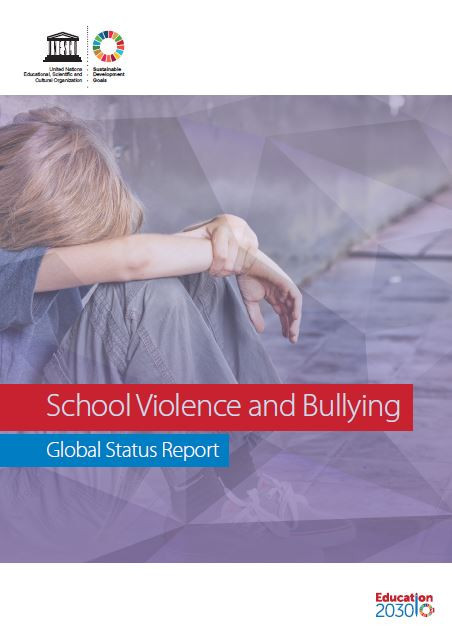 School Violence and Bullying: Global Status Report Year of publication: 2017 Corporate author: UNESCO School violence and bullying occurs throughout the world and affects a significant proportion of children and adolescents. It not only negatively impacts their educational outcomes, but harms their physical health and emotional well-being.This report aims to provide an overview of the most up-to-date available data on the nature, extent and impact of school violence and bullying and efforts to address the problem. It was prepared by UNESCO and the Institute of School Violence and Prevention at Ewha Womans University for the International Symposium on School Violence and Bullying: From Evidence to Action, Seoul, Republic of Korea, 17 – 19 January, 2017.
 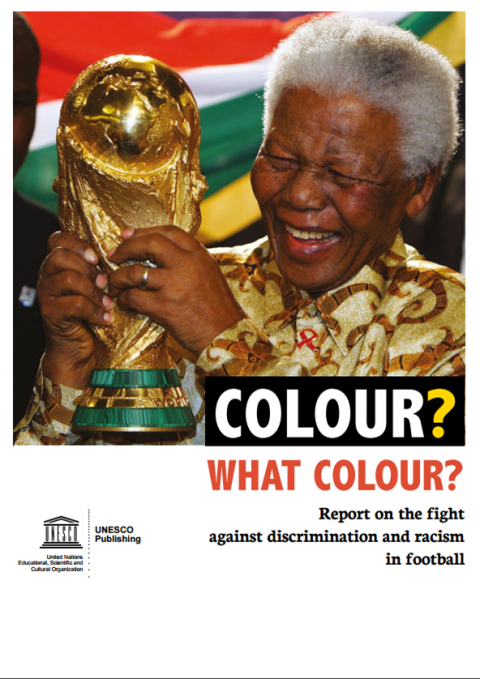 Colour? What colour? Report on the fight against discrimination and racism in football Year of publication: 2015 Author: Albrecht Sonntag | David Ranc Corporate author: UNESCO Football has been shown to be a mirror of society, it may also be viewed as providing a temporary suspension of reality for an interlude of high emotion and idealized hopes and dreams. Football’s public transcends differences of age, gender, culture, religion, and socioeconomic status to unite in support of their team. The broad diversity of backgrounds of football players represents tangible evidence of equal opportunity and meritocracy. The sport itself has team solidarity, fair play and mutual respect among members and for opponents ingrained within its rules and practices. Yet, the ‘beautiful game’ is one with an imbedded paradox. Football is also a game that may in many vaguely resemble war, where opponents face each other in a struggle to win over the other side, with the noisy and emphatic support of the spectators. An ‘us’ and ‘them’ mentality is an integral part of trying to help a team reach the objective, which is to win the game. This setting naturally produces a desire by supporters to intimidate the other side by encouraging their team and expressing both confidence and superiority through their words and actions. When the ‘us’ and ‘them’ mentality turns into symbolic exclusion of others, language of disparagement and insult based on racism or discrimination, or physical confrontation, the ‘beautiful game’ is debased. The existence of racism and discrimination in football is not a secret, but it is a shame on the game. Although much is already being done, both observers and experts feel too many problems persist and measures to tackle them have not been effective enough. This report was commissioned by UNESCO within the framework of UNESCO’s partnership with Juventus. It focuses on discrimination and racism in professional football and to some extent the amateur clubs that funnel into the leagues. It provides an overview of the historic and theoretical background. It reports on the state of affairs on the ground. It summarizes what has been done and is being done to mitigate racism and discrimination in domestic and international football, how the effects of these actions may be evaluated, and which new avenues for further, complementary action are promising. The report is based on a literature review, desk research, regional reports from the Unesco network and a field survey among a purposive sample of experts and actors in a number of countries. The report has a somewhat European focus, in its sources and examples. Europe has a unique position Executive Summary in the world of football, with its leading competitions, championships and clubs. It is the region where racism and discrimination in football has been most intensively researched. A number of civil society organisations from Europe have played a pioneering role in the fight against racism and discrimination in football. Moreover, the pressure that comes with the money invested in and generated by western European football, as well as its exposure in the media, has also made clubs, federations and UEFA particularly sensitive to the negative impact that discrimination can have on the game and its image, within Europe and worldwide. Europe must therefore occupy a central role in a study of the fight against discrimination in professional football and in determined policies to mitigate racism and discrimination related to football wherever they occur. The examples of incidents of discrimination and racism, as well as of existing measures to combat them have been selected to be as wide-ranging as possible. The authors do not, however, claim the report to be a comprehensive listing. Similarly, the examples of best practice have been collected through extensive reading and contacts, but must be looked at as an overview rather than as a directory. They are chosen by the authors to illustrate types of actions and institutions with the potential for greatest impact. The report also does not deal with the methods of allocation of resources to football, with issues of employment, or with womens’ football. While these are significant topics on which concerns can be expressed, the necessary focus of a report of this type means that they are alluded to without being treated in depth.
  Stopping violence in schools: a guide for teachers Year of publication: 2014 Corporate author: UNESCO “Stopping Violence in Schools: A Guide for Teachers” examines various forms of violence that take place in schools, and offers practical suggestions as to what teachers can do to prevent them. Ten action areas are proposed, each with specific examples that teachers can adapt to address and prevent violence. Excerpts from relevant international normative instruments as well as a list of links to online resources for stopping violence in schools are annexed at the end of the book. En finir avec la violence à l'école: guide à l'intention des enseignants Year of publication: 2014 Corporate author: UNESCO “Stopping Violence in Schools: A Guide for Teachers” examines various forms of violence that take place in schools, and offers practical suggestions as to what teachers can do to prevent them. Ten action areas are proposed, each with specific examples that teachers can adapt to address and prevent violence. Excerpts from relevant international normative instruments as well as a list of links to online resources for stopping violence in schools are annexed at the end of the book. Poner fin a la violencia en la escuela: guía para los docentes Year of publication: 2014 Corporate author: UNESCO “Stopping Violence in Schools: A Guide for Teachers” examines various forms of violence that take place in schools, and offers practical suggestions as to what teachers can do to prevent them. Ten action areas are proposed, each with specific examples that teachers can adapt to address and prevent violence. Excerpts from relevant international normative instruments as well as a list of links to online resources for stopping violence in schools are annexed at the end of the book. Как остановить насилие в школе. Пособие для учителей Year of publication: 2014 Corporate author: Организация Объединенных Наций по вопросам образования, науки и культуры (UNESCO) Пособие для учителей «Как остановить насилие в школе» — это вклад ЮНЕСКО в поддержку программы «Образование для всех» и объявленного ООН Международного десятилетия культуры мира и ненасилия в интересах детей планеты (2001–2011). Педагоги и учащиеся могут использовать это пособие для противостояния насилию в школе и его предотвращения. Школьное насилие чрезвычайно сложная проблема, и при ее решении необходимо учитывать самые разные факторы. Такой комплексный подход предполагает участие самих школьников; привлечение родителей, преподавателей и местных жителей; взаимосвязь политики, законодательства и практики; определение индикаторов насилия и следование принципам соблюдения прав человека с учетом их универсального характера и культурных традиций.